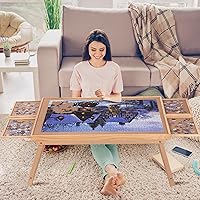
What Is a Puzzle Table, and Do You Need One?
A puzzle table is a dedicated work surface for assembling and keeping a jigsaw puzzle. To understand what a puzzle table is best suited for, decide whether you need a separate workstation or a movable board for an existing table.
On this page (8 sections)
- What is a puzzle table?
- What is the difference between a puzzle table and a puzzle board?
- Do you need a puzzle table?
- Which puzzle table features matter most?
- How do you set up and care for a puzzle table?
- What mistakes should you avoid when buying a puzzle table?
- How is a puzzle table different from a puzzle mat?
- How should you decide which puzzle table to buy?
A puzzle table is a dedicated surface for assembling and keeping a jigsaw puzzle. It gives an unfinished puzzle a place to stay between sessions, sometimes with drawers, a cover, or an adjustable top.
To understand what a puzzle table is, check how it stands: some models have their own legs, while others are boards that need a supporting table. That difference matters more than the name.
What is a puzzle table?
A puzzle table is a workspace built around keeping puzzle pieces together while you assemble them. Its main benefit is leaving your work intact when you stop for the day.
A rigid surface supports connected sections without needing to roll them up. Drawers separate loose pieces, while a cover helps shield the work area between sessions.
Not every design includes all those features. Our puzzle board and table buying guide explains the main types so you can choose the structure before comparing extras.
What is the difference between a puzzle table and a puzzle board?
A puzzle table generally stands on its own, while a puzzle board sits on furniture you already have. A board saves you from adding another desk, but it still occupies space somewhere.
Choose legs when you want a separate puzzling spot. Choose a board when your dining table works well during a session but needs to be cleared afterward.
The TEAKMAMA 1500 Table with Legs bridges those uses with folding legs, 4 drawers, and a protective cover. It measures 34.2 x 26.5 in and stands 27.6 in high.
This is a sensible choice for someone who wants a fixed-height workspace that folds away. Skip it if you need height adjustment to match different chairs or users.
Before buying, measure your seated knee height and the intended storage gap. Folding legs reduce bulk, but you still need room for the full board and its folded hardware.
Do you need a puzzle table?
You need one if it solves a specific problem: an occupied dining table, awkward reach, or nowhere to leave an unfinished puzzle. If your current setup is comfortable and can stay undisturbed, another table may add little.
Consider how often you pause mid-puzzle. Someone who works for a few minutes each evening benefits more from a ready-to-use station than someone who finishes small puzzles in one sitting.
The JoyBerri Adjustable Height Table suits a dedicated setup shared by people who need different working positions. It combines a felt surface, locking wheels, 4 magnetically secured drawers, and a protective cover.
Choose it when you have floor space for a workstation and want to change its position within a room. Skip it if your main requirement is a board to lift onto a shelf.
Plan a parking spot before adding furniture. Our guide to placing a puzzle table in a small room helps you account for chair access and walking routes.
Which puzzle table features matter most?
Prioritize fit, working position, and storage before extras. A rotating base cannot rescue a surface that's too small, and drawers won't make an awkward chair fit underneath.
What size puzzle table do you need?
Your puzzle's finished width and depth must fit inside the usable assembly area. Piece count is only a starting point because puzzles with the same number of pieces can have different shapes and dimensions.
Leave extra sorting room if you want loose pieces beside the picture. If space is limited, drawers or separate trays can handle that job instead.
The ALL4JIG 1500 Rotating Board, 6 Drawers combines a 360° rotating base, sliding drawers, and a translucent cover. Its stated dimensions include 24.92 x 33.58 in, so confirm the clear area inside the frame against your puzzle.
Choose this board if you already have a suitable table and want to bring distant sections closer without changing seats. Skip it if you need a freestanding desk or a tilted work surface.
Rotation needs clearance beyond the board's resting footprint. Keep cups, lamps, and nearby objects outside the path of its corners.
For a measuring walkthrough, see what size table fits a 1,500-piece puzzle.
Should the table have legs or adjustable height?
Choose adjustable height when your chair, users, or preferred working position change. Fixed legs make more sense when you've already checked that one height suits your usual seat.
JoyBerri offers 9 height settings from 21 to 37 in and a top that tilts up to 45°. These adjustments give you more ways to position the puzzle than a fixed-height table.
Start with your feet supported and shoulders relaxed, then bring the surface within easy reach. The board and its base also add height when placed on existing furniture.
Check armrest and knee clearance as well as tabletop height. Our guide to adjustable puzzle table height explains how to match the setup to your chair.
Are drawers, covers, and rotation worth having?
Drawers are worth choosing if sorted pieces otherwise take over your workspace. A cover helps between sessions, and rotation is useful when the far edge is hard to reach.
Use separate drawers for clear groups such as borders, lettering, or a distinct color. Avoid packing them so tightly that pieces scrape or catch when you close them.
A cover should be treated as surface protection, not a carrying restraint. Don't assume it seals against spills or can keep every piece in place if you tip the board.
If the puzzle will remain in one quiet room, you may need fewer storage features. Spend your attention on the surface size and chair fit first.
Is a tilting puzzle table right for you?
Tilt suits puzzlers who prefer a more upright view of the picture. It changes the viewing angle; rotation changes which section sits nearest to you.
The WELGEE 1000 Tilting Board with Stand has a 31 x 24 in work area for most standard 1,000-piece puzzles. Its ABS plastic construction weighs 3.5 lb, and its 6 panels connect with locking pins.
Choose it if low carrying weight matters and you're comfortable assembling a panel board. Skip it if you want a full-height workstation, since its detachable stand needs another supporting surface.
Don't assume tilt means loose pieces will grip the surface at every angle. Begin flat, secure the stand, and increase the angle gradually while watching for sliding.
For positioning and cover use, see how to use a puzzle board.
How do you set up and care for a puzzle table?
Set the table on a level surface, secure its supports, and check your reach before opening the puzzle. A few adjustments now prevent moving a half-finished puzzle later.
- Make room around it. Allow space for drawers, your chair, and any rotating corners.
- Secure the structure. Fully open folding legs, engage wheel locks, or connect modular panels before adding pieces.
- Arrange the work area. Keep the picture reference visible and put frequently used sorting groups within easy reach.
- Check your position. Start with a flat top, then adjust height or tilt without loose pieces near the edges.
Brush away puzzle dust with a soft, dry brush or cloth. For felt, lift debris gently rather than scrubbing it into the fibers.
Follow the care instructions before using moisture or cleaners, and dry any damp surface before returning cardboard pieces. Keep drinks on a separate surface.
Before moving a board, close drawers and support its base with both hands. For longer breaks, our guide to storing unfinished puzzles covers ways to keep the work together.
What mistakes should you avoid when buying a puzzle table?
The biggest mistakes are buying by piece count alone and measuring only where the table will stand. You also need room to use, move, and store it.
- Confusing outer size with work area. Frames and borders can reduce the space available for the puzzle.
- Forgetting drawer access. A board against a wall may leave a drawer difficult to open.
- Assuming portable means easy to lift. Consider the board's weight and width together, especially if you'll move it often.
- Buying every feature without a storage plan. A larger base or stand can make a board harder to tuck away.
- Choosing tilt without considering loose pieces. Keep unsorted pieces in trays or drawers if they slide at your preferred angle.
How is a puzzle table different from a puzzle mat?
A table or board keeps your puzzle on a rigid surface, while a roll-up mat stores it around a tube. Choose based on how you want to pack away the puzzle.
A rigid board needs flat storage space but avoids rolling the assembled sections. A mat can suit tighter storage, though rolling and unrolling need care to limit shifting.
Compare those tradeoffs in puzzle board or puzzle mat: which is better?.
How should you decide which puzzle table to buy?
Knowing what a puzzle table is helps you choose the simplest design that fixes your current setup. Start with the puzzle dimensions, then match the support and storage to your room.
Pick ALL4JIG for a rotating board on an existing table. Choose JoyBerri for a separate workstation with adjustable height and tilt.
TEAKMAMA suits a fixed-height setup with folding legs. WELGEE suits someone who wants a light board with a detachable tilting stand.
If you still need to choose between furniture and a movable surface, read puzzle table or puzzle board: which should you buy? before deciding on a model.
Frequently asked questions
What is the difference between a puzzle table and a puzzle board?
A puzzle table usually stands on its own legs, while a puzzle board rests on another surface; the names overlap, so check the design before choosing. A board needs a suitable table underneath; a freestanding table needs floor space, chair clearance, and somewhere to stay between sessions.
Do you need a puzzle table?
You need a puzzle table only if it solves a problem with your current setup, such as losing dining space or reaching across a large puzzle. If your existing table is comfortable and the puzzle can stay there safely, separate sorting trays or a cover may be enough.
Can a puzzle table be used for other activities?
Some puzzle tables and boards can support other tabletop hobbies when the surface suits the task; ALL4JIG describes its wooden rotating board for diamond painting, fuse beads, and building bricks. Keep glue, paint, and heat away unless the accessory's care instructions allow them, and clear small craft parts before puzzling.
What should you measure before buying a puzzle table?
Measure your puzzle's finished width and depth, then compare both with the usable work area; also measure the chair opening, drawer clearance, and intended storage space. For a rotating board, allow room for its corners to swing; for a folding table, check its folded height before planning under-bed storage.