Puzzle Table or Board: Which Should You Buy? (November 2026)
Choose a puzzle board or table based on its support: a board uses existing furniture, while a table has its own legs. Then check puzzle fit, seated reach and storage space.
On this page (9 sections)
- Puzzle board or table: which fits your room?
- Which setup will feel comfortable from your chair?
- How much usable puzzle space do you need?
- Which product matches your daily puzzle routine?
- How should you set up a board or table for the first puzzle?
- How do you organize pieces and protect unfinished work?
- What is the safest way to move and care for the setup?
- Which buying mistakes should you avoid?
- How do you choose between a puzzle board or table?
Choose a puzzle board or table based on where it will stand: a board uses furniture you already have, while a table supplies its own legs. The right choice also needs to fit your puzzle, your chair and the place you'll leave unfinished work.
A board makes sense when your dining table is comfortable but needs clearing for meals. A separate table makes sense when you want the puzzle ready without taking over that furniture.
The 3 options below cover rotating access, adjustable working positions and folding storage. Start with the support you need, then choose the extra feature that solves a problem in your routine.

 Best for changing work positions
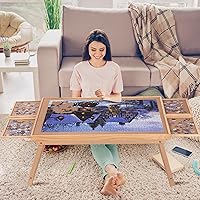
ALL4JIG 1500 Table with Legs and Wheels
Puzzle board or table: which fits your room?
Choose a board for suitable existing furniture or a table for a separate work area. Count the space needed during a session, including your chair and open drawers, rather than measuring only the top.
A board shares a furniture footprint, but it still occupies that surface until you move it. If the dining table needs clearing twice a day, decide where the loaded board will go before buying.
A table claims floor space even when the puzzle is covered. That can be worthwhile if it keeps meals, work and puzzling from competing for the same spot.
When does a puzzle board fit better than a table?
A board fits better when you have a steady surface at a useful height and a nearby place to put it away. It also avoids adding another set of legs to a crowded room.
Check the furniture beneath the board, especially if it has a small top or narrow base. The board needs secure support through normal use, including turning it or opening a drawer.
A deep counter may fit the board but leave you standing or stretching. Available space alone doesn't make furniture comfortable for a long session.
If carrying a rigid surface is the main obstacle, compare puzzle boards versus mats. A mat changes the storage method, so consider how you want to pause and resume the puzzle.
When is separate floor space worth using?
A separate table earns its space when you puzzle often and want work ready between sessions. It also lets another person use the dining table without disturbing your pieces.
Mark the proposed footprint on the floor with removable tape. Pull your chair back, walk past it and check access to nearby doors or cabinets.
For a shared room, our guide to placing a puzzle table in a small room helps you plan around furniture and walking space.
Which setup will feel comfortable from your chair?
Choose a work level that lets you sit close with relaxed shoulders and reach the near half without hunching. A board inherits the height of its supporting furniture, then adds its own thickness.
Use your intended chair when judging fit. A setup that feels comfortable from an upright dining chair may feel too high from a low sofa.
Check knee clearance as well as surface height. A tabletop can sit at the right level while its frame prevents you from pulling close enough.
Height adjustment gives you more ways to match a table to a chair. For a fixed-height table, the chair becomes the main adjustment, so confirm that both your feet and arms have support.
Our guide to choosing an adjustable puzzle table height explains how to check that seated fit before settling on a work position.
Does tilting solve the same problem as rotation?
Tilt changes your viewing angle; rotation brings another edge closer. Choose tilt when you want the puzzle angled toward you, and rotation when you mainly struggle to reach different sides.
An angled surface can make the far part easier to see, but loose pieces may shift as the angle increases. Begin nearly flat and raise it gradually with loose groups stored separately.
Rotation is useful for working around borders or sharing a puzzle across a table. Turn slowly, close drawers first and keep cups outside the turning path.
The guide to tilting versus rotating puzzle boards compares these movements in more detail if both sound useful.
How much usable puzzle space do you need?
Match the finished puzzle dimensions to the usable work area, rather than relying on piece count. Two puzzles with the same number of pieces can have different shapes and finished sizes.
Check both directions, especially for panoramic designs. A puzzle that fits the long side may still exceed the shorter side.
The ALL4JIG models are described with a 24.92 x 33.58 in puzzle area. TEAKMAMA gives overall table dimensions of 34.2 x 26.5 in, so confirm the clear space inside its frame before choosing a close-fitting puzzle.
Outside dimensions help you plan furniture and storage; they aren't interchangeable with working dimensions. Leave a little handling space around the completed border so you can place pieces without working against the frame.
Decide where unsorted pieces will sit, too. If the assembled puzzle fills most of the surface, you will need drawers or separate trays from the start.
For a size check, use our guide to choosing a puzzle table for a 1,500-piece puzzle. It explains why the dimensions on the puzzle box matter more than the piece-count label.
Which product matches your daily puzzle routine?
Choose the rotating ALL4JIG board for existing furniture, the adjustable ALL4JIG table for changing work positions, or TEAKMAMA for folding storage. Each suits a different way of setting up and putting away a puzzle.
ALL4JIG 1500 Rotating Board, 4 Drawers
This board suits someone with a comfortable dining table or counter who wants easier access to every edge. Its 360° rotation lets you bring the area you're building toward your seat.
The wooden board has 4 sliding drawers and a translucent cover. Use the drawers for distinct piece groups so the center stays available for assembly.
It is also the strongest fit here for two people working from different sides, provided both agree before turning it. A slow turn is easier to manage than reaching across another person's section.
Skip it if your only available support is too low, too narrow or unstable. It won't correct an awkward furniture height, and its corners need room to sweep past nearby objects.
ALL4JIG 1500 Table with Legs and Wheels
This table suits frequent puzzlers who want to adjust the work position without changing the furniture beneath it. Its height adjusts, and its felt-covered surface tilts from 0° to 90°.
That full angle range isn't a recommendation to assemble loose pieces upright. Start flat, use a modest angle and check that pieces stay where you put them before increasing the slope.
It has 4 drawers, a protective cover and 4 caster wheels. At 20.9 lb, rolling it along a clear floor route is a more practical plan than regularly carrying it between levels.
Skip it if you only puzzle occasionally on an already comfortable table. Assembly and a separate floor footprint add work without much benefit if you won't use the adjustments.
TEAKMAMA 1500 Table with Legs
This table suits occasional puzzlers who want a separate surface during a session and folding legs afterward. Its open height is 27.6 in, making chair fit the main check before buying.
The table weighs 18.1 lb and includes 4 drawers and a PVC cover. Folding the legs saves space underneath, but it doesn't reduce the width or depth of the top.
It also includes 10 adhesive sheets measuring 16 x 11.2 in and display hooks. Those accessories are for preserving finished work, rather than securing loose pieces between sessions.
Skip it if you need adjustable height or expect to carry a loaded table often. Plan a reachable storage spot and a clear lifting route before treating folding legs as the answer to limited space.
How should you set up a board or table for the first puzzle?
Set up the empty surface first, then check stability, chair fit and drawer access before opening the puzzle. Adjusting furniture is much easier before loose pieces cover the work area.
For a board, center its supporting base on sturdy furniture and check for rocking. Run through the full turning path if it rotates, keeping lamps and other objects clear.
For a legged table, follow the assembly instructions and fully open or secure the supports as directed. Check the frame and adjustment points before adding your puzzle.
Next, sit down and reach toward each corner. If you must lean heavily on the edge, move the setup or change your position before starting.
Build the border early enough to confirm the fit. Keep sorted groups out of the center until you know how much space the finished puzzle will occupy.
Read how to use a puzzle board for more guidance on rotating, covering and moving your work.
How do you organize pieces and protect unfinished work?
Use drawers for sorting and a cover for breaks, with a separate plan for moving the puzzle. Storage features help organize a session, but don't make a loaded surface safe to tip or carry vertically.
Sort pieces into groups you can recognize later, such as border pieces, lettering, sky or one strong color. Avoid overfilling a drawer so pieces catch when you close it.
Keep small assembled sections on the main surface or a suitable tray. A narrow drawer may work for loose pieces while being awkward for a joined section you want to preserve.
Cover the work after checking that nothing is caught beneath the cover's edge. Keep drinks elsewhere and store the setup away from curious pets rather than relying on a cover alone.
For more options, read how to store a puzzle in progress and our guide to sorting puzzle pieces into trays and drawers.
What is the safest way to move and care for the setup?
Move an unfinished puzzle slowly and as level as possible, and keep the surface clean and dry. Plan the destination before lifting or rolling anything.
Close drawers, collect loose pieces into suitable storage and place the cover as directed. Don't assume drawers latch shut or that a cover clamps the puzzle in place.
For a wheeled table, clear rugs, cords and clutter from the route. Check thresholds before moving, and get help if the loaded setup feels difficult to control.
Before folding legs, support the surface and follow the folding sequence in the instructions. Avoid holding a broad loaded top with one hand while trying to release its supports.
For routine care, remove crumbs and dust with a soft brush or cloth. Follow the care instructions for damp cleaning, avoid soaking wood or felt, and let the surface dry before replacing pieces or covering it.
Which buying mistakes should you avoid?
Avoid buying for one attractive feature before checking the full setup. Rotation, wheels and folding legs only help when the furniture, floor route and storage spot also work.
- Buying by piece count alone: compare the puzzle's finished width and length with the clear assembly area.
- Measuring only the closed top: allow space for drawers, rotation, your chair and the tilted surface.
- Assuming folding means easy carrying: check the weight and lifting route as well as the folded shape.
- Choosing tilt to solve a height problem: an angled top won't make an unsuitable chair or blocked knee space disappear.
- Leaving storage until later: measure the opening, depth and clearance where the loaded setup will actually rest.
A cardboard outline can help you check a close fit before buying. Use it on the intended furniture and at the storage opening, then add room for your hands when lifting.
How do you choose between a puzzle board or table?
Choose your puzzle board or table by the task you repeat most often: clearing shared furniture, adjusting your position or putting the whole setup away. The best choice makes that task manageable every session.
Pick the ALL4JIG rotating board if your furniture already fits and you want easier access around the puzzle. Choose the ALL4JIG wheeled table if you need a separate adjustable work area and have room to keep it.
Choose TEAKMAMA if its fixed height suits your chair and folding legs solve your storage problem. If none fits your puzzle dimensions or moving routine, keep looking rather than accepting a setup you'll struggle to use.
The complete puzzle table and board guide is the next step for comparing other formats and features.
Frequently asked questions
Is a puzzle board or table better?
A puzzle board is better if you already have comfortable, sturdy furniture and somewhere to store the loaded board; a table is better if you want a separate puzzle area with its own legs. Choose between them by checking your chair, reach, puzzle dimensions and daily storage routine.
Can you put a puzzle board on a regular table?
Yes, a regular table can support a puzzle board if it is stable and supports the base securely; check the board's outside dimensions, then allow space for drawers and rotation. Sit at the combined height before committing, since the board raises the puzzle above the original tabletop.
Do puzzle tables fold for storage?
Some puzzle tables fold, including the TEAKMAMA model here, which has folding legs; folding reduces the space needed for the legs, but the broad puzzle surface remains. Measure the storage opening and available depth, and plan how to support an unfinished puzzle while putting the table away.
Should a puzzle board rotate?
Choose rotation if reaching the far side interrupts your sessions or several people share the puzzle; turning the board brings another edge closer without changing seats. A rotating board still needs a stable base and a clear turning path, so check nearby walls, drinks and open drawers before moving it.