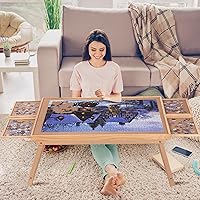
What Size Puzzle Table Fits a 1,500-Piece Puzzle?
How big should a puzzle table be? Choose a usable surface larger than your puzzle's finished length and width, with extra room for any loose pieces you plan to sort beside it.
On this page (9 sections)
- How big should a puzzle table be for a 1,500-piece puzzle?
- How do you measure the table and the room?
- Does a 1,500-piece puzzle always need a 1,500-piece table?
- When is a larger table worth the space?
- Which table sizes suit a 1,500-piece puzzle?
- Can a 1,000-piece table hold a 1,500-piece puzzle?
- How much space should you leave for loose pieces?
- How should you set up and care for a puzzle table?
- How big should a puzzle table be for your next purchase?
A puzzle table should be large enough for your finished puzzle, plus the space you need to sort and work. To decide how big a puzzle table should be for a 1,500-piece puzzle, start with the finished length and width printed on its box.
A 1,500-piece capacity label is only a starting point. Your puzzle's shape, piece size, and your sorting habits determine whether a particular table will feel roomy or crowded.
How big should a puzzle table be for a 1,500-piece puzzle?
Choose a surface that holds the entire finished puzzle inside its usable edges, with clearance for placing pieces. Add more space if loose pieces will stay beside the picture.
Compare the long side of the puzzle with the long side of the working area, then compare the short sides. Total area can hide a poor fit: a long, narrow surface may have plenty of square inches but still lack enough depth.
For example, a hypothetical 32 x 23 in puzzle on a 34 x 25 in working area leaves just 1 in around each side when centered. That fits the picture, but it isn't a useful sorting border for hundreds of loose pieces.
How big should your puzzle table be with sorting space?
Allow separate room for assembly and sorting if you want everything on one surface. Draw the finished puzzle's outline on a paper plan of the table, then mark where loose pieces or trays would go.
If adding 3 in on every side, add 6 in to both the puzzle's length and width. Treat that as a planning example, not a fixed rule: your tray sizes and sorting method decide the extra room you need.
How do you measure the table and the room?
Measure the usable area inside the frame for puzzle fit, then measure the full setup for room fit. These are different measurements, and both matter before buying.
Raised edges, borders, and frames can reduce the flat space available for pieces. Don't assume the outer tabletop dimensions describe the assembly area.
Mark the table's footprint on the floor with removable tape. Pull your chair into place and check that you can sit down, stand up, and pass behind it without shifting furniture.
Allow room for drawers to open and for the table to move along its intended storage route. A table on wheels still needs clearance through doorways and around furniture.
For help choosing between a stand-alone surface and a board, see our complete guide to puzzle tables and boards.
Does a 1,500-piece puzzle always need a 1,500-piece table?
No, finished dimensions matter more than piece count. Two puzzles with the same number of pieces can need different amounts of space.
Large-piece puzzles and panoramic designs deserve particular attention. A table capacity label won't account for every shape or format.
Plan around the largest puzzle you realistically expect to build, rather than buying extra furniture for a distant possibility. If you're unsure whether you need a dedicated setup, read what a puzzle table is and whether you need one.
When is a larger table worth the space?
A larger table is worth choosing when you build bigger puzzles, assemble separate sections, or sort beside the picture. Skip the extra size if it makes the far edge hard to reach or crowds your room.
The ALL4JIG 2000 Table with Legs and Wheels has a 40.16 x 28.50 in board. Its overall length and width are 41.1 x 29.45 in, so use the smaller measurements when planning puzzle space.
Its rotating board suits a solo puzzler who wants to bring different sections closer. It also has adjustable height, tilt, 4 drawers, and a protective cover.
Choose it if larger puzzles are a regular part of your hobby and the room allows the board to turn. Skip it if you mainly build smaller puzzles and would have to squeeze past the table daily.
Rotation needs more clearance than a stationary rectangular footprint. Check the space around the corners, and secure the tabletop adjustment knob before working.
Which table sizes suit a 1,500-piece puzzle?
Choose between these options by puzzle fit first, then how you plan to leave or store the table. A rolling setup suits a regular puzzle spot, while folding legs help when the room has other uses.
ALL4JIG 1500 for a regular puzzle spot
The ALL4JIG 1500 Table with Legs and Wheels has a 33.58 x 24.92 in board. Its overall length and width are 35.04 x 25.98 in, which include more than the working surface.
This model combines adjustable height and tilt with a felt surface, cover, and wheels. It suits someone who wants to keep a fitting puzzle ready and move the setup between nearby spots.
Skip it if your puzzle nearly fills the board and you want broad sorting space around the picture. Drawers help organize loose pieces, but they don't make the assembly surface larger.
TEAKMAMA 1500 for a shared room
The TEAKMAMA 1500 Table with Legs measures 34.2 x 26.5 in and stands 27.6 in high. Check the space inside its frame before treating those outer dimensions as puzzle capacity.
Its folding legs, 4 drawers, and PVC cover suit someone who needs the floor space back after a session. Check your under-bed or under-sofa clearance before choosing that storage plan.
Skip it if you need adjustable height or a rolling base. Match its fixed height to your chair, and keep the board level when moving an unfinished puzzle.
Can a 1,000-piece table hold a 1,500-piece puzzle?
A smaller table works only when both finished puzzle dimensions fit its usable area. Don't choose one just because it is easier to store.
The SZXDS 1000 Wooden Table, Folding Legs measures 29.92 x 22.04 in and is designed for most 1,000-piece puzzles. It includes folding legs, 4 drawers, and a clear protective cover.
Choose it for smaller puzzles or as a sorting station beside a larger assembly surface. Skip it as your main 1,500-piece table unless you have confirmed that your particular puzzle fits.
For puzzles that exceed these smaller surfaces, see puzzle tables for 2,000-piece puzzles.
How much space should you leave for loose pieces?
Reserve enough room to see and pick up your sorted pieces without covering the unfinished picture. You don't need every piece spread out at once.
Drawers work well for broad groups, such as edges, sky, buildings, and foliage. Trays let you bring one group beside the puzzle and move it away when you need assembly space.
If you prefer pieces spread face up, choose a larger surface or a nearby side table. Our guide to sorting puzzle pieces with trays explains how to organize groups without filling the main board.
In a tight room, plan storage before increasing table size. Read where to put a puzzle table in a small space to work out a practical location.
How should you set up and care for a puzzle table?
Start with a level, secure surface and a comfortable seat, then adjust the setup before spreading pieces. Follow the assembly instructions and check folding legs or adjustment knobs before each move.
Sit close enough to reach the near edge without leaning forward. If reaching the center makes you stretch, change your seat position or bring the section closer before continuing.
Begin with a tilting surface flat, then raise it gradually while watching for movement. Keep loose pieces away from the lower edge, and don't assume a felt surface will hold every piece at every angle.
Clear crumbs and dust before starting a puzzle. Use a soft brush on felt and a soft cloth for suitable hard surfaces, following the care instructions and avoiding soaked wood or felt.
Place the cover over the board between sessions, but don't treat it as a sealed carrying case. Close drawers before moving the table, and get help if lifting it level feels awkward.
How big should a puzzle table be for your next purchase?
Choose the smallest table that fits your largest regular puzzle and your sorting plan. Move up in size when either finished dimension exceeds the working area or loose pieces would crowd assembly.
Pick the ALL4JIG 1500 for a fitting puzzle and a movable, adjustable setup. Choose the ALL4JIG 2000 when larger projects and extra working room justify its footprint.
Choose TEAKMAMA when folding storage and a fixed-height setup suit your room. Keep SZXDS for smaller puzzles or separate sorting unless your measurements confirm a larger puzzle fits.
Before ordering, check puzzle fit, room clearance, and storage access together. Use our puzzle table guide to compare the types of surfaces that meet those needs.
Frequently asked questions
What size table do I need for a 1,500-piece puzzle?
Choose a table whose usable length and width exceed the finished dimensions printed on your puzzle box. A surface that barely fits the completed picture leaves little room for loose pieces.
Add space for sorting beside the puzzle, or use separate trays if you need a smaller table.
Is a 1,500-piece puzzle table big enough for a 2,000-piece puzzle?
A table sold for 1,500 pieces can hold a 2,000-piece puzzle only if that puzzle fits within its usable length and width. Piece count alone cannot confirm this.
Check the finished dimensions before starting, and keep loose pieces in drawers or trays if the remaining tabletop space is limited.
Should a puzzle table be bigger than the puzzle?
Yes, some clearance makes it easier to place edge pieces and move small sections without crowding the frame. More space is useful if loose pieces stay on the tabletop.
If you sort elsewhere, a closer fit can work, as long as the entire finished puzzle sits flat inside the usable area.
How do I measure a puzzle table for fit?
Measure the flat working area inside any raised rim or frame, then compare its long and short sides with your puzzle's finished dimensions. Outer tabletop measurements can include space you cannot use.
Measure the room separately, allowing for your chair, open drawers, and a clear path around the table.