Where to Put a Puzzle Table in a Small Room
Put a puzzle table for small spaces on a fully supporting tabletop or beside a seat with clear legroom. Choose a folding model if you need to reclaim the space, and measure its storage route as well as its working footprint.
On this page (8 sections)
- Where should a puzzle table go in a small room?
- How do you measure a puzzle table for small spaces?
- Which puzzle setup works on a dining table or coffee table?
- Which folding tables suit under-bed or under-sofa storage?
- When is a small board better than a full puzzle table?
- How should you set up and care for a small puzzle station?
- What mistakes waste space around a puzzle table?
- Which puzzle table for small spaces should you choose?
Put a puzzle table for small spaces on existing furniture or beside a seat, where you can reach the puzzle without blocking a walkway. Choose its working spot and storage spot together so clearing the room doesn't become a daily chore.
The smallest board isn't always the right choice. A surface that fits your puzzle, with sorting pieces stored elsewhere, can use space better than a tiny board that forces you to split the puzzle into sections.
Where should a puzzle table go in a small room?
Place it beside furniture you already use, with room for your knees and a clear route through the room. A spot near a sofa, bed, or dining chair saves you from finding space for another seat.
Check the position while sitting down. If you must lean far forward or twist to reach the center, move the surface closer or choose a different base.
Keep it clear of door swings, curtains that brush the surface, and busy paths. Use light from beside or above you so your body doesn't cast a shadow across the pieces.
For help deciding whether you need a separate table or a board on existing furniture, see puzzle table or puzzle board: which should you buy?.
How do you measure a puzzle table for small spaces?
Measure the puzzle, the working spot, and the storage route before choosing a table. Overall board dimensions alone won't tell you whether you can use it comfortably.
Start with the puzzle's finished width and height on its box. Compare both with the usable assembly area, allowing spare space for moving pieces or planning to sort in separate containers.
Next, mark the table's outline with paper on the floor or tabletop. Sit in position, move your knees, open nearby doors, and check where each drawer would extend.
Finally, measure the opening beneath your bed or sofa, including the lowest rail and any center supports. Confirm the folded table's full thickness rather than using the board's thickness as a substitute.
Our guide to puzzle table sizes for a 1,500-piece puzzle explains the difference between puzzle capacity and a surface that actually fits.
Which puzzle setup works on a dining table or coffee table?
A board or low folding-leg model works when the base supports it fully and evenly. A tall table with floor-standing legs needs its own floor space.
A dining table gives you a chair and a broad base, but meals create a deadline for clearing it. Choose the storage location before laying out pieces, especially if you'll move an unfinished puzzle every evening.
A coffee table puts the puzzle near the sofa, though a low surface can make you lean forward. Raising a board on its legs also raises your arms, so check the seated position before committing to that arrangement.
RAGOZONERY puzzle table for small spaces with shared furniture
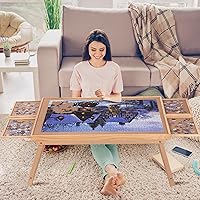
Choose RAGOZONERY if you want one folding setup for several locations, such as a dining table, coffee table, or floor. It arrives ready to use and has 4 drawers with metal retaining clips plus a plastic cover.
The wood construction weighs 7.21 kg, so consider the lift as well as the available space. It suits someone who can carry a broad board level between nearby spots.
Skip it if you need a small, light board for frequent moves through tight corners. Before carrying it, fasten the drawer clips and put loose pieces away; the cover shields the surface but doesn't clamp pieces down.
Which folding tables suit under-bed or under-sofa storage?
Choose a folding table only when the whole folded unit fits your storage opening and you can reach it easily. A wide empty area beneath a bed is little help if a low rail blocks entry.
Check for rug edges, furniture feet, and corners along the route. Avoid a storage plan that requires tipping unfinished work onto its side.
TEAKMAMA for a separate seated workspace
Choose TEAKMAMA if you want a floor-standing table that folds away rather than a board that borrows dining space. Its height is 27.6 in, and its work area is 34.3 x 26.4 in.
It arrives without assembly and includes 4 divided, lined drawers with latches. The included adhesive sheets and hanging hooks also suit someone who plans to keep completed puzzles.
Skip it if you need an adjustable height or want a light daily carry: it weighs 19 lb. Compare its fixed height with your seat using our adjustable puzzle table height guide.
TEAKMAMA warns that the legs deploy automatically when released. Keep your face clear during opening, then check that the legs are locked before placing a puzzle on top.
SZXDS for a smaller shared-room setup
Choose SZXDS if you mainly assemble 1,000-piece puzzles and want less board to store than the larger options above. It has 4 drawers, a clear protective cover, and folding legs.
Its smaller outline helps when the storage opening is narrow, but fit your actual puzzle to the usable surface before buying. At 4.63 kg, it still needs a planned, level carry.
Skip it for puzzles that exceed its assembly area or if you expect drawer locks for transport. Put loose pieces in closed containers before moving it.
Our guide to folding puzzle tables covers other features that matter when the room needs to return to everyday use.
When is a small board better than a full puzzle table?
A small board is better for compact puzzles and short moves between nearby surfaces. It saves space only if your puzzle fits without needing several extra work areas around it.
BrightRow for compact personal puzzles
Choose BrightRow if you want a small board for personal use, rather than a surface sized around large puzzles. It weighs 3.3 lb and includes 2 drawers, folding legs, and raised edges.
Check the usable area inside the edges against your finished puzzle. Don't assume a standard 1,000-piece puzzle will fit because the board has drawers and legs.
Skip it if you want room for a large puzzle and several sorting piles on the same surface. It also doesn't include a cover, so plan a separate protected storage spot for unfinished work.
How should you set up and care for a small puzzle station?
Use a firm, level base, with sorting pieces close by and supplies off the main assembly area. A soft bed or sofa cushion can let feet sink unevenly, so check support before spreading out pieces.
Start with these steps:
- Clear the walking route and the storage spot.
- Set the board down empty and check that it sits evenly.
- Fully open and secure any legs you plan to use.
- Place the puzzle box or picture where it won't crowd your arms.
- Divide loose pieces among drawers or trays before building.
Sort by useful groups rather than filling every available drawer at random. Borders, large color areas, and distinct objects make good starting groups; our guide to puzzle sorting trays explains how to keep those groups manageable.
For routine care, remove loose pieces and wipe dust away with a soft, dry cloth. Keep drinks off the board, dry spills promptly, and avoid soaking wood or leaving it against a damp wall.
Before moving the setup, close drawers and secure any fitted clips or latches. Carry from the board's frame with both hands, keep it level, and fold the legs only when the board is supported.
Our guide to storing unfinished puzzles covers ways to protect work between sessions.
What mistakes waste space around a puzzle table?
The biggest mistake is buying by piece count instead of finished dimensions. A table marketed for a certain count can still be too small for a wide or unusually shaped puzzle.
Other mistakes can make a workable table awkward:
- Measuring only the closed board. Drawers need room to open, and your chair needs room to move.
- Ignoring the daily lift. A table that fits under the bed can still be awkward to carry from the dining room.
- Using the cover as a clamp. Move covered work level and contain loose pieces separately.
- Storing the board upright with work on it. Plan flat storage for these setups.
- Choosing a tiny board, then spreading trays everywhere. Count the sorting space as part of the total setup.
For a wider view of board styles and room layouts, use our puzzle tables and boards buying guide.
Which puzzle table for small spaces should you choose?
Choose your puzzle table for small spaces by the task your room must handle next. A dining room needs quick clearing, while a bedroom may offer flat storage but a longer carrying route.
Pick RAGOZONERY for use across existing furniture and floor spots, or TEAKMAMA for a separate seated workspace. Choose SZXDS for a smaller setup around puzzles that fit, and BrightRow for compact puzzles where easy carrying matters most.
Before ordering, settle 3 points: where you'll sit, where the unfinished puzzle will sleep, and how you'll move it between those places. If a separate table consumes too much floor space, the board-versus-table guide will help you choose a setup that uses furniture you already have.
Frequently asked questions
Where should I put a puzzle table in a small room?
Put it beside a seat or on existing furniture where it leaves a clear walking path; check door swings, legroom, drawer access, and how far you'll reach across the puzzle. If that spot serves another purpose, choose a setup you can move and store level between sessions.
Can I put a puzzle table on a dining table?
Yes, a board or low folding-leg model can work if the base supports it fully and evenly; fold the legs flat when using it as a board, or check every foot if using it raised. Leave space for seating and choose a storage spot before starting a puzzle.
How do I store a puzzle table in a small room?
Store it flat under a bed or sofa if its folded dimensions clear the opening and furniture supports; measure the route too, including corners and rugs. Close drawers, secure any clips or latches, and contain loose pieces before moving the board; a cover doesn't clamp the puzzle in place.
Is a small puzzle board enough for a 1,000-piece puzzle?
Only if the usable surface fits that puzzle's finished width and height; piece count alone can't confirm the fit because puzzle shapes and piece sizes vary. Leave room to move pieces around, or sort in separate trays if the assembled puzzle takes up most of the board.