10 Best Folding Puzzle Tables (November 2026)
The best folding puzzle tables include the RAGOZONERY 1500 Table for shared dining tables, the Tektalk 2000 Foldable Table for large puzzle projects, and the CODACE 1500 Foldable Table for different seating heights.
On this page (8 sections)
- Which folding puzzle table fits your routine?
- How do you choose the right folding puzzle table size?
- How do you check chair fit, tilt and reach?
- What should you measure before storing a folding table?
- How should you set up and move your table?
- Which storage features help keep a puzzle intact?
- How do you care for the board and avoid common mistakes?
- Which folding puzzle table should you choose?
The RAGOZONERY 1500 Table, Folding Legs is the best folding puzzle table for puzzlers who want no assembly, drawers and a cover. Choose Tektalk for a larger work area, or CODACE 1500 if adjusting both height and tilt matters more.
Start with the puzzle you actually build and the place you'll sit. A table that folds neatly still needs room for your knees, open drawers and a safe route to storage.
Our complete guide to puzzle tables and boards covers the wider category. For room planning, see where to put a puzzle table in a small room and our guide to puzzle tables with legs and wheels.
Our picks at a glance
-
1

-
2

-
3
- 4
 Check it
JoyPcsTable 1500 Folding Table, 3 Angles
Best for tool-free tilted puzzling - 5
 Check it
JoyPcsTable 1500 No-Assembly Table
Best for hiding unfinished puzzles - 6
 Check it
TEAKMAMA 1500 No-Assembly Table
Best for fixed-height chair setups - 7
 Check it
Doerpuz 1500 Folding Table with Wheels
Best for frequent reference checks - 8
 Check it
SZXDS 1000 Wooden Table, Folding Legs
Best for compact tabletop sessions - 9
 Best for tray-based piece sortingCheck it
- 10
 Check it
upvercy 1500 3-in-1 Folding Table
Best for occasional room changes
Which folding puzzle table fits your routine?
Choose RAGOZONERY for clearing a shared surface, Tektalk for larger projects, or CODACE 1500 for adjustable seating. The other picks solve narrower needs, including compact tabletop use, tool-free tilt and keeping a reference image in view.
RAGOZONERY: a folding puzzle table for shared surfaces
RAGOZONERY 1500 Table, Folding Legs: Best for shared dining tables
- 34 x 26 in board
- 4 drawers
- Plastic cover
- Folding legs
A no-assembly option for keeping a puzzle together when a shared table needs clearing. Folding legs allow floor or tabletop use.
Pros
- No assembly required
- Drawer clips help prevent drawers sliding out
- Smooth surface allows easy piece movement
Cons
- No height or tilt adjustment specified
- Folded clearance needs checking
RAGOZONERY suits someone who starts a puzzle on a shared table and needs to move the whole project later. Its smooth wooden surface lets you slide connected sections into position without working directly on the dining table.
The 34 x 26 in board suits most 1,500-piece puzzles, with four drawers for loose groups. Metal drawer clips help prevent drawers sliding out during movement, and a plastic cover shields the work when you step away.
No assembly is required, so there's no frame-building task before your first session. Folding legs also let you choose between floor use and placing the board on an existing surface.
Skip it if your main need is changing the table height or working at an angle. Choose it for a simple storage routine, but plan to lift the board with support beneath it rather than pulling on drawers or the cover.
Tektalk 2000 Foldable Table
Tektalk 2000 Foldable Table: Best for large puzzle projects
- Maximum board size of 40.2 x 30.3 in
- Height adjusts from 29.5 to 37.4 in
- 8 drawers
- Bottom shelf
The expanding board suits larger projects, while adjustable height helps match the table to your seat. Choose it when you have space for a rolling frame.
Pros
- Expands for larger puzzles
- Adjustable working height
- Shelf keeps boxes off the work surface
Cons
- Requires assembly
- Weighs 18.5 kg
Tektalk is the stronger choice for a large project that needs its own station. Its board expands to 40.2 x 30.3 in, and the frame adjusts from 29.5 to 37.4 in high.
Eight drawers separate piece groups, while a bottom shelf gives the puzzle box and accessories a home. Two felt covers are included for different puzzle sizes, so the main surface doesn't have to remain exposed between sessions.
This is a rolling frame with four casters, two of which lock. Assembly is required, and its 18.5 kg weight makes rolling a more practical plan than frequent lifting.
Skip it if you need a board you can easily carry away after every short session. Also allow room for the expanded top before opening it, and change the board configuration before laying out your puzzle.
CODACE 1500 Foldable Table
CODACE 1500 Foldable Table: Best for different seating heights
- Height adjusts from 27.5 to 35.4 in
- Tilt from 0 to 45 degrees
- 6 removable sorting trays
- 4 casters
Height and tilt adjustment suit puzzlers who move between different seats. Removable trays let you bring a group of pieces closer without moving the whole table.
Pros
- Adjustable height and tilt
- Removable sorting trays
- Felt work surface
Cons
- Some assembly required
- Usable work dimensions need confirmation
CODACE 1500 suits puzzlers who need to match the work surface to different seats. Height adjusts from 27.5 to 35.4 in, and the top moves from flat to 45 degrees.
Two pull-out drawers contain six removable sorting trays. You can bring one group close for detailed work, then return it to storage without mixing it into the remaining pieces.
The felt surface, protective cover and four casters support a movable setup. Before use, secure the legs with the eight included screws; this is a short assembly task rather than a ready-to-unfold frame.
Choose it when height and angle adjustment will both earn their space. Skip it if you only need a flat board for occasional use, and confirm the usable work area before choosing a puzzle that fills the surface.
JoyPcsTable 1500 Folding Table, 3 Angles
JoyPcsTable 1500 Folding Table, 3 Angles: Best for tool-free tilted puzzling
- 3 tilt settings from 15 to 30 degrees
- 4 drawers
- Plastic cover
- Detachable locking casters
Folding metal legs and preset tilt positions suit buyers who want an angled surface without assembling a frame. Detachable wheels offer another setup choice.
Pros
- No installation required
- Felt surface for angled use
- All 4 casters lock
Cons
- Confirm current working height
- Confirm usable puzzle dimensions
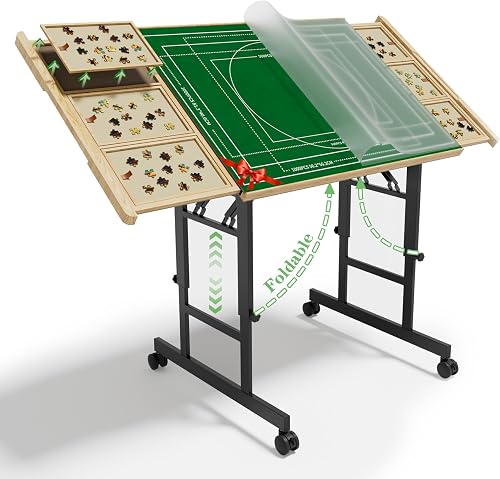
This JoyPcsTable suits buyers who want an angled work surface without assembling a frame. Its three tilt settings run from 15 to 30 degrees, and green felt helps hold pieces on the slope.
The folding metal legs require no installation. Four removable drawers provide sorting space, while a plastic cover lets you cover unfinished work without packing the puzzle away.
All four detachable casters lock, and the drawers have safety locks for movement. Those details suit someone who wants to shift the table within a room and secure it again before sitting down.
Confirm the current working height against your chair because JoyPcsTable describes a change to the leg height. Skip this model if you need a broad height-adjustment range; preset tilt positions won't solve a poor match between the seat and tabletop.
JoyPcsTable 1500 No-Assembly Table
JoyPcsTable 1500 No-Assembly Table: Best for hiding unfinished puzzles
- Tilt angles of 15, 30 and 40 degrees
- 4 drawers
- Wooden cover
- 4 lockable casters
The wooden cover hides unfinished work, making this a useful choice for a shared living room. Folding legs and locking wheels support a movable setup.
Pros
- No assembly required
- Choice of 3 tilt positions
- Opaque cover hides the work surface
Cons
- Working height needs checking against your chair
- Overall board size is not usable-area confirmation
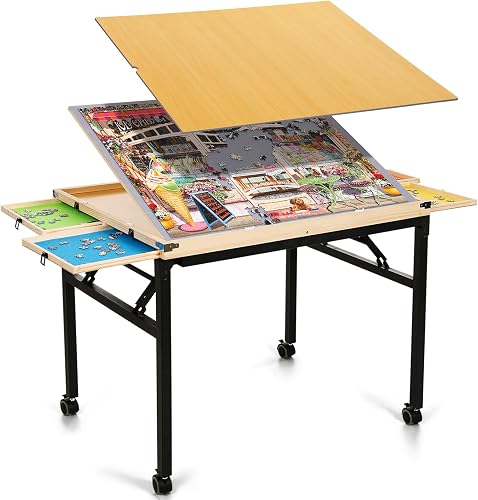
Choose this JoyPcsTable when you want unfinished work hidden beneath a wooden cover. That suits a shared living room where you prefer to close the surface between sessions.
It offers tilt positions of 15, 30 and 40 degrees, four drawers and four locking casters. No installation is required, making it an alternative to a frame that needs screws and tools.
The board measures 38 x 25 in overall, so establish the usable puzzle area before planning a close fit. Check the working height and space beneath the frame against your usual chair as well.
Skip it if seeing the puzzle through its cover is part of the appeal. Give the removable cover a nearby resting place during use, where it won't lean against your legs or block access to a drawer.
TEAKMAMA 1500 No-Assembly Table
TEAKMAMA 1500 No-Assembly Table: Best for fixed-height chair setups
- 34.3 x 26.4 in work area
- 27.6 in working height
- 4 divided drawers
- Translucent cover
A fixed-height table for buyers whose chair already suits its working height. Divided drawers keep separate piece groups together between sessions.
Pros
- No assembly required
- Drawer latches help keep storage closed
- Includes 10 adhesive sheets and hanging hooks
Cons
- Weighs 19 lb
- Legs deploy automatically when released
TEAKMAMA suits buyers who want a fixed-height table and already know what fits their chair. It stands 27.6 in high, with a 34.3 x 26.4 in work area.
Four divided, lined drawers keep piece groups apart, and latches help keep the drawers closed during movement. A translucent cover protects unfinished work while leaving it visible.
No assembly is required, but opening the legs needs care. TEAKMAMA warns that they deploy automatically when released, so keep your head and face away from their path.
Choose it for a steady chair setup rather than frequent changes between seats. Skip it if you need height adjustment or find a 19 lb lift awkward; the included adhesive sheets and hanging hooks are useful extras only if you plan to display finished puzzles.
Doerpuz 1500 Folding Table with Wheels
Doerpuz 1500 Folding Table with Wheels: Best for frequent reference checks
- 5 locked tilt angles
- Reference holder with 2 clips
- 4 felt-lined drawers
- 4 locking casters
A reference holder keeps the puzzle image nearby without using the main work area. Multiple tilt positions and locking wheels suit a rolling puzzle station.
Pros
- Reference holder and clips included
- 5 tilt positions
- Drawers have locking clips
Cons
- Weighs 13.52 kg
- Usable work area needs confirmation
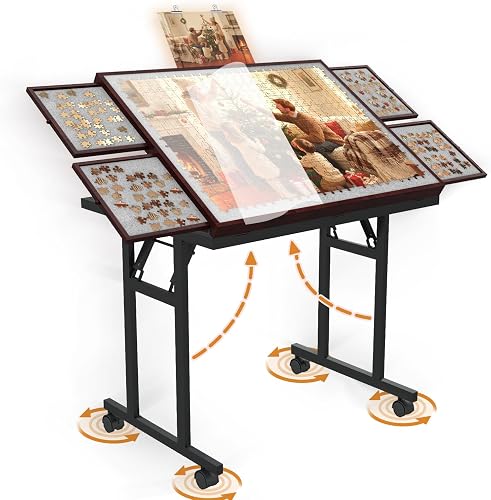
Doerpuz suits puzzlers who check the box image often and want it off the work surface. Its reference holder and two clips keep the image nearby, leaving more room for puzzle sections.
Five locked tilt positions give you several viewing choices. Four felt-lined drawers hold sorted pieces, with locking clips to keep them closed when the table moves.
Each caster has a brake, and a protective cover is included. Put the reference holder where it remains easy to see without blocking your light, then check that the tilt support is fully seated before adding pieces.
Skip it if your storage routine involves carrying a table up stairs or lifting it daily. At 13.52 kg, it makes more sense for rolling between nearby spots; confirm the usable work area and allow time for setup using the included assembly instructions.
SZXDS 1000 Wooden Table, Folding Legs
SZXDS 1000 Wooden Table, Folding Legs: Best for compact tabletop sessions
- 29.92 x 22.04 in board
- 4 drawers
- Clear cover
- Folding legs
The smaller board suits compact projects on an existing table or floor. Choose it when fitting the room matters more than leaving extra space around a large puzzle.
Pros
- Smaller footprint than the larger boards here
- Drawers separate loose pieces
- Weighs 4.63 kg
Cons
- Limited space for oversized puzzles
- Confirm leg height for your intended setup
SZXDS suits compact projects on a floor, bed or existing table. Its 29.92 x 22.04 in board is aimed at most 1,000-piece puzzles, so start with your puzzle's finished measurements.
Four drawers move loose-piece storage away from the main work area. The clear cover lets you see your progress between sessions, and folding legs make the board easier to put away.
Choose it when a smaller board fits your room and your usual puzzle size. At 4.63 kg, it weighs less than several larger choices here, though you should still plan a supported, level lift.
Skip it for oversized puzzles or if you prefer spreading every loose piece around the border. Also confirm leg height before treating it as a chair-height table; floor or tabletop use is the clearer fit for this design.
CODACE 2000 Foldable Table
CODACE 2000 Foldable Table: Best for tray-based piece sorting
- 2,000-piece model
- Height adjusts from 27.5 to 35.4 in
- Tilt from 0 to 45 degrees
- 6 removable sorting trays
Removable trays suit detailed sorting, and the frame adjusts in height and angle. Choose this model only after confirming that your finished puzzle fits its usable surface.
Pros
- Adjustable height and tilt
- Removable trays for separate piece groups
- Felt surface and cover
Cons
- 34 x 26 in overall dimensions require a careful fit check
- Some assembly required
Choose this CODACE only after a usable-area check confirms that your puzzle fits. It's sold as a 2,000-piece model, but its overall dimensions are 34 x 26 in, so the piece count alone isn't a sound fit guide.
It combines height adjustment, tilt and six removable sorting trays in pull-out storage. That arrangement suits someone who sorts small color or pattern groups and wants to bring each group closer while working.
A felt surface, cover and four casters are included. Secure the legs with the eight included screws before setting the table's working position.
Skip it if your large puzzle needs more space than the confirmed work area offers. Tektalk is the clearer starting point when a larger published board size matters; choose this CODACE for its tray layout only when the size works.
upvercy 1500 3-in-1 Folding Table
upvercy 1500 3-in-1 Folding Table: Best for occasional room changes
- 34 x 26 in board
- 27.7 in working height
- 4 tilt settings
- Carry handle
A carry handle suits occasional moves between nearby storage and a puzzling spot. Fixed height and four tilt settings suit buyers who already know their preferred chair fit.
Pros
- 4 tilt settings
- Handle for carrying
- Felt surface and protective cover
Cons
- Assembly required
- Weighs 25.7 lb
upvercy suits someone who wants an angled board and makes occasional moves between nearby spots. A carry handle helps with handling, but the table still weighs 25.7 lb.
Its 34 x 26 in board stands 27.7 in high and offers four tilt settings. Felt supports angled work, while four drawers and a translucent cover keep the project together between sessions.
An assembly guide and installation tool are included. Set the tilt bracket fully into its chosen groove, and fold and lock the legs before using the board on an existing table.
Skip it if you need adjustable height or expect to move a table often without lifting. Before choosing it, picture the full trip to storage, including any low furniture you must bend beneath while supporting the board.
How do you choose the right folding puzzle table size?
Use your puzzle's finished width and height, then check how much usable surface remains. Piece count describes the puzzle, but it doesn't set a standard shape or finished size.
A panorama can be too wide for a board that holds a more square puzzle with the same number of pieces. Raised edges and frame parts may also reduce the space available within an overall board measurement.
For a close fit, plan to keep loose pieces in drawers or trays. If you prefer building several sections beside the main puzzle, allow spare surface for those sections before joining them.
Our guide to what size puzzle table fits a 1,500-piece puzzle explains the measurement process. Measure the actual puzzle you intend to build rather than choosing the largest piece count printed on a table.
Check the room with drawers open, too. A board can fit neatly beside a chair yet become awkward when a drawer opens into a walkway or against another piece of furniture.
How do you check chair fit, tilt and reach?
Choose a setup that lets you sit close, relax your shoulders and reach the working area. Tilt changes the viewing angle; height adjustment changes where the whole surface sits relative to your body.
Sit in your usual chair with your feet supported and your elbows resting near your sides. Measure the height of a nearby surface that feels comfortable, then compare that with the table you're considering.
Check the space for your knees and feet beneath the frame. A height range alone doesn't confirm access around braces, drawers or a lower shelf.
For more help matching a surface to your seat, read how high an adjustable puzzle table should be. This matters especially when switching between a low sofa and a firmer dining chair.
Start with a shallow tilt and bring the section you're working on closer. A steeper angle is less useful if it makes the far edge hard to reach or causes loose pieces to slide.
Our guide to using a puzzle board to tilt, rotate and cover your work covers those changes. Take position breaks during longer sessions rather than relying on one setting to keep you comfortable.
What should you measure before storing a folding table?
Measure folded thickness, width and the whole storage route before you order. Folding legs reduce bulk, but drawers, hinges, handles and wheels can still prevent a table fitting beneath furniture.
Measure the narrowest opening under a bed or sofa, including any low crossbar. Leave room to grasp the board and pull it out without dragging the cover across the furniture above it.
Decide whether storage means keeping the table horizontal or standing it upright. Folding a frame does not make an unfinished puzzle safe to store on its edge.
If your main need is moving work off a dining table, compare a puzzle table with a separate puzzle board. A freestanding frame earns its place when you use the legs regularly.
Weight matters most where rolling stops. A threshold, staircase or tight turn can turn a short move into a lift, so choose around that difficult part of the route.
How should you set up and move your table?
Set up the table empty on a level floor, then secure its supports before starting a puzzle. Keep fingers clear of folding joints and follow the opening order in the instructions.
For models that need assembly, finish every fastening step before adjusting height or tilt. Keep small tools away from the puzzle surface so they don't get mixed into your pieces.
Engage any caster brakes before sitting down, and check that each wheel contacts the floor properly. Recheck the setup after moving from a hard floor onto a rug.
Before a move, return loose pieces to their storage compartments, close drawers and secure their clips or latches. Lower the top to a safe travel position according to the instructions.
Lift from supported structural parts rather than the cover, open drawers or tilt bracket. Keep the board level, and get help if its width makes it awkward to carry even when its weight feels manageable.
Which storage features help keep a puzzle intact?
Drawers organize loose pieces; covers shield the unfinished puzzle. Choose how you'll use each feature rather than assuming they make a table safe to carry in any position.
Sort into groups you'll recognize next time, such as border pieces, lettering and distinct colors. Leave enough space in each drawer for pieces to sit below the closing edge without being trapped.
Removable trays help when you want one group beside your chair or on another surface. Fixed drawers suit pieces you want to keep with the table throughout the project.
A translucent cover keeps progress visible, while an opaque cover hides it. Neither type should be treated as a clamp that holds every loose piece down during folding.
Check for raised or overlapping pieces before replacing the cover. For longer breaks, follow our guide to storing puzzles, finished or not and choose a spot away from spills and heavy objects.
How do you care for the board and avoid common mistakes?
Keep the work surface dry, clear and free of trapped pieces. Brush loose dust from felt with a soft brush, and follow the brand's care directions before using any cleaner.
For a smooth wooden surface, use a soft cloth and avoid soaking joints or drawer edges. Let any damp area dry fully before returning cardboard pieces.
Keep drinks on another surface, even when a cover is described as water resistant. Liquid can reach edges, seams or uncovered drawers, and a spill can damage the puzzle before you notice it.
Don't force a drawer that catches. Open it gently and check for a piece lodged near the edge rather than pressing harder and bending the cardboard.
Avoid changing board size, folding the frame or raising the tilt with loose pieces spread everywhere. Set the table's shape first, then arrange your project around the usable area.
Finally, don't buy around accessories you rarely use. A simpler board that fits your storage space is a better choice than a larger frame that stays folded because setting it up feels like a chore.
Which folding puzzle table should you choose?
Pick RAGOZONERY for a shared surface you need to clear, Tektalk for a larger dedicated project, or CODACE 1500 when chair height and viewing angle both need adjustment. Choose SZXDS when your usual puzzle and available space favor a smaller board.
The first JoyPcsTable suits tool-free tilted use, while the second suits buyers who want a wooden cover. TEAKMAMA fits a known fixed-height chair setup; Doerpuz earns its place when you use the reference holder often.
Consider upvercy for occasional carrying, and choose CODACE 2000 only after confirming its usable area. Before deciding on any folding puzzle table, settle three things: puzzle fit, chair fit and the trip to storage.
If folding is only one of your priorities, compare our best puzzle tables for other ways to build a comfortable puzzle station.
| Product | Best for | Puzzle size | Storage | Setup | Our score |
|---|---|---|---|---|---|
| RAGOZONERY 1500 Table, Folding Legs | shared dining tables | Most 1,500-piece puzzles | 4 drawers and plastic cover | Ready to use out of the box | 7.8 |
| Tektalk 2000 Foldable Table | large puzzle projects | Up to 2,000 pieces when finished dimensions fit | 8 drawers, bottom shelf and 2 felt covers | Assembly required | 7.6 |
| CODACE 1500 Foldable Table | different seating heights | 1,500-piece model; confirm usable area | 2 drawers with 6 removable trays and a cover | Secure legs with 8 included screws | 7.4 |
| JoyPcsTable 1500 Folding Table, 3 Angles | tool-free tilted puzzling | 1,500-piece model; confirm usable area | 4 drawers and plastic cover | No installation required | 7.4 |
| JoyPcsTable 1500 No-Assembly Table | hiding unfinished puzzles | 1,500-piece model; confirm usable area | 4 drawers and wooden cover | No installation required | 7.3 |
| TEAKMAMA 1500 No-Assembly Table | fixed-height chair setups | 1,500-piece puzzles that fit the work area | 4 latched drawers and translucent cover | No assembly required | 7.3 |
| Doerpuz 1500 Folding Table with Wheels | frequent reference checks | 1,500-piece model; confirm usable area | 4 drawers and protective cover | Assembly instructions included | 7.2 |
| SZXDS 1000 Wooden Table, Folding Legs | compact tabletop sessions | Most 1,000-piece puzzles | 4 drawers and clear cover | Folding legs for floor or tabletop use | 7.2 |
| CODACE 2000 Foldable Table | tray-based piece sorting | Confirm usable dimensions before choosing for 2,000 pieces | 6 removable sorting trays in pull-out storage and a cover | Secure legs with 8 included screws | 7.1 |
| upvercy 1500 3-in-1 Folding Table | occasional room changes | 1,000- and 1,500-piece puzzles that fit the surface | 4 drawers and translucent cover | Assembly guide and tool included | 6.8 |
Our top 3 picks at a glance
-
1
-
2
-
3
Frequently asked questions
What should you check before buying a folding puzzle table?
Check your puzzle's finished dimensions, your chair height and the space available for storage. Measure the usable work area rather than relying on piece count, and allow room to open drawers.
Also check folded thickness and the route to storage, especially if you must carry the table through a doorway.
Can a folding puzzle table hold a 2,000-piece puzzle?
Yes, if the finished puzzle fits the usable surface. Tektalk expands to a maximum board size of 40.2 x 30.3 in, making it the clearer starting point here for larger projects.
Compare both puzzle dimensions with the work area, and keep loose pieces in drawers when little spare surface remains.
Are drawers or a cover more useful on a puzzle table?
Drawers help organize loose pieces, while a cover shields the unfinished puzzle between sessions. Choose drawers for sorting and a cover when dust or curious pets are your main concern.
Neither feature turns the table into a sealed carrying case, so keep it level and secure drawers before moving it.
Do folding puzzle tables need assembly?
Some need assembly, while others arrive ready to unfold. RAGOZONERY, both JoyPcsTable models here and TEAKMAMA require no assembly; Tektalk needs assembly, and the CODACE models require screws to secure their legs.
Even a no-assembly table needs its leg locks and supports checked before you place a puzzle on it.
Should you choose a folding puzzle table with tilt?
Choose tilt if you prefer viewing your puzzle at an angle and can comfortably reach its far edge. Start at a low angle and check that loose pieces stay put before raising it further.
A flat board is often enough when your main goal is clearing a shared dining table between sessions.


