How to Store Jigsaw Puzzles, Finished or Not
Knowing how to store puzzles starts with keeping unfinished jigsaws flat and covered and completed puzzles fully supported. Use labeled containers for loose pieces and a size-matched binder for finished puzzles you want to keep unglued.
On this page (7 sections)
To work out how to store puzzles, keep unfinished jigsaws flat and covered, then choose fitted storage for completed puzzles you want to save unglued. Put loose pieces in labeled containers so clearing the table doesn't mix up your work.
Choose by the puzzle's condition, finished size, and where it will live. A binder suits a completed collection; a board suits work in progress; the original box suits a puzzle you're ready to take apart.
How do you store an unfinished puzzle?
Leave an unfinished puzzle flat on a rigid board or table, with a cover over it between sessions. Store sorted pieces beside the assembled section so they can't scratch or disturb it.
If you'll need the table tomorrow, start on a movable board today. Transferring a partly assembled puzzle later creates extra chances for sections to break apart.
Choose a cover that won't catch the pieces when lifted. Remove cups, tools, and sorting containers before covering the workspace, and keep food and drinks elsewhere.
A board with drawers can hold loose pieces alongside your progress. See how to use a puzzle board for advice on covering, rotating, and moving the workspace.
How to store puzzles on a roll-up mat
Use a roll-up mat when clearing the table matters more than keeping every piece in place. A mat can save space, but rolling may separate joined sections or shift loose pieces.
Follow its rolling direction and tube instructions, and don't tighten it to force a smaller bundle. Bag loose pieces separately if you want to preserve your sorting.
Choose a rigid board instead if you dislike rebuilding small sections after each break. Compare puzzle boards and puzzle mats before deciding which storage routine you'll use.
How should you store a completed puzzle?
Keep a completed puzzle flat and supported until you decide to save it, display it, or take it apart. A storage binder makes sense when you want to revisit several finished pictures without committing to glue.
Measure the finished width and height, including any irregular edges. Piece count can't confirm fit because puzzles with the same count can have different shapes and dimensions.
Allow room to insert and remove the puzzle without forcing its edges against a pocket. If your measurements sit right at a folder's limit, choose more space.
Which binder suits a smaller finished collection?
The ALL4JIG Puzzle Binder, 500 to 1000 Pieces suits someone keeping a modest collection of completed puzzles together. Its clear film pockets let you view the pictures without removing each puzzle.
Choose it if your puzzles fit and you prefer a dedicated folder over separate stacks of boards. Skip it if you're mainly storing loose pieces or unfinished sections that need a working surface.
The plastic folder has a carrying handle, but plan its resting place before filling it. A wide folder still needs full support even when it holds only a few puzzles.
Which folder suits large completed puzzles?
The ALL4JIG 2000 Puzzle Storage Folder suits larger finished jigsaws that exceed smaller binders' pocket sizes. Choose it for the extra puzzle area, rather than buying it solely because your box says 2000 pieces.
It weighs 5.5 kg before puzzles are added and has no closure. That makes it a better match for supported storage in one place than frequent carrying through the house.
Skip it if you need a light folder or have nowhere broad enough to support it. Measure the storage spot and the route there, including doorways and tight turns.
Which folder suits a growing 1000-piece collection?
The Nariolar 1000 Puzzle Storage Folder suits someone saving many finished puzzles within a standard rectangular size range. Its larger stated capacity is useful if you regularly finish another puzzle and want to keep it intact.
It has 6 screw bindings, 2 metal clasps, and a handle. The pockets open at the top, so keep their openings facing upward during loading and follow the storage instructions before changing orientation.
Skip it for wider finished puzzles or if you'll struggle to move a growing collection. Maximum capacity is a limit, not a reason to fill every space regardless of bulk or handling.
Which book suits a smaller standard-size collection?
The ZFCLXX Puzzle Storage Book suits someone keeping finished rectangular puzzles together without needing Nariolar's higher stated capacity. ZFCLXX describes room for up to 24 completed puzzles.
Its 6 screw bindings hold the pages together, while 3 elastic fasteners close the book. Those fasteners help manage the cover; they don't replace careful support for an unglued puzzle.
Skip this book if your puzzle exceeds either dimension or you're choosing it for an exact sleeve count. Confirm that detail before ordering, since its pocket and page counts differ.
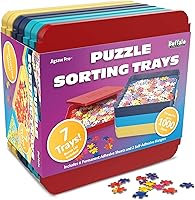
For loose pieces that need separate storage, see puzzle sorting trays, lids, and drawers.
How do you move a finished puzzle into storage?
Move a finished puzzle with continuous support underneath it, following the folder's loading instructions. Never lift an unglued puzzle by its corners or assume tight-fitting pieces will hold its weight.
- Clear a work surface large enough for the puzzle and open folder.
- Check that the pocket is clean, dry, and free of folds.
- Bring the receiving surface level with the puzzle's support.
- Transfer slowly using the recommended support or backing method.
- Stop if an edge catches, a sleeve bunches, or pieces begin separating.
Use a thin, rigid backing to help transfer the puzzle where the folder design allows it. Don't force extra backing into a tight sleeve, since added thickness can strain the pocket.
Load 1 puzzle first and check that you can remove it comfortably. Keep the binder flat while learning how its pages behave.
How do you store loose puzzle pieces?
Use closed trays or sealed bags, labeled with the puzzle title. Sorting by color, edge pieces, or image section can save time when you return.
Keep bags loose enough that closing them doesn't bend the pieces. Put small bags together in the original box or another labeled container so one group doesn't get separated from the rest.
Save the box picture or a clear photo of it for reference. Read how to sort puzzle pieces if your current groups make it hard to find what you need.
If you're ready to rebuild the puzzle another day, taking it apart is often the simplest storage choice. Separate joined sections gently rather than folding or crushing them into the box.
Should you store a puzzle flat or upright?
Keep loose and partly assembled puzzles flat. Store completed puzzles upright only when their frame or storage system supports unglued puzzles in that position.
A handle, cover, or clasp doesn't confirm vertical storage is suitable. Follow the folder's instructions, and carry it with support beneath the base when needed.
Avoid storing folders where they overhang a shelf or must bend to fit. For ideas on finding a usable storage spot, see where to put a puzzle table in a small room.
How do you store puzzles long term?
Choose a dry indoor spot away from direct sunlight, and keep puzzles covered against dust. Avoid damp basements, hot attics, and places where spills or condensation can reach the storage.
Wipe a plastic cover with a soft, lightly damp cloth, then let it dry before closing. Keep moisture away from cardboard pieces and follow any specific care instructions for the folder.
Don't stack heavy boxes on stored puzzles. Check occasionally for dampness, bent pockets, loose fasteners, or pieces pressing against an edge.
If wall display is the goal, read how to preserve a finished puzzle before choosing glue or a frame. A storage sleeve shouldn't be treated as an archival enclosure without a material rating to support that use.
How to choose your puzzle storage method
Decide what you want to keep intact and how often it must move. That gives you a clearer choice than buying the folder with the biggest capacity.
- Still building: use a covered board, with closed containers for loose pieces.
- Clearing a shared table: consider a mat if some shifting is acceptable.
- Saving smaller finished puzzles: choose the smaller ALL4JIG if its pocket dimensions fit.
- Keeping larger finished puzzles: choose the larger ALL4JIG if you have supported storage space.
- Building a large finished collection: consider Nariolar for its higher stated capacity.
- Keeping fewer standard-size finished puzzles: consider ZFCLXX after checking fit and sleeve count.
- Planning to rebuild: separate the pieces and return them to a labeled box.
The last step in deciding how to store puzzles is measuring your actual storage spot, not just the puzzle. For a workspace that doubles as storage, use the complete guide to puzzle tables and boards to choose a suitable base.
Frequently asked questions
How do you store a puzzle that is not finished?
Keep an unfinished puzzle flat on a rigid board and cover it between sessions. Put loose pieces in labeled, closed containers beside it, and support the board across its full width when moving it so the assembled sections don't bend or separate.
How do you store a completed puzzle without gluing it?
Use a size-matched puzzle folder or keep the completed puzzle flat on a rigid board under a cover. Measure both finished dimensions before choosing a sleeve, support the puzzle throughout the transfer, and keep it flat unless the storage instructions allow another position.
Can you store a jigsaw puzzle vertically?
Store a puzzle vertically only if its frame or storage system supports that position for the type of puzzle you're keeping. A handle or clasp alone doesn't confirm that an unglued puzzle can stand upright, so keep it flat when the instructions don't clearly allow vertical storage.
How do you store puzzle pieces so they don't get lost?
Keep loose pieces in closed trays or sealed bags labeled with the puzzle title. Put those containers together in the puzzle box or beside the supported puzzle, and check the work surface before packing up so pieces don't get left under a cover or board.