Do Puzzle Mats Work?
Yes, puzzle mats work for storing unfinished puzzles in less space when rolled evenly around their tube and secured. Choose a flat board if keeping every section flat matters more than compact storage.
On this page (8 sections)
- Do puzzle mats work for unfinished puzzles?
- What makes pieces shift while you roll a mat?
- How do you set up and roll a puzzle mat?
- What size puzzle mat should you buy?
- Is felt or a smooth puzzle mat better?
- Can you carry a rolled puzzle mat?
- How do you care for a puzzle mat?
- Which puzzle mat should you choose, and when should you skip one?
Yes, puzzle mats work for storing an unfinished jigsaw puzzle between sessions, especially when you need to clear a shared table. They save space by rolling around a tube, but some pieces may shift as the surface bends.
A mat suits you if compact storage matters and you don't mind checking sections after unrolling. Choose a rigid board if you want to move the puzzle while keeping it flat.
Do puzzle mats work for unfinished puzzles?
Puzzle mats work best for connected sections laid in a single layer on a flat surface. The mat wraps around a tube, holding the puzzle between its layers rather than locking each piece into position.
That makes a mat useful for a dining table you need back each evening. It is less useful if you expect to pack away scattered pieces and reopen an untouched layout.
The fit of the puzzle pieces matters too. Loosely joined sections can separate as they curve around the tube, so allow time to check connections when you resume.
For a closer comparison of the two storage styles, see puzzle board or puzzle mat: which is better?.
When do puzzle mats work best?
Puzzle mats work best when you have a supported work surface and a safe place for the finished roll. They provide storage flexibility, but they don't replace a tabletop or rigid backing.
Use one for ordinary flat jigsaws that fit comfortably within its edges. Raised pieces and layered puzzles need storage that doesn't press them between rolled surfaces.
What makes pieces shift while you roll a mat?
A crooked tube, uneven pressure, and overlapping pieces increase the chance of movement. A soft or partly inflated core can also lose its shape as you roll.
Keep the tube square to the mat's edge and move both ends together. If one side gets ahead, pause and straighten it instead of pulling the other side tight.
Remove loose pieces before packing away the puzzle. Sorting them separately also leaves more room for the assembled sections and prevents hidden piles from forming inside the roll.
Do sorting trays help with a roll-up puzzle mat?
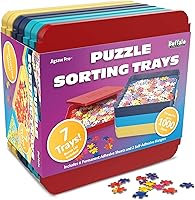
Sorting trays keep loose pieces separate from connected sections, making pack-up simpler. They also let you preserve color or shape groups without spreading everything across the mat.
The Pohxev Roll-Up Mat, 48 by 31 Inches has a smooth polyester top, a rubber bottom, and 6 sorting trays. Its actual dimensions are 48 by 30.7 in, with capacity described as up to 2,000 pieces.
Choose Pohxev if you want a larger work area and several sorting groups. Its rubber base suits a setup where you want grip against the table while moving sections across the top.
Skip it if your table cannot support the whole mat or you lack room beside it for trays. Before carrying sorted pieces, put them in containers that close securely.
How do you set up and roll a puzzle mat?
Start flat, prepare the tube, and roll slowly with the puzzle fully inside the mat's edges. Follow the instructions for your mat's core and fasteners.
Before assembly, clear crumbs and grit from the table and smooth the mat out. Check that it lies flat so you aren't building across a ridge.
- Inflate or assemble the core before you need to pack away.
- Move loose pieces into trays or a closed container.
- Check that no pieces overlap and no sections hang off the mat.
- Position the tube straight across the starting edge.
- Roll with light, even pressure across the width.
- Secure the bands or straps without crushing the roll.
- Place it somewhere protected from pressure and falls.
If you feel a bump, unroll enough to check it. Tightening straps over an overlapping piece can press that piece against the puzzle beneath it.
To resume, lay the roll on a clear table, remove the fasteners, and unroll slowly. Flatten the mat before moving sections, then check for separated joins.
For handling a firm surface instead, read how to use a puzzle board. A board still needs support when you lift or rotate it.
What size puzzle mat should you buy?
Buy by finished puzzle dimensions, then check the mat against your table and storage space. Piece count is only a rough guide because puzzle shapes and piece sizes vary.
Leave some clear space around the puzzle for handling. A puzzle that reaches the very edge leaves little room to straighten sections before rolling.
The Becko Roll-Up Mat with Storage Bag measures 46 by 26 in and holds puzzles up to 1,500 pieces. Check both puzzle dimensions, especially for panoramic designs.
Choose Becko if your puzzle fits and you want a felt mat with bag storage. Skip it if you prefer a core that needs no inflation or want sorting trays included.
To inflate its tube, squeeze the valve to open the slit before blowing air in. Check that the tube holds its shape before wrapping the puzzle around it.
Also measure where the roll will go. Compact storage still needs enough length for the tube, without forcing the bundle into a tight gap.
Is felt or a smooth puzzle mat better?
Choose felt for a grippy working surface, or a smooth top if you often slide assembled sections. More grip can help pieces stay put, but it can also make repositioning them harder.
Lift a section carefully if it catches rather than dragging it until joins separate. On any surface, move larger sections in small steps instead of pushing from one corner.
The Buffalo Games Roll-Up Puzzle Mat uses thick felt and includes a solid expandable tube reaching 34.5 in, plus 3 Velcro straps. Its work surface measures 44 by 26 in and accommodates puzzles up to 1,500 pieces.
Choose Buffalo Games if you want felt with a core that needs no inflation. Skip it if you need a wider work area or prefer the feel of a smooth polyester top.
An expandable core still needs proper assembly before use. Check its joints and follow the directions rather than assuming a solid tube needs no preparation.
Can you carry a rolled puzzle mat?
Yes, a secured puzzle mat can be carried, but support the roll and handle it gently. A carrying bag helps contain the bundle; it doesn't stop all movement inside.
The ropoda Roll-Up Mat, 46 by 26 Inches combines a polyester surface with a natural rubber base. It includes a foam roller, 3 hook-and-loop straps, 4 sorting trays, and a bag with a shoulder strap.
Choose ropoda if carrying between locations is part of your routine and you want trays included. Skip it if you mainly need a rigid surface to carry an open puzzle between rooms.
Keep the bundle away from heavy bags and other objects that could press against it. Store loose pieces separately in a closed container during travel.
For more storage options, including keeping work flat, read how to store unfinished puzzles.
How do you care for a puzzle mat?
Keep the surface clean and dry, and follow its care instructions before using water or cleaning products. Felt and rubber-backed mats may need different treatment.
Remove pieces before cleaning, then gently brush away dry debris. Avoid soaking or machine washing unless the instructions allow it, and let any damp area dry fully before putting the puzzle back.
Store the empty mat rolled rather than forcing folds into it. Keep its tube and fasteners together so you can pack away without searching for a missing part.
A rolled mat also needs protection from pets and spills. Store it out of reach rather than relying on the storage bag as a protective case.
Which puzzle mat should you choose, and when should you skip one?
Puzzle mats work when saving storage space is worth a careful pack-up step. Pick by fit first, then choose the surface, core, and accessories that match your routine.
- Choose Becko for felt, bag storage, and an inflatable core you don't mind preparing.
- Choose Pohxev for the larger work area and 6 sorting groups.
- Choose Buffalo Games for felt with a solid expandable core.
- Choose ropoda for a foam roller, sorting trays, and shoulder-strap carrying.
Skip a mat if you want to keep every section flat or move an open puzzle often. Compare puzzle boards with drawers and covers for a firm surface with separate piece storage.
If loose pieces are your main pack-up problem, start with how to sort puzzle pieces with trays. For the wider choice of work surfaces, see the puzzle tables and boards guide.
Frequently asked questions
Do puzzle mats keep pieces in place?
Puzzle mats help hold connected sections during storage, but pieces can still shift as the mat bends around its tube. Roll slowly with even pressure, secure the fasteners, and support the roll during moves; choose a rigid board if you need to keep the puzzle flat between sessions.
Can you roll up a puzzle mat with loose pieces on it?
You can, but storing loose pieces separately reduces the chance of movement and overlap inside the roll. Put them in trays or a closed container before rolling your connected sections; keep pieces in a single layer, and stop if you feel a lump rather than tightening the roll around it.
Are puzzle mats better than puzzle boards?
Puzzle mats suit compact storage, while boards suit frequent moves with the puzzle kept flat. A mat needs a table or another firm surface during assembly and careful rolling afterward; choose a board if you want to carry the entire work surface between rooms without rolling it each time.
What size puzzle mat do I need?
Choose a mat larger than your puzzle's finished length and width, with space around the edges for handling. Check the dimensions on the puzzle box instead of relying on piece count; also measure your table, since a mat that fits the puzzle still needs a fully supported work surface.