11 Best Puzzle Boards with Drawers and Covers (November 2026)
The best puzzle boards with drawers and covers include the ALL4JIG 1500 Rotating Board for regular puzzle nights, the ALL4JIG 2000 Rotating Board for ambitious puzzle projects, and the Playboda 1500 Rotating Board for easy cleanup.
On this page (9 sections)
- How we chose puzzle boards with drawers and covers
- Compare puzzle boards by size, drawers and cover
- The best puzzle boards with drawers, reviewed
- How do you choose the best puzzle board with drawers?
- Does a cover protect a puzzle during storage?
- Should you choose rotation, tilt or both?
- What size puzzle board fits your puzzle?
- How should you set up and care for a drawer board?
- Which puzzle board with drawers should you choose?
The best puzzle board with drawers for most puzzlers is the ALL4JIG 1500 Rotating Board, 6 Drawers. It balances separate sorting spaces with a covered, rotating assembly area without requiring the footprint of a 2000-piece board.
Choose a larger board for bigger puzzles, smooth plastic for easy cleanup, or a tilting model if you prefer an angled workspace. Start with your puzzle's finished measurements, then check where the board will sit and how you'll store it.
Our guide to puzzle board features worth paying for explains which extras earn their place in a daily setup.
Our picks at a glance
-
1
 Best for regular puzzle nights
ALL4JIG 1500 Rotating Board, 6 Drawers
9.1/10 our score
See it on Amazon -
2
Best for ambitious puzzle projects
ALL4JIG 2000 Rotating Board, 6 Drawers
9.0/10 our score
See it on Amazon -
3
 Best for easy cleanup
Playboda 1500 Rotating Board, Drawers and Cover
8.9/10 our score
See it on Amazon
- 4
 Check it
ALL4JIG 2000 Rotating Board, 4 Drawers
Best for broad-group sorters - 5
 Check it
WELGEE 1500 Tilt and Rotate Board
Best for changing work angles - 6
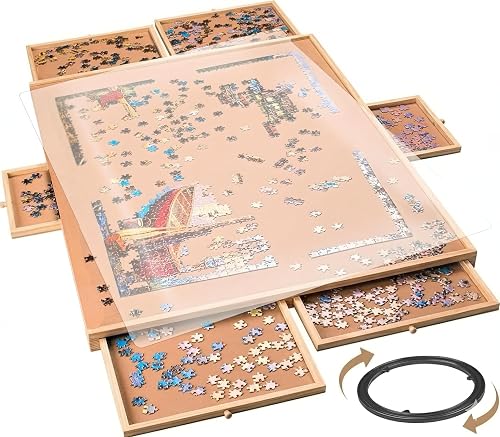 Check it
FUNbelievable 1500 Rotating Board
Best for detailed color sorting - 7Check it
ALL4JIG 1000 Rotating Board, 6 Drawers
Best for smaller puzzle projects - 8
 Check it
Playboda 1000 Rotating Board, Drawers and Cover
Best for compact shared tables - 9
 Check it
Playboda 1500 Tilt and Rotate Board
Best for angled felt puzzling - 10
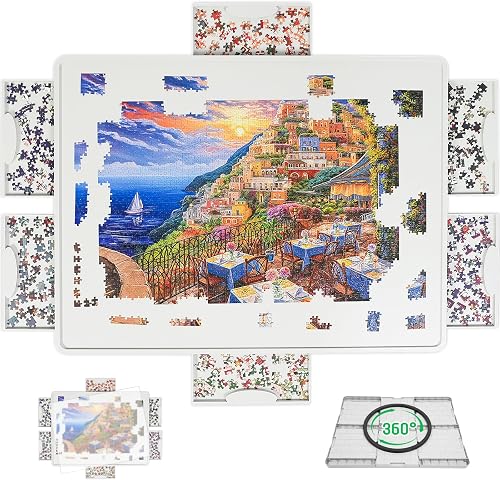 Check it
BuilderButler 1500 Lightweight Board
Best for frequent table clearing - 11
 Check it
Bits and Pieces Original Rotating Board, 1500
Best for framing finished puzzles
How we chose puzzle boards with drawers and covers
We compared usable dimensions, sorting options, cover styles, materials and movement features. The strongest choices pair enough assembly space with storage you can use without crowding your table.
The order favors a useful mix of these features rather than drawer count alone. A smaller board can be the better buy if it fits your usual puzzles and is easier to keep within reach.
Compare puzzle boards by size, drawers and cover
Choose the right work area first, then compare drawers and covers. A board labeled for your puzzle's piece count can still be too narrow for its finished shape.
| Product | Best for | Puzzle size | Organization | Cover and movement | Our score |
|---|---|---|---|---|---|
| ALL4JIG 1500 Rotating Board, 6 Drawers | regular puzzle nights | Up to 1500 pieces | 6 sliding drawers | Translucent cover; 360-degree rotation | 9.1 |
| ALL4JIG 2000 Rotating Board, 6 Drawers | ambitious puzzle projects | Up to 2000 pieces | 6 sliding drawers | Translucent cover; 360-degree rotation | 9.0 |
| Playboda 1500 Rotating Board, Drawers and Cover | easy cleanup | Up to 1500 pieces | 4 sliding drawers | Natural rubber mat cover; 360-degree rotation | 8.9 |
| ALL4JIG 2000 Rotating Board, 4 Drawers | broad-group sorters | Up to 2000 pieces | 4 sliding drawers | Translucent cover; 360-degree rotation | 8.8 |
| WELGEE 1500 Tilt and Rotate Board | changing work angles | Up to 1500 pieces | 4 slide-out drawers | Natural rubber mat cover; tilts and rotates | 8.7 |
| FUNbelievable 1500 Rotating Board | detailed color sorting | Most puzzles up to 1500 pieces | 6 storage drawers | Plastic cover; rotating mechanism | 8.7 |
| ALL4JIG 1000 Rotating Board, 6 Drawers | smaller puzzle projects | Up to 1000 pieces | 6 sliding drawers | Translucent cover; 360-degree rotation | 8.6 |
| Playboda 1000 Rotating Board, Drawers and Cover | compact shared tables | Most 1000-piece puzzles | 4 built-in drawers | Natural rubber mat cover; 360-degree rotation | 8.6 |
| Playboda 1500 Tilt and Rotate Board | angled felt puzzling | Up to 1500 pieces | 4 drawers | Natural rubber mat cover; tilts and rotates | 8.5 |
| BuilderButler 1500 Lightweight Board | frequent table clearing | Up to 1500 pieces | 6 sliding drawers | Translucent cover; 360-degree rotation | 8.1 |
| Bits and Pieces Original Rotating Board, 1500 | framing finished puzzles | Up to 1500 pieces | 4 sliding drawers | Clear PVC cover; 360-degree rotation with spinner | 8.0 |
The best puzzle boards with drawers, reviewed
The ALL4JIG 1500 with six drawers is the starting point for most buyers. The alternatives below suit larger puzzles, different sorting habits and specific surface preferences.
ALL4JIG 1500 Rotating Board, 6 Drawers: Best for regular puzzle nights
- Fits up to 1500 pieces
- Six sliding drawers
- Translucent cover
- 360-degree rotation
- Wood
A balanced choice for regular puzzlers who want several sorting groups without moving to a larger board.
Pros
- Six separate sorting spaces
- Translucent cover keeps progress visible
- Rotation brings distant sections closer
Cons
- Finished puzzle must fit within 24.92 x 33.58 in
Choose this ALL4JIG if your usual puzzle fits a 24.92 x 33.58 in work area and you like separating pieces into several groups. Six drawers let you keep similar colors apart without spreading extra containers across the dining table.
For a landscape, you could separate sky, foliage, buildings, water, edges and uncertain pieces. That arrangement leaves the main surface available for connected sections rather than loose-piece piles.
The wood board has a translucent cover and full rotation. It suits regular sessions where you want to stop with your sorting intact and return to the same project later.
Skip it if your finished puzzle nearly fills either dimension or you expect to move into much larger projects. Also measure your storage route: fitting beneath a bed is useful only if you can carry the board there horizontally.
ALL4JIG 2000 Rotating Board, 6 Drawers: Best for ambitious puzzle projects
- Fits up to 2000 pieces
- Six sliding drawers
- Translucent cover
- 360-degree rotation
- Wood
Choose this larger board for big puzzles that benefit from several separate sorting groups.
Pros
- Large assembly area
- Six drawers for detailed sorting
- Cover and rotating base included
Cons
- Needs substantial table space and turning clearance
Choose the larger ALL4JIG for big projects that need both assembly room and several sorting categories. Its 28.5 x 40.16 in work area gives it more room than the top pick, while keeping the same drawer count.
It also makes sense for a smaller puzzle if you deliberately want spare space for building separate sections. That benefit requires a table large enough to support the board and leave room for turning it.
The wood construction, translucent cover and rotating base suit projects that stay in progress across many sessions. Rotation is especially useful when the far edge would otherwise be difficult to reach.
Skip this size if most of your puzzles are small and your table serves other daily tasks. Extra board area becomes a chore if you must repeatedly carry it through a narrow room or clear furniture before each session.
Playboda 1500 Rotating Board, Drawers and Cover: Best for easy cleanup
- 35 x 27 in surface
- Four sliding drawers
- Natural rubber mat cover
- 360-degree rotation
- ABS plastic
A smooth plastic work surface suits puzzlers who want to wipe away dust and keep their sorting simple.
Pros
- Waterproof plastic work surface
- Tool-free removable rotating base
- Warm-white background
Cons
- No tilt function
Playboda's flat 1500-piece model is the choice for smooth plastic and simple cleanup. Its 35 x 27 in surface is ABS plastic, with a warm-white background and four drawers for broad sorting groups.
That setup suits a puzzler who separates pieces into a few categories, then sorts more closely as the image develops. A natural rubber mat cover lets you pause without clearing the assembly area.
The 18 in rotating base can be installed or removed without tools. Keep your setup consistent during a project so the board's position and height do not change unexpectedly between sessions.
Choose this over the tilting models if you prefer working flat and want fewer moving parts to adjust. Skip it if angled viewing is a priority or you regularly need more than four separate sorting compartments.
ALL4JIG 2000 Rotating Board, 4 Drawers: Best for broad-group sorters
- Fits up to 2000 pieces
- Four sliding drawers
- Translucent cover
- 360-degree rotation
- Wood
A large work area suits puzzlers who separate pieces into a few broad groups rather than many small categories.
Pros
- Same stated work dimensions as the six-drawer 2000 model
- Translucent cover included
- Rotates for access from different sides
Cons
- Fewer sorting compartments than the six-drawer version
This ALL4JIG suits large-puzzle buyers who use a few broad sorting groups. Its stated work dimensions match the six-drawer 2000-piece version, so choosing four drawers does not mean choosing a smaller assembly area.
Use the compartments for major regions of the image, then subdivide pieces on the board as space opens. It is a sensible approach for puzzles with clear sections, such as a building against sky and trees.
The wood surface, translucent cover and rotation provide the same basic workflow as the larger six-drawer option. Your decision between them should center on sorting habits rather than puzzle capacity.
Skip this version if you already find four categories restrictive. You would gain little by choosing a large board and immediately surrounding it with extra trays because the drawer layout does not match how you work.
WELGEE 1500 Tilt and Rotate Board: Best for changing work angles
- 35 x 27 in surface
- Four slide-out drawers
- Natural rubber mat cover
- Tilts and rotates
- ABS plastic
Choose WELGEE if you want an angled assembly surface and smooth plastic that wipes clean.
Pros
- Tilt and rotation in one board
- Waterproof work surface
- Warm-white background
Cons
- Tilt adds a setup step when changing positions
WELGEE suits puzzlers who want an angled view and a smooth plastic surface. It combines tilt and rotation with a 35 x 27 in work area, four drawers and a natural rubber mat cover.
Tilt changes how you see the image; rotation changes which section sits nearest your hands. Together, they give you more ways to position the puzzle without moving your chair around the table.
The waterproof surface can be wiped with a damp cloth after the puzzle is removed. That makes it a better match for easy surface care than a fabric-covered assembly area.
Skip it if you usually build flat and have no reason to change the angle. Start with a shallow tilt, check that loose pieces remain where you place them, and lower the board before covering or moving it.
FUNbelievable 1500 Rotating Board: Best for detailed color sorting
- Fits most puzzles up to 1500 pieces
- Six storage drawers
- Plastic cover
- Rotating mechanism
- Wood
Six sorting spaces suit color-heavy puzzles, with raised edges around a 35 x 26 in workspace.
Pros
- Six drawers for separate piece groups
- Raised edges around the workspace
- Clear plastic cover
Cons
- Finished puzzle must measure under 35 x 26 in
FUNbelievable suits detailed sorting on a wood board, especially when you want separate color or pattern groups. Its six drawers support that approach, while raised edges surround the assembly area.
The finished puzzle must measure under 35 x 26 in. Leave some spare room if you like building small sections outside the border before connecting them to the main image.
The clear plastic cover keeps the project visible during a pause. Rotation lets another person bring a preferred section closer without exchanging seats, which suits shared puzzle sessions.
Skip it if your puzzle needs the extra short-side room available on some other boards here. FUNbelievable describes vertical storage when the board is not in use, but keep an unfinished project horizontal so loose pieces and connected sections do not shift.
ALL4JIG 1000 Rotating Board, 6 Drawers: Best for smaller puzzle projects
- Fits up to 1000 pieces
- Six sliding drawers
- Translucent cover
- 360-degree rotation
- Wood
A smaller assembly area keeps the six-drawer sorting layout for puzzlers who usually choose 1000-piece projects.
Pros
- Several sorting groups on a smaller board
- Cover and rotation included
- Wood construction
Cons
- Limited room for moving up to larger puzzles
Choose this smaller ALL4JIG if you mostly build compatible 1000-piece puzzles and still want several sorting categories. Its work area measures 22.44 x 30.16 in, so check both finished dimensions before committing.
The smaller assembly area is useful when you do not want a larger board occupying the table throughout a project. Six drawers let detailed sorting happen beside the puzzle rather than across the remaining tabletop.
It retains the wood construction, translucent cover and rotation of the larger ALL4JIG options. That makes the choice mainly about how much assembly room your regular puzzles require.
Skip it if you buy puzzles in many formats or expect to move up in size soon. A board that barely fits your current project leaves little room for building separate sections, even when its drawers keep loose pieces contained.
Playboda 1000 Rotating Board, Drawers and Cover: Best for compact shared tables
- 30 x 22 in inner work surface
- Four drawers
- Natural rubber mat cover
- 360-degree rotation
- ABS plastic
A compact plastic option for compatible puzzles, with a rubber mat cover for pauses between sessions.
Pros
- Waterproof, wipe-clean surface
- Removable rotating base
- Four sorting drawers
Cons
- Does not fit White Mountain and Springbok 1000-piece puzzles measuring 24 x 30 in
Playboda's smaller plastic model suits a shared table where a larger board would take over. Its 30 x 22 in inner work area fits many 1000-piece puzzles, with four drawers for keeping broad groups off the assembly surface.
It does not fit White Mountain and Springbok 1000-piece puzzles measuring 24 x 30 in. Turning those puzzles sideways will not solve the mismatch because one side still exceeds the usable area.
The smooth waterproof surface suits buyers who want easy cleanup, and the rubber mat cover is useful between sessions. The rotating base can also be removed without tools.
Choose it if your current puzzle collection fits and you expect to stay with that format. Skip it for oversized pieces or varied puzzle shapes unless you have checked each finished size, since the piece count alone is not enough.
Playboda 1500 Tilt and Rotate Board: Best for angled felt puzzling
- 35 x 27 in surface
- Four drawers
- Tilts and rotates
- ABS plastic
- Felt work surface and black cover
This model suits puzzlers who want a felt assembly surface when working at an angle.
Pros
- Tilt and rotation
- Felt surface intended to limit sliding
- Black rubber mat cover
Cons
- Felt needs different care from smooth plastic
Choose this Playboda if you want felt beneath the pieces while working at an angle. It has an ABS plastic structure, a 35 x 27 in assembly area, four drawers and a black rubber mat cover.
Playboda says the felt helps prevent pieces from sliding when tilted. That makes the surface the main reason to choose it over the smooth WELGEE, rather than tilt or rotation alone.
The gray drawers have retention features intended to keep them in place when the board is lifted. Still, close them before changing the board's position and keep unfinished work level during a move.
Skip it if wipe-clean assembly space is your main priority. A plastic frame does not make the felt surface waterproof, so keep glue and damp cleaning methods away from the fabric unless the care instructions allow them.
BuilderButler 1500 Lightweight Board: Best for frequent table clearing
- Fits up to 1500 pieces
- Six sliding drawers
- Translucent cover
- 360-degree rotation
- Plastic
Drawer retention slots make this worth considering when your puzzle board regularly moves between a table and storage.
Pros
- Six drawers with retention slots
- Gray plastic work surface
- Translucent cover
Cons
- Weighs 5.65 kg despite its lightweight name
BuilderButler is worth considering if you regularly clear the table and want drawer retention slots. They are designed to keep its six drawers from falling out during transport, though you should still close every drawer before lifting.
The gray plastic surface measures 34.25 x 25.98 in. It suits compatible puzzles and buyers who prefer a darker background than the warm-white plastic options.
Its translucent cover lets you see the project while it is put aside. Rotation provides access to different sides when the board is back on the table.
Do not choose it on the lightweight name alone: it weighs 5.65 kg. Skip it if lifting that load while keeping a broad board level would be difficult, or if your puzzle needs a wider usable surface.
Bits and Pieces Original Rotating Board, 1500: Best for framing finished puzzles
- 26 x 35 in work area
- Four sliding drawers
- Clear PVC cover
- 360-degree rotation with spinner
An open side gives finished puzzles a route off the board when you're ready to preserve or frame them.
Pros
- Open side for puzzle removal
- Four sorting drawers
- Clear PVC cover
Cons
- Also sold without a spinner
- 7.35 kg weight matters for frequent lifting
Bits and Pieces suits puzzlers who plan to remove finished work for preservation. Its open side provides a route for sliding a completed puzzle onto a suitable support rather than lifting it over a raised edge.
The wood board has a 26 x 35 in work area, four drawers and a clear PVC cover. Keep the open side away from the table edge, especially while rotating or moving loose sections.
The rotating configuration uses a Lazy Susan spinner, but a version without the spinner is also sold. Choose the configuration that includes rotation if reaching from different sides is part of your plan.
Skip it for frequent solo carrying if its 7.35 kg weight would be awkward. The open side helps with removal, but a loose finished puzzle still needs support beneath it before you transfer it for gluing or framing.
How do you choose the best puzzle board with drawers?
Choose by fit, sorting style and storage route, in that order. Covers and movement features matter after you know the board can hold your puzzle and work in your room.
Match a puzzle board with drawers to your space
Measure the finished puzzle against the usable assembly area, not the outer frame. A little spare room helps you place border pieces and build sections without crowding the edge.
Next, measure the table, the drawer-opening space and the area swept by rotating corners. A rectangular board can sit neatly on a table but hit a wall or lamp when turned.
Finally, check where it will go between sessions. Include handles, the rotating base and any folded tilt support when measuring storage clearance.
Choose compartments around your sorting habits
Four drawers suit broad groups such as edges, sky, foreground and buildings. Six make sense when you prefer separating several shades, patterns or small image regions from the start.
More drawers do not automatically mean more total storage volume. Choose a layout that supports your habits rather than assuming every loose piece will fit face up inside it.
For practical grouping methods, read how to sort puzzle pieces with trays, lids and drawers.
Does a cover protect a puzzle during storage?
A cover helps keep dust and casual contact away from unfinished work. Clear and translucent covers keep progress visible, while an opaque mat hides the image between sessions.
None should replace a sensible storage location. Keep the covered board away from drinks, heavy objects and places where pets can climb onto it.
A cover also does not turn the board into a sealed carrying case. Carry unfinished puzzles flat, and reserve upright storage for an empty board unless the instructions clearly permit otherwise.
For longer pauses, how to store jigsaw puzzles, finished or not covers the next storage decisions.
Should you choose rotation, tilt or both?
Choose rotation for reach and tilt for viewing angle. A flat rotating board is enough if you mainly want to bring the far side closer.
Tilt is worth considering if you prefer seeing the image on a slope. It also changes how loose pieces behave, so surface grip matters more than it does on a flat board.
Close drawers before rotating, and turn slowly enough to watch the corners. Lower a tilted board before moving it, rather than carrying the project with its support raised.
Read tilting or rotating puzzle boards if you are deciding which movement you will use most.
What size puzzle board fits your puzzle?
Both finished dimensions must fit inside the usable work area. Piece count describes the puzzle, but it does not set a standard width or height across brands.
Do not assume a larger capacity label leaves sorting room around every puzzle. If you like assembling separate clusters outside the border, allow extra space for that workflow.
A narrow panoramic puzzle also needs its full length supported. Our guide to what size puzzle table fits a 1500-piece puzzle explains how to compare the footprints.
How should you set up and care for a drawer board?
Set the empty board on a firm, level table before opening the puzzle. Check that the base sits securely, drawers open freely and the board can turn without striking anything.
Open each drawer and decide its purpose before sorting. Keep pieces below the drawer rim, since overfilled piles can catch when you close the drawer.
Place the box image where it will not block a drawer or the board's turning path. Leave yourself enough table space for your hands rather than filling every remaining gap with accessories.
For a complete session routine, see how to use a puzzle board: tilt, rotate and cover.
Clean the surface according to its material
Remove cardboard dust between projects with a soft, dry cloth or brush. On smooth waterproof plastic, use a lightly damp cloth and dry the surface before adding another puzzle.
Keep wood dry and avoid soaking seams or drawer runners. For felt, lift loose debris gently and follow the care instructions before using moisture or cleaning products.
Use a separate protective support for glue unless your board's instructions allow direct application. Keep adhesive away from drawers, rotating parts and fabric, even if the main surface tolerates it.
Avoid the mistakes that disrupt progress
Do not force a drawer that catches. Open it carefully and check for a raised piece or an overfilled group before trying again.
Avoid pulling the board across the table by a drawer handle. Support the frame when repositioning it, and prepare the destination before lifting an unfinished puzzle.
Do not carry the board with one hand while opening a door or clearing a shelf. Set up a clear route first, and ask for help if its size makes a level carry awkward.
Which puzzle board with drawers should you choose?
The best puzzle board with drawers is the one that fits your regular puzzles and daily routine. Choose the ALL4JIG 1500 with six drawers for detailed sorting, or its larger version when your finished puzzle needs more room.
Choose flat Playboda for a smooth plastic workspace, WELGEE for smooth plastic with tilt, or the tilting Playboda for felt. For smaller puzzles, compare the compact models before giving up table space to a larger board.
Make the final choice with a tape measure: check the puzzle, tabletop, turning space and storage route. If drawers are only one option you are considering, compare the best puzzle boards before deciding.
Our top 3 picks at a glance
-
1
Best for regular puzzle nights
ALL4JIG 1500 Rotating Board, 6 Drawers
9.1/10 our score
See it on Amazon -
2
Best for ambitious puzzle projects
ALL4JIG 2000 Rotating Board, 6 Drawers
9.0/10 our score
See it on Amazon -
3
Best for easy cleanup
Playboda 1500 Rotating Board, Drawers and Cover
8.9/10 our score
See it on Amazon
Frequently asked questions
What should I check before buying a puzzle board with drawers?
Check the usable work area against your puzzle's finished dimensions, then measure your table and storage space; leave room for drawers to open and corners to swing during rotation. Choose drawer count around your sorting habits, and make sure you can carry the board level if you'll move it often.
Are four or six drawers better for puzzle sorting?
Four drawers suit broad sorting groups, while six suit more colors, patterns or sections; extra compartments help only if you use them consistently. Drawer count does not tell you total storage capacity, so avoid assuming that six drawers will hold more pieces than four on a different board.
Do puzzle board covers protect unfinished puzzles?
A cover helps shield unfinished work from dust and casual contact, but it does not fasten each piece to the board; keep the board horizontal during moves and store it away from spills and pets. Clear covers let you see progress; opaque covers hide the puzzle until your next session.
Should I choose a rotating puzzle board?
Choose rotation if you want to bring distant sections closer while staying in your seat; leave enough clearance for the corners to turn, and close drawers before rotating. Tilt serves a different purpose: it changes the viewing angle, so choose a combined model only if you'll use both functions.


