11 Best Rotating Puzzle Boards (November 2026)
The best rotating puzzle boards include the ALL4JIG 1500 Rotating Board for everyday puzzlers, the ALL4JIG 1500 Rotating Board for detailed sorting, and the ALL4JIG 2000 Rotating Board for complex large puzzles.
On this page (7 sections)
- How we chose rotating puzzle boards
- Compare rotating puzzle boards by size and features
- The best rotating puzzle boards for different needs
- What should you check before buying a rotating puzzle board?
- How should you set up and use a rotating puzzle board?
- How do you care for the board and avoid common mistakes?
- Which rotating puzzle board should you choose?
The ALL4JIG 1500 Rotating Board, 4 Drawers is the best rotating puzzle board for most puzzlers here who want simple sorting and a cover. Choose a larger board for bigger puzzles or Playboda if easy cleanup matters most.
Rotation brings distant sections closer, but the board still needs to fit your puzzle, table and storage spot. Buy around those three spaces before deciding how many drawers you want.
Use our guide to the best puzzle boards to compare other board styles, or see puzzle boards with drawers and covers for more storage choices.
If reaching across the table isn't your main concern, our tilting puzzle board picks cover boards that angle the picture toward you.
Our picks at a glance
-
1

-
2

-
3
Best for complex large puzzles
ALL4JIG 2000 Rotating Board, 6 Drawers
9.0/10 our score
See it on Amazon
- 4
 Check it
Playboda 1500 Rotating Board, Drawers and Cover
Best for frequent cleanup - 5Check it
ALL4JIG 2000 Rotating Board, 4 Drawers
Best for large-puzzle tray users - 6
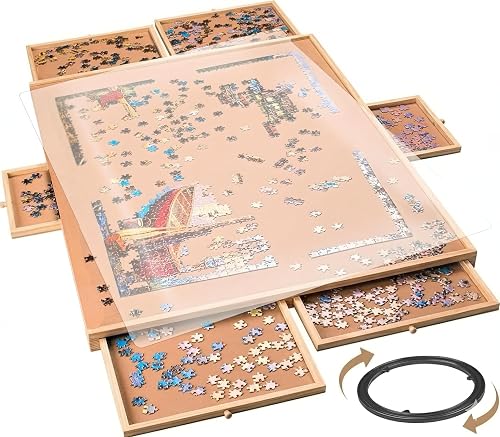 Check it
FUNbelievable 1500 Rotating Board
Best for section-by-section builders - 7Check it
ALL4JIG 1000 Rotating Board, 6 Drawers
Best for smaller-puzzle organizers - 8
 Check it
Beyond Innovations 1000 Rotating Board
Best for quick setup - 9
 Check it
Playboda 1000 Rotating Board, Drawers and Cover
Best for smaller shared tables - 10
 Check it
BuilderButler 1000 Rotating Board
Best for occasional puzzlers - 11Check it
ALL4JIG 1000 Rotating Board, 4 Drawers
Best for compact puzzle routines
How we chose rotating puzzle boards
Puzzle fit and usable organization matter more than the longest feature list. We compared work areas, piece capacities, drawer layouts, materials and covers to identify who each board suits.
A larger board earns its space when you regularly build larger puzzles. Extra drawers help when you actually separate pieces into more groups, rather than leaving most compartments empty.
The recommendations favor practical differences you can plan around. Finish quality and long-term durability aren't reasons to rank one board above another without stronger evidence.
Compare rotating puzzle boards by size and features
Start with puzzle dimensions, then compare sorting space and cleanup needs. A board that can't hold your finished puzzle is the wrong choice, regardless of its score.
| Product | Best for | Puzzle size | Drawers | Cover | Our score |
|---|---|---|---|---|---|
| ALL4JIG 1500 Rotating Board, 4 Drawers | everyday puzzlers | Up to 1500 pieces | 4 | Translucent cover included | 9.2 |
| ALL4JIG 1500 Rotating Board, 6 Drawers | detailed sorting | Up to 1500 pieces | 6 | Included | 9.1 |
| ALL4JIG 2000 Rotating Board, 6 Drawers | complex large puzzles | Up to 2000 pieces | 6 | 9.0 | |
| Playboda 1500 Rotating Board, Drawers and Cover | frequent cleanup | Up to 1500 pieces | Removable natural rubber mat cover | 8.9 | |
| ALL4JIG 2000 Rotating Board, 4 Drawers | large-puzzle tray users | Up to 2000 pieces | 4 | 8.8 | |
| FUNbelievable 1500 Rotating Board | section-by-section builders | Most puzzles up to 1500 pieces | 6 | 8.7 | |
| ALL4JIG 1000 Rotating Board, 6 Drawers | smaller-puzzle organizers | Up to 1000 pieces | 6 | 8.6 | |
| Beyond Innovations 1000 Rotating Board | quick setup | Up to 1000 pieces | 4 | 8.6 | |
| Playboda 1000 Rotating Board, Drawers and Cover | smaller shared tables | Most 1000-piece puzzles | 8.6 | ||
| BuilderButler 1000 Rotating Board | occasional puzzlers | 1000-piece model | 4 | Included | 8.5 |
| ALL4JIG 1000 Rotating Board, 4 Drawers | compact puzzle routines | Up to 1000 pieces | 4 | 8.4 |
Piece capacity is a rough filter, not a fit guarantee. A wide landscape puzzle and a nearly square puzzle can need different work areas despite having the same number of pieces.
The best rotating puzzle boards for different needs
The first ALL4JIG is the balanced choice, while the other picks solve more specific space, sorting or cleanup needs. Read the skip advice as closely as the reasons to buy.
ALL4JIG 1500 Rotating Board, 4 Drawers: Best for everyday puzzlers
- 360° rotating base
- 4 sliding drawers
- Translucent cover
- Wood surface
A balanced choice for regular puzzling, with broad sorting groups and a cover for breaks. Choose it when your puzzle fits and you don't need extra compartments.
Pros
- Separate drawers for broad sorting groups
- Cover included for pauses
- Rounded wood edges
Cons
- Less sorting separation than the six-drawer version
Choose this ALL4JIG if you want an organized place to build without creating a detailed sorting system. Its four drawers work for broad categories such as edges, light pieces, dark pieces and a main picture feature.
The wood board has a translucent cover for pauses and rounded edges. Its advertised puzzle dimensions are 24.92 x 33.58 in, so check the usable area if your finished puzzle comes close to those limits.
This is a sensible middle format for someone moving between smaller puzzles and larger weekend projects. You don't need to choose the biggest board just to keep loose pieces off the dining table.
Skip it if you divide every image into several small groups or regularly tackle puzzles beyond its work area. The next option adds sorting compartments, while the larger models add assembly room.
ALL4JIG 1500 Rotating Board, 6 Drawers: Best for detailed sorting
- 360° rotating base
- 6 sliding drawers
- Cover included
- Wood surface
Choose this version if you separate similar colors, patterns and picture sections before building. The extra compartments change your sorting options, not the puzzle capacity.
Pros
- More separate sorting groups
- Handled drawers
- Cover included
Cons
- Extra drawers don't add assembly space
Choose the six-drawer version if your sorting habits are already more detailed. A scene with buildings, sky, trees, water and lettering can benefit from keeping those groups apart from the edges.
Its six compartments give you more separate categories than the first pick, without moving up to a larger puzzle format. That makes it a better match for careful sorters than for buyers who simply want more assembly space.
Assign each drawer a clear purpose before emptying the box. If two groups become hard to tell apart, change the categories rather than spending each session searching through both.
Skip this version if you usually sort only edges and everything else. More compartments won't make that routine better, and drawers don't automatically provide room to lay every loose piece face up.
ALL4JIG 2000 Rotating Board, 6 Drawers: Best for complex large puzzles
- Up to 2000 pieces
- 360° rotating base
- 6 sliding drawers
- Cover included
A larger assembly area and several sorting compartments suit big puzzles with distinct picture sections. Choose it only if your table and storage spot can handle the larger footprint.
Pros
- Larger puzzle format
- Several separate sorting spaces
- Cover included
Cons
- Needs substantial turning and storage room
Choose this larger ALL4JIG for big puzzles with several distinct sections. The advertised puzzle dimensions are 28.5 x 40.16 in, paired with six drawers to keep loose groups away from the build area.
It makes sense for a puzzler who regularly needs both the larger surface and more sorting categories. Occasional large-puzzle plans are a weaker reason to keep a big board on a shared table.
Before buying, mark its footprint on your table and check where the corners will travel. A board that fits while straight can still bump a wall, lamp or chair as it turns.
Skip it if your storage route includes tight doorways or an awkward lift under furniture. For more planning help, the 2000-piece puzzle table guide covers the space a larger setup needs.
Playboda 1500 Rotating Board, Drawers and Cover: Best for frequent cleanup
- ABS plastic board
- 4 sliding drawers
- Removable cover
- 360° rotating base
The plastic surface suits puzzlers who want to wipe away puzzle dust or switch between puzzles and games. A warm white background also gives pieces a plain backdrop.
Pros
- Damp-cloth cleanup
- Natural rubber mat cover
- Base removes without tools
Cons
- Four drawers offer fewer groups than six-drawer alternatives
Choose the Playboda 1500 if cleanup is a regular part of your routine. Its ABS plastic surface can be wiped with a damp cloth, making it useful for clearing puzzle dust between projects.
The warm white background gives pieces a plain backdrop. Playboda describes it as non-glaring, though your lamp position will still affect how easily you can see shiny puzzle pieces.
This model has a natural rubber mat cover and a removable rotating base. The base attaches and comes off without tools, which helps when you need to separate those parts for storage.
Skip it if several separate sorting groups matter more than material choice. Its four drawers handle broad categories, but the six-drawer alternatives better suit a detailed sorting routine.
The advertised board size is 35 x 27 in. Confirm the usable area for a close-fitting puzzle rather than treating the full footprint as guaranteed assembly space.
ALL4JIG 2000 Rotating Board, 4 Drawers: Best for large-puzzle tray users
- Up to 2000 pieces
- 360° rotating base
- 4 sliding drawers
- Cover included
Choose this larger board when you already use sorting trays or prefer a few broad groups. It keeps the same puzzle format as the six-drawer alternative.
Pros
- Large assembly area
- Broad sorting compartments
- Translucent cover included
Cons
- Large footprint despite fewer drawers
Choose this ALL4JIG if you need a large build area but already sort in trays. It offers the same advertised puzzle dimensions as the larger six-drawer ALL4JIG, with fewer built-in compartments.
That makes it a practical match for someone who likes to spread groups beside the board. The drawers can hold edges and pieces for the current section while your existing trays handle the rest.
It also suits broad sorting, such as separating a landscape into sky, ground, buildings and remaining pieces. More drawers aren't necessary when those categories match how you build.
Skip it if you expect fewer drawers to solve a tight-space problem. The large surface still needs turning clearance, and external trays add to the total table space you use.
If you want all your categories stored within the board, choose the six-drawer model instead.
FUNbelievable 1500 Rotating Board: Best for section-by-section builders
- 35 x 26 in workspace
- 6 storage drawers
- Protective cover
- 360° rotation
A defined workspace and separate drawers suit builders who divide an image into sections. Your finished puzzle must measure under 35 x 26 in.
Pros
- Clear workspace dimensions
- Raised edges
- Clear protective cover included
Cons
- Some 1500-piece puzzles exceed its workspace
Choose FUNbelievable if you build one picture section at a time and want a clearly stated workspace limit. Its 35 x 26 in work area fits many puzzles in its intended size range.
The finished puzzle must measure under both limits. Turning the puzzle can help only when the two dimensions fit in the opposite orientation.
Six drawers let you separate image sections before assembling them, and raised edges help contain loose pieces near the border. Keep some empty surface available if you like building small clusters before joining them.
Skip it if your finished puzzle fills nearly the entire workspace and you dislike using separate trays. A technical fit may still leave too little room for your preferred method.
Use the clear cover for pauses, and keep an unfinished puzzle flat during storage rather than assuming the cover holds every piece in place.
ALL4JIG 1000 Rotating Board, 6 Drawers: Best for smaller-puzzle organizers
- Up to 1000 pieces
- 360° rotating base
- 6 sliding drawers
- Cover included
This smaller format keeps several sorting compartments for color-heavy or detailed puzzles. Choose it for puzzles that fit, rather than buying a larger board solely for more drawers.
Pros
- Several groups in a smaller format
- Handled drawers
- Cover included
Cons
- Less assembly room than the larger ALL4JIG options
Choose this smaller ALL4JIG if you enjoy detailed sorting without large puzzles. It keeps six drawers in a format intended for 1000-piece projects, so organization doesn't require buying the larger models.
Its advertised puzzle dimensions are 22.44 x 30.16 in. Compare both sides with your usual puzzle boxes, particularly if you favor wide scenes or unusually large pieces.
A useful sorting plan might separate edges, lettering, buildings, foliage, sky and unassigned pieces. Leave the last group flexible so uncertain pieces have a place without muddling the clearer categories.
Skip it if you're likely to move into larger puzzles soon. More drawers won't compensate for a work area that is too small.
It also offers little benefit over a simpler model if you prefer to spread all loose pieces together and search by shape.
Beyond Innovations 1000 Rotating Board: Best for quick setup
- Up to 1000 pieces
- 360° rotating base
- 4 sliding drawers
- Removable transparent cover
A pre-installed rotating base makes this a straightforward choice for starting a puzzle. The lacquered wood surface comes with drawers and a removable transparent cover.
Pros
- Pre-installed rotating base
- Lacquered natural wood
- Transparent cover included
Cons
- Usable workspace needs confirmation for a close-fitting puzzle
Choose the Beyond Innovations board if you want a pre-installed turning base and a straightforward wood setup. It combines a lacquered natural wood surface with four drawers and a removable transparent cover.
This is a reasonable match for puzzlers who separate a few broad groups and want to start with minimal assembly. Confirm the usable work area for your puzzle because the available size descriptions differ.
Its 9 lb weight is worth considering if you plan to move it often. A wide board can be awkward to carry even when its weight sounds manageable.
Skip it if you need an especially easy carry or want several extra sorting compartments. Plan the route from your table to the storage spot before placing an unfinished puzzle on it.
Lift from the board's structure with both hands, rather than pulling on a drawer handle.
Playboda 1000 Rotating Board, Drawers and Cover: Best for smaller shared tables
- ABS plastic surface
- 4 built-in drawers
- Removable cover
- 360° rotating base
A smaller plastic option for shared tables where a larger board would be awkward. Its work surface excludes 24 x 30 in Springbok and White Mountain puzzles.
Pros
- Damp-cloth cleanup
- Removable rubber mat cover
- Base lifts off without tools
Cons
- Does not fit 24 x 30 in puzzles
Choose the smaller Playboda if you want a wipe-clean surface for a shared table and your puzzles fit its 30 x 22 in workspace. The warm white top offers the same plain background as the larger plastic option.
The fit restriction is important: it cannot hold the 24 x 30 in Springbok and White Mountain puzzles identified by Playboda. Rotating one of those puzzles won't solve the mismatch because the shorter workspace dimension remains too small.
Four drawers and a rubber mat cover support packing away between sessions. The base lifts off without tools, but carry the board by its structure rather than relying on that removable connection.
Skip it if you regularly build those larger-format puzzles or want room for loose clusters beside the finished outline. The larger Playboda is the better starting point for those needs.
BuilderButler 1000 Rotating Board: Best for occasional puzzlers
- 360° rotating base
- 4 sliding drawers
- Translucent cover
- Wood surface
A straightforward wood option for occasional puzzles that fit its smaller format. Four drawers support broad sorting without requiring a detailed system.
Pros
- Handled sorting drawers
- Rounded edges
- Translucent cover included
Cons
- Smaller format limits puzzle choice
Choose BuilderButler for occasional puzzles and broad sorting when its smaller dimensions fit your projects. The wood board has rounded edges, handled drawers and a translucent cover.
Its advertised puzzle dimensions are 28.74 x 20.94 in. That makes checking the finished puzzle size especially important before committing to this format.
The four drawers suit a simple system such as edges, obvious features, background and uncertain pieces. You can start building a clear section without sorting the entire box into narrow categories.
Skip it if you want room to grow into larger puzzles or often choose puzzles close to its size limit. It is also worth checking whether its 4.99 kg weight suits your planned storage routine.
For someone who must clear the table every evening, an easy lift matters as much as the ability to rotate.
ALL4JIG 1000 Rotating Board, 4 Drawers: Best for compact puzzle routines
- Up to 1000 pieces
- 360° rotating base
- 4 sliding drawers
- Cover included
Choose this smaller ALL4JIG when your usual puzzles fit and a few sorting groups are enough. It avoids buying extra assembly area you won't use.
Pros
- Smaller puzzle format
- Cover included
- Separate sorting drawers
Cons
- Limited spare space around close-fitting puzzles
Choose this ALL4JIG for a small, repeatable puzzle routine: sort a few groups, build a section, cover it and return later. Its advertised dimensions are 20.94 x 28.74 in.
The four-drawer layout suits someone who wants loose pieces contained without maintaining many categories. Its 9.7 lb weight still deserves attention if you expect to carry it after every session.
A smaller board is useful only when it fits the puzzles you actually buy. Check several recent puzzle boxes rather than choosing around one unusually compact example.
Skip it if your current puzzles already approach its edges or you like assembling several loose clusters on the main surface. The next size up gives that working method more room.
Choose the six-drawer smaller ALL4JIG only if sorting separation, rather than surface area, is what you lack.
What should you check before buying a rotating puzzle board?
Check puzzle fit, turning space and storage access before choosing drawer count or material. These decide whether the board will work throughout a project, including the moments when you need the table back.
Will a rotating puzzle board fit your puzzle?
Match the finished puzzle's width and height to the usable assembly area, with a little spare room where possible. Outside dimensions can include a frame or border that the puzzle cannot occupy.
Also think about your building method. A close fit works better when loose pieces stay in drawers or trays than when you build several separate clusters around the border.
For more sizing help, see our guide to puzzle board size and capacity. Don't assume puzzles from different brands have matching dimensions because their piece counts match.
How much room does rotation need?
Allow space for the corners to sweep outward, not just the board's straight edges. A rectangular board takes more room at an angle than it does when aligned with the table.
Mark the expected footprint with paper or removable tape and check the corner path. Include nearby walls, lamp bases, cups and anything hanging over the table.
Leave access for drawers, too. You may need to close them before turning and reopen them once the board is in position.
How many drawers do you need?
Choose four drawers for broad categories or six when your usual puzzles call for more distinct groups. Drawer count tells you how many categories you can separate, not how many pieces will fit face up.
Avoid making a deep pile of pieces that hides most of the group. Shallow groups are easier to scan, even if that means keeping some pieces outside the board.
Our guide to sorting puzzle pieces with trays explains how to divide a puzzle into useful groups. If you already have a tray system, prioritize workspace over extra drawers.
What should you expect from a cover?
Expect a cover to keep dust off between sessions, not to turn the board into a sealed carrying case. Close the drawers and keep the puzzle level when moving it.
Never assume a cover makes an unfinished puzzle safe to store upright. Loose pieces and partly joined sections can shift unless the storage system specifically secures them.
If your main concern is storage, our puzzle board features guide helps you weigh cover styles against your routine.
Should you choose wood or plastic?
Choose plastic for damp-cloth cleanup or wood if you prefer a wood surface and can keep it dry. Avoid choosing by broad claims that one material always lasts longer.
If you plan to glue finished puzzles, use a suitable barrier unless the board and adhesive instructions permit direct use. Protecting the board also makes stray glue easier to manage.
How should you set up and use a rotating puzzle board?
Set the board on a firm, level table, then check its full movement before adding pieces. Arrange the setup so you can reach the near section without leaning your weight onto the board.
Start with an empty-board check
Follow the base assembly instructions and check that everything sits securely. Turn the empty board slowly, open the drawers and place the cover where you'll keep it during a session.
Check your chair position after adding the board's height to the table. If your shoulders rise while working, adjust the seating arrangement before starting a long session.
Rotate toward the section you need
Bring the active section closer with a slow, controlled turn. Close drawers first and keep cups, tools and loose trays out of the corner path.
Avoid repeated full spins just to search for one piece. Finish a small task in the near section, then turn when another area needs attention.
For a fuller setup sequence, read our guide to using a puzzle board.
Pack away without disturbing progress
Choose the storage spot before you start the puzzle. Measure the opening, check the route and clear anything that could snag the board while carrying it.
Move loose pieces into shallow drawer groups, close the drawers and place the cover carefully. Lift level with both hands, getting help if the width or weight makes the move awkward.
How do you care for the board and avoid common mistakes?
Keep dust, moisture and stray pieces away from moving parts, and clean the board between puzzles. Regular clearing is easier than dealing with debris caught around drawer openings or the rotating base.
For wood, remove loose dust first and avoid soaking the surface. For plastic, use the recommended damp-cloth method and dry it before adding cardboard pieces.
Care for the cover separately according to its instructions. A waterproof top doesn't mean the drawers, base and cover can all be washed the same way.
Avoid these common mistakes:
- Buying by piece count alone: compare finished puzzle measurements with usable workspace.
- Choosing the largest board automatically: unused surface still needs turning and storage room.
- Overfilling drawers: leave enough room for them to close without catching pieces.
- Forcing a stiff drawer: check for a trapped piece or obstruction first.
- Leaving drinks in the turning path: place them on a separate surface.
- Lifting by handles or the base: support the board itself with both hands.
If rotation becomes uneven, clear the puzzle area and inspect for debris before using force. Follow the care instructions rather than adding lubricant that could reach puzzle pieces.
Which rotating puzzle board should you choose?
Choose your rotating puzzle board by the constraint that matters most: puzzle dimensions, sorting habits, cleanup or daily storage. Eliminate any model that fails your fit or carrying needs before comparing the remaining features.
Pick the first ALL4JIG for a balanced everyday setup, its six-drawer version for detailed sorting, or a larger model when your puzzles need the extra surface. Existing tray users can choose the larger four-drawer option without adding compartments they won't use.
Choose Playboda when wipe-clean care is the priority, with the smaller model reserved for puzzles within its workspace. Choose a smaller wood board when your regular puzzles fit comfortably and the carrying weight works for you.
If you can reach the puzzle but want it angled toward your eyes, compare tilting or rotating puzzle boards before buying. That decision can matter more to your setup than another drawer or a larger board.
Our top 3 picks at a glance
-
1
-
2
-
3
Best for complex large puzzles
ALL4JIG 2000 Rotating Board, 6 Drawers
9.0/10 our score
See it on Amazon
Frequently asked questions
What is a rotating puzzle board?
A rotating puzzle board is a puzzle surface on a turning base that brings different sections within reach. The boards here turn through a full circle.
It needs a firm table and clear space around its corners, and rotation doesn't replace choosing a comfortable chair and table height.
How do I choose the right rotating puzzle board size?
Match your puzzle's finished width and height to the board's usable workspace, leaving a little spare room where possible. Piece counts don't set a standard finished size.
Also measure the board's turning clearance, drawer access and storage location so it works beyond the assembly stage.
Are rotating puzzle boards with drawers useful?
Drawers are useful when they keep loose pieces off the assembly area and preserve sorting groups between sessions. Four compartments suit broad categories, while six allow more separate sections.
Existing tray users may gain more from the right board size and cover than from extra built-in drawers.
Should I get a rotating board with a cover?
Choose a cover if your puzzle stays out between sessions or you need to reclaim a shared table. It helps keep dust off the work surface.
Keep the board level during moves, and don't assume a cover locks pieces down, secures drawers or makes the whole board waterproof.
Is a wood or plastic rotating puzzle board better?
Choose plastic when damp-cloth cleanup matters most, or wood when you prefer a wood work surface. Playboda describes its ABS surfaces as waterproof and easy to clean.
For either material, puzzle fit comes first, and care for the cover and rotating base may differ from care for the top.


