11 Best Puzzle Boards (November 2026)
The best puzzle boards include the ALL4JIG 1500 Rotating Board for everyday puzzlers, the ALL4JIG 1500 Rotating Board for detailed sorting, and the ALL4JIG 2000 Rotating Board for large puzzle projects.
On this page (9 sections)
- Which best puzzle board fits your puzzling style?
- How do these puzzle boards compare?
- How do you choose the right puzzle board size?
- Is a rotating puzzle board worth it?
- Do drawers and covers make puzzling easier?
- Should you buy a tilting or rotating puzzle board?
- How should you set up and care for a puzzle board?
- Which puzzle board mistakes should you avoid?
- Which puzzle board should you choose?
The best puzzle board for most puzzlers is the ALL4JIG 1500 Rotating Board, 4 Drawers, because it combines turning access, sorting space and covered storage. Choose a different model when your puzzle size, preferred working angle or cleanup needs call for it.
Start with the finished puzzle measurements and the place you'll store the board. Those 2 checks matter more than extra drawers or a larger piece-count label.
Our picks at a glance
-
1

-
2

-
3
Best for large puzzle projects
ALL4JIG 2000 Rotating Board, 6 Drawers
9.0/10 our score
See it on Amazon
- 4
 Check it
Playboda 1500 Rotating Board, Drawers and Cover
Best for shared craft spaces - 5
 Check it
FUNbelievable 1500 Rotating Board
Best for loose-piece containment - 6
 Check it
WELGEE 1500 Tilt and Rotate Board
Best for easy-clean angled puzzling - 7
 Check it
BuilderButler 1000 Rotating Board
Best for smaller-table puzzlers - 8
 Check it
Beyond Innovations 1500 Board, 6 Drawers
Best for ready-to-use gifting - 9
 Check it
ALL4JIG 1500 Tilt and Rotate Board
Best for fabric-surface tilt fans - 10
 Check it
Becko 1500 Tilting Board, 4 Drawers
Best for frequent angle changes - 11
 Check it
Bits and Pieces Original Rotating Board, 1500
Best for finished-puzzle transfers
Which best puzzle board fits your puzzling style?
Choose the 4-drawer ALL4JIG for everyday use, the larger ALL4JIG for bigger projects, or a tilt model for an angled workspace. The other picks address more specific needs, including wipe-clean surfaces, detailed sorting and finished-puzzle transfers.
Our best puzzle board picks, compared
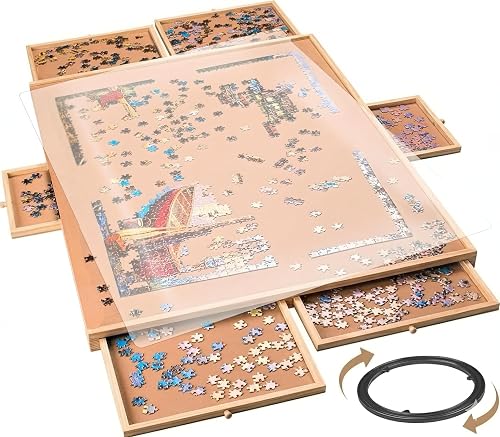
ALL4JIG 1500 Rotating Board, 4 Drawers: Best for everyday puzzlers
- For 1500-piece puzzles
- 360-degree rotation
- 4 drawers
- Translucent cover
Choose this wooden board for a regular puzzling routine that needs turning access, simple sorting and covered storage.
Pros
- Rotates to bring distant sections closer
- Drawers keep sorting groups off the main surface
- Cover shields work between sessions
Cons
- No tilt adjustment
- Requires clearance for turning and opening drawers
The ALL4JIG 1500 Rotating Board, 4 Drawers suits someone who wants to keep one puzzle ready between sessions without building a separate hobby station. Its wooden surface works with a simple sorting routine: edges, background, main subject and pieces you're still deciding about.
Four compartments are enough if you usually build one section at a time. The rotating base brings that section toward you, so you can work from your preferred seat rather than reaching over completed areas.
Use the translucent cover when you pause, then move the board only after clearing the route to storage. Keep both hands beneath the board rather than lifting it by a drawer handle.
Skip this version if you sort an image into many small groups or prefer an angled surface. The next ALL4JIG adds sorting compartments, while the tilt models farther down change how you view the puzzle.
ALL4JIG 1500 Rotating Board, 6 Drawers: Best for detailed sorting
- For 1500-piece puzzles
- 360-degree rotation
- 6 drawers
- Translucent cover
Extra compartments suit puzzlers who separate an image into several colors or sections before building.
Pros
- More separate sorting compartments
- Rotating access from one seat
- Cover included for breaks
Cons
- No tilt adjustment
- Extra drawers add little if you rarely sort
The ALL4JIG 1500 Rotating Board, 6 Drawers is the better choice for a methodical sorter. It gives you 2 more compartments than the top pick, useful when an image has several distinct subjects or color bands.
For a landscape, you might separate sky, water, buildings, foliage, edges and uncertain pieces. Assigning each group a home makes it easier to pause without sweeping loose piles back into the box.
Extra compartments don't mean you should divide every puzzle into tiny categories. If a drawer fills with unrelated pieces, change the sorting plan to match the image rather than forcing the same system onto each project.
Skip this model if you rarely sort before assembling or already have trays you like. For storage-focused alternatives, see our guide to puzzle boards with drawers and covers.
ALL4JIG 2000 Rotating Board, 6 Drawers: Best for large puzzle projects
- For 2000-piece puzzles
- 360-degree rotation
- 6 drawers
- Translucent cover
The larger format suits puzzles that exceed a smaller board's work area, provided your table and storage space can accommodate it.
Pros
- Largest puzzle capacity in this roundup
- Separate drawers for sorting
- Rotates to bring far sections closer
Cons
- Needs a larger working and storage area
- Unnecessary bulk for smaller projects
The ALL4JIG 2000 Rotating Board, 6 Drawers is the choice for projects that outgrow the smaller boards. Its 28.50 x 40.16 in format gives larger puzzles room, subject to checking the usable space inside the edges.
Rotation matters more as the distance across a puzzle grows. Bring the far section toward you instead of resting your arm over loose pieces or stretching across an assembled border.
Before buying, plan the entire route from table to storage. Check narrow gaps beside chairs, the opening beneath your bed and any turn you'll need to make while carrying the board level.
Skip this size if your usual projects fit comfortably on a smaller surface. Spare capacity is useful only when you can support, turn and store the board without making your room harder to use.
Playboda 1500 Rotating Board, Drawers and Cover: Best for shared craft spaces
- For up to 1500 pieces
- Waterproof ABS surface
- 4 drawers
- Rubber mat cover
A wipe-clean surface suits a workspace that switches between puzzles, games and crafts.
Pros
- Waterproof work surface
- Warm white background
- Tool-free removable rotating base
Cons
- No tilt adjustment
- Four compartments may limit detailed sorting
The Playboda 1500 Rotating Board, Drawers and Cover suits a table that alternates between puzzles, games and craft work. Its waterproof ABS surface is the main reason to choose it over a wooden board.
The warm white background provides a plain backdrop for comparing piece colors and shapes. Its 35 x 27 in format also gives you a clear size reference when planning where the board will sit.
The rotating base attaches and removes without tools, which is useful when changing the setup. Keep its attachment points clear of puzzle dust and check that it's seated correctly before turning the loaded board.
Choose this model if wiping the empty surface clean matters more than having fabric beneath your pieces. Skip it if an angled workspace is essential, since this version is for flat use.
FUNbelievable 1500 Rotating Board: Best for loose-piece containment
- Fits most 1500-piece puzzles
- 35 x 26 in workspace
- 6 drawers
- Protective cover
Raised edges and separate sorting drawers suit puzzlers who want to keep loose pieces within a defined workspace.
Pros
- Raised edges around the work area
- Multiple sorting compartments
- Rotating access
Cons
- Puzzle must fit within the stated workspace
- No tilt adjustment
The FUNbelievable 1500 Rotating Board suits puzzlers who want raised edges around loose pieces and several sorting compartments. It's a practical match for images that involve moving small groups around while searching for connections.
Its workspace measures 35 x 26 in, and FUNbelievable advises keeping the puzzle's finished dimensions below those limits. Leave a little working room rather than choosing a puzzle that fills every available inch.
The edge helps contain pieces during normal use, but it isn't a reason to turn the board quickly. Rotate slowly, especially when unfinished clusters sit close to loose pieces.
Skip this board if you need tilt or regularly move finished puzzles straight off an open edge. Store an unfinished project flat even though the empty board can be stored differently; a cover doesn't guarantee that loose pieces will stay arranged upright.
WELGEE 1500 Tilt and Rotate Board: Best for easy-clean angled puzzling
- For most 1500-piece puzzles
- Tilt and rotation
- 4 drawers
- ABS plastic surface
Choose this board when you want an angled workspace and turning access without a fabric-covered surface.
Pros
- Combines tilt and rotation
- Waterproof surface wipes clean
- Rubber mat cover included
Cons
- Confirm the tilt range for a specific angle
- Needs clearance for both movement features
The WELGEE 1500 Tilt and Rotate Board suits someone who wants an angled workspace with easy surface cleanup. It combines those needs without using a fabric-covered work area.
Its 35 x 27 in board has a warm white surface, a rubber mat cover and a folding tilt support. The oversized rotating base lets you change which section faces you as well as how the board sits.
Set the angle before arranging large groups of loose pieces. Begin shallow, check how the pieces behave, and return the surface to flat before changing the support.
Choose WELGEE if you expect to use both movement features. Skip it if you always puzzle flat, or if you need a specific tilt angle that you haven't confirmed.
A waterproof surface also doesn't make the puzzle waterproof. Keep drinks away from the work area and remove cardboard dust before wiping the empty board.
BuilderButler 1000 Rotating Board: Best for smaller-table puzzlers
- For 1000-piece puzzles
- 360-degree rotation
- 4 drawers
- Translucent cover
A smaller-format wooden board suits regular 1000-piece projects without reserving space for larger puzzles.
Pros
- Smaller format than the large-capacity picks
- Sorting drawers with handles
- Cover included for storage
Cons
- Unsuitable for puzzles beyond its work area
- No tilt adjustment
The BuilderButler 1000 Rotating Board suits regular 1000-piece projects on a table where a larger board would dominate the space. Its 28.74 x 20.94 in format makes it a smaller option within this group.
Choose it around the puzzles you actually finish, rather than leaving room for a larger project you may never start. A more manageable setup is easier to bring out for a short evening session.
The hardwood board includes handled sorting drawers and a cover. Keep pieces in shallow groups when possible so you can inspect them without repeatedly emptying a whole drawer.
Skip this model if you often buy panoramic puzzles or expect to move into larger formats. Check your usual puzzle dimensions first, and remember that even a smaller rotating board needs clear space around its corners.
Beyond Innovations 1500 Board, 6 Drawers: Best for ready-to-use gifting
- For 1500-piece puzzles
- Preassembled wooden board
- 6 drawers
- Puzzle saver stickers
Preassembled construction and an included puzzle saver sticker set make this a useful gift for someone who enjoys keeping completed puzzles.
Pros
- Arrives preassembled
- Includes puzzle saver stickers
- Rotating base and sorting drawers
Cons
- 8.02 kg weight matters for frequent moves
- No tilt adjustment
The Beyond Innovations 1500 Board, 6 Drawers suits a gift recipient who wants to start with a preassembled board. Its lacquered wood construction comes with a removable cover and puzzle saver stickers.
The sticker set makes it a more relevant choice for someone who keeps finished pictures rather than immediately taking every puzzle apart. Plan the preservation step before starting so there's a suitable receiving surface ready at the end.
Its 35 x 28 in board dimensions describe the overall format, so check usable space for a puzzle that comes close to those limits. Don't assume the entire outer footprint is available for assembly.
Skip this option if frequent lifting is a priority: its stated weight is 8.02 kg before adding a puzzle. It makes more sense where storage is close to the working table and carrying distance is short.
ALL4JIG 1500 Tilt and Rotate Board: Best for fabric-surface tilt fans
- For 1500-piece puzzles
- Tilt and 360-degree rotation
- 4 drawers
- Oxford cloth surface
An Oxford cloth surface and adjustable support suit puzzlers who prefer fabric beneath their pieces while working at an angle.
Pros
- Tilt and rotation in one board
- Cloth surface adds grip
- Built-in carrying handle
Cons
- Fabric needs different care from wipe-clean plastic
- Confirm usable space for close-fitting puzzles
The ALL4JIG 1500 Tilt and Rotate Board suits puzzlers who prefer fabric beneath their pieces while working at an angle. Its Oxford cloth surface separates it from the plastic WELGEE option.
There are 3 tilt settings, plus a rotating base for bringing different sections closer. The built-in carrying handle helps with repositioning, though a loaded board still needs support beneath it.
Cloth adds grip, so move assembled sections carefully rather than dragging them hard across the surface. Lift a small connected group gently if it catches, and avoid forcing pieces sideways.
Choose this model if you expect to use the slope regularly. Skip it if your main need is a surface you can wipe after messy crafts or glue work.
For the order of setup, angle changes and covering, read our guide to using a puzzle board to tilt, rotate and cover.
Becko 1500 Tilting Board, 4 Drawers: Best for frequent angle changes
- For most 1500-piece puzzles
- 5 tilt adjustments
- 4 colored drawers
- Flannel tabletop and cover
Several defined angles suit puzzlers who like changing the slope of their work surface throughout a session.
Pros
- Multiple tilt positions
- Colored drawers with magnetic closures
- Flannel adds friction beneath pieces
Cons
- No rotating base
- Conflicting usable dimensions need checking for a close fit
The Becko 1500 Tilting Board, 4 Drawers suits someone who wants several defined working angles without a spinning base. It offers 5 positions up to 30 degrees over a flannel-covered surface.
The colored drawers make it easy to remember where you've placed each group. Small magnets help keep them closed, while the pad underneath helps protect the supporting table and limit slipping.
Becko gives conflicting usable dimensions of 35.43 x 24.41 in and 36.4 x 24.6 in. For a puzzle approaching either limit, confirm the actual work area before committing to this board.
Choose it when adjusting the slope matters more than turning the puzzle. Skip it if you mainly want to bring different sides toward your seat, since changing the tilt doesn't replace rotation.
Start with the lowest useful angle and position your chair so your shoulders stay relaxed.
Bits and Pieces Original Rotating Board, 1500: Best for finished-puzzle transfers
- For puzzles up to 1500 pieces
- 26 x 35 in work area
- 360-degree rotation
- 4 drawers and clear cover
An open side gives you a route for moving a finished puzzle onto another surface for preservation.
Pros
- Open side for transferring completed puzzles
- Rotating access
- Separate sorting drawers
Cons
- Open edge needs care around loose pieces
- No tilt adjustment
The Bits and Pieces Original Rotating Board, 1500 suits puzzlers who often preserve completed pictures. Its open side gives a finished puzzle a route off the board, rather than requiring you to lift it over a raised edge.
The work area measures 26 x 35 in, with a lacquered wood surface. The rotating base and sorting drawers support assembly, while the clear PVC cover protects work during breaks.
Before transferring a puzzle, place a suitable receiving board beside the open edge at the same height. Support the puzzle throughout the move rather than letting part of it hang over a gap.
Skip this model if containing loose pieces on every side matters more than easy removal. Keep the open edge away from the busiest part of your table, and follow the preservation method you've chosen before attempting a transfer.
How do these puzzle boards compare?
The main differences are working size, movement and surface material. Start with those, then choose the storage arrangement that matches how you sort.
QuaintQuill compared those features and included accessories against common puzzling routines. The highest-scoring general pick won't suit every room, especially when you need tilt, a larger puzzle area or less lifting.
| Product | Best for | Puzzle size | Rotation | Storage | Our score |
|---|---|---|---|---|---|
| ALL4JIG 1500 Rotating Board, 4 Drawers | everyday puzzlers | 1500 pieces | 360 degrees | 4 drawers and cover | 9.2 |
| ALL4JIG 1500 Rotating Board, 6 Drawers | detailed sorting | 1500 pieces | 360 degrees | 6 drawers and cover | 9.1 |
| ALL4JIG 2000 Rotating Board, 6 Drawers | large puzzle projects | 2000 pieces | 360 degrees | 6 drawers and cover | 9.0 |
| Playboda 1500 Rotating Board, Drawers and Cover | shared craft spaces | Up to 1500 pieces | 4 drawers and cover | 8.9 | |
| FUNbelievable 1500 Rotating Board | loose-piece containment | Most 1500-piece puzzles | 6 drawers and cover | 8.7 | |
| WELGEE 1500 Tilt and Rotate Board | easy-clean angled puzzling | Most 1500-piece puzzles | 4 drawers and cover | 8.7 | |
| BuilderButler 1000 Rotating Board | smaller-table puzzlers | 1000 pieces | 360 degrees | 4 drawers and cover | 8.5 |
| Beyond Innovations 1500 Board, 6 Drawers | ready-to-use gifting | Up to 1500 pieces | 6 drawers and cover | 8.4 | |
| ALL4JIG 1500 Tilt and Rotate Board | fabric-surface tilt fans | 1500 pieces | 4 drawers and cover | 8.3 | |
| Becko 1500 Tilting Board, 4 Drawers | frequent angle changes | 4 drawers and cover | 8.0 | ||
| Bits and Pieces Original Rotating Board, 1500 | finished-puzzle transfers | Up to 1500 pieces | 4 drawers and cover | 8.0 |
How do you choose the right puzzle board size?
Choose by finished puzzle width and height, then check the usable area inside the board's edges. Piece count describes how many pieces you assemble, not a standard finished shape.
A panoramic puzzle can fail the fit check even when its piece count is comfortably below the board's stated capacity. An unusually tall design can cause the same problem in the other direction.
Leave working space if you build separate clusters beside the border. If the finished picture nearly fills the board, plan to sort loose pieces in drawers or trays from the start.
For a sizing walkthrough, see what size puzzle table fits a 1,500-piece puzzle. Measure the supporting furniture separately, since work area and outer board size serve different purposes.
Is a rotating puzzle board worth it?
A rotating board is worth choosing when reaching is the main problem. It brings a distant section toward you and lets people sharing a puzzle work from different sides in turn.
Check the corners' travel before placing drinks, lamps or trays nearby. A rectangular board needs more turning room than its footprint suggests when it sits square to the table.
Close drawers before each turn and keep fingers clear of moving parts. Rotate slowly so loose pieces and unfinished groups don't shift into one another.
If carrying a rigid board to storage would be awkward, our puzzle board or puzzle mat comparison explains the different storage routines.
Do drawers and covers make puzzling easier?
Drawers help when they replace loose piles, and covers help when a puzzle stays unfinished between sessions. Neither feature removes the need for a sensible storage plan.
Choose 4 drawers if you sort broadly and work through one section at a time. More compartments help when you keep several image sections separate, but drawer count doesn't tell you total storage volume.
Don't force a drawer shut over a pile of pieces. Spread them out, move overflow elsewhere and keep completed clusters on the main surface if they won't fit freely.
Treat a cover as protection from everyday dust and disturbance, not as a clamp or pet-proof barrier. Read how to store jigsaw puzzles, finished or not when planning where the covered board will go.
Should you buy a tilting or rotating puzzle board?
Choose tilt to change your viewing angle and rotation to change which section is nearest. Buy both only if both solve a problem in your normal seat.
A raised board can make the top section harder to reach, particularly on a high table. Check the combined height of your furniture and board rather than assuming a steeper slope will feel better.
Fabric surfaces add friction, which helps limit movement but also makes sliding assembled sections less free. Plastic suits easier wiping, while plain wood suits people who prefer that surface for arranging pieces.
Compare adjustment options in our best tilting puzzle boards guide. Choose a shallow, comfortable setting first instead of starting at the maximum angle.
How should you set up and care for a puzzle board?
Set the board on a firm, level surface, arrange your lighting, and check movement before opening the puzzle box. This prevents having to relocate a half-sorted project because a drawer hits a wall or the board can't turn.
Open every drawer once and confirm that the cover has somewhere clean to rest during use. Position your chair so you can reach the near edge without lifting your shoulders.
Sort edges first if that helps you establish the puzzle's footprint, then group the image by useful details rather than color alone. Our guide to sorting puzzle pieces with trays explains ways to separate similar-looking areas.
Brush away cardboard dust before it builds up in corners or drawer tracks. Use a soft, dry cloth on wood, and avoid soaking fabric surfaces.
Wipe suitable plastic surfaces with a damp cloth, then let them dry before replacing pieces or the cover. Follow the board's care directions for cleaners and glue, since waterproof plastic doesn't guarantee compatibility with every adhesive.
Which puzzle board mistakes should you avoid?
Avoid buying by piece count alone, carrying unfinished work upright or choosing features your room can't accommodate. These mistakes can turn a useful accessory into something you rarely bring out.
Check the storage opening as well as the space beneath the furniture. A board won't slide under a sofa if the front rail blocks it, even when there's room farther back.
Plan where loose pieces go when you pause. Leaving piles above the drawer rim or balancing trays on the covered board makes moving the project harder.
Keep the board level, close drawers and use a clear carrying route. Don't lift by the cover, drawer knobs or tilt support.
Decide how you'll finish the project before applying glue. Our guide to preserving a finished puzzle helps you choose a method without making your board part of the finished artwork.
Which puzzle board should you choose?
The best puzzle board for your home is the smallest suitable model that fits your puzzle and storage routine. Choose the everyday ALL4JIG if you want simple sorting, or its extra-drawer version if you regularly separate many image sections.
Choose the larger ALL4JIG when your finished puzzle needs the space. Pick Playboda for a flat, wipe-clean workspace, WELGEE for plastic with tilt, or a fabric-covered tilt board when surface grip matters.
Before ordering, confirm 3 things: the puzzle fits inside the work area, the board can move freely on your table, and you can carry it level to storage. If you need furniture with its own legs, use our puzzle table buying guide next.
Our top 3 picks at a glance
-
1
-
2
-
3
Best for large puzzle projects
ALL4JIG 2000 Rotating Board, 6 Drawers
9.0/10 our score
See it on Amazon
Frequently asked questions
What should I look for in the best puzzle board?
Choose the best puzzle board by usable dimensions first, then match its movement and storage features to your routine. Rotation brings distant sections closer, tilt changes the viewing angle, and drawers separate loose pieces.
A cover helps during breaks, but it doesn't make an unfinished puzzle safe to carry upright.
Are rotating puzzle boards useful?
Rotating puzzle boards are useful when you want access to every side from one seat. They also help people sharing a puzzle take turns working on different sections.
Leave room for the corners through a full turn, and close drawers before rotating so they don't catch nearby objects.
How do I know if a puzzle will fit a board?
Compare the puzzle's finished width and height with the usable area inside the board's edges. Piece count alone isn't enough, especially for panoramic or unusually shaped designs.
Allow extra room if you build separate sections beside the border.
Our puzzle size guide explains how to plan that space.
Should I choose a puzzle board with tilt?
Choose tilt if you prefer viewing pieces at an angle rather than looking down at a flat table. Check that your chair, table height and reach still feel comfortable with the board raised.
Start at a shallow setting and watch for loose-piece movement.
Compare options in our tilting puzzle boards guide.
What is the difference between a puzzle board and a puzzle table?
A puzzle board normally rests on furniture you already have, while a puzzle table may have its own legs. Choose a board for a removable workspace and a table for a separate puzzling station.
Check the actual design because names overlap.
Our puzzle table and board guide explains the main formats.


