10 Best Tilting Puzzle Boards (November 2026)
The best tilting puzzle boards include the WELGEE 1500 Tilt and Rotate Board for easy cleanup, the Playboda 1500 Tilt and Rotate Board for grip while tilting, and the ALL4JIG 1500 Tilt and Rotate Board for wood-loving puzzlers.
On this page (8 sections)
- How we chose these tilting puzzle boards
- Compare the best tilting puzzle boards
- Which tilting puzzle board fits your setup?
- How do you choose the best tilting puzzle board for your space?
- What makes a tilting puzzle board comfortable to use?
- Which surface and storage features will you actually use?
- How do you care for a tilting puzzle board?
- Which tilting puzzle board should you choose?
The best tilting puzzle board for most people is the WELGEE 1500 Tilt and Rotate Board, especially if you want easy cleanup, sorting storage and rotation. Choose Playboda for a felt work surface, Becko for more angle settings, or the larger ALL4JIG for projects that outgrow a standard board.
Your best choice depends on how you puzzle: sitting in one place, sharing a dining table, moving between rooms or spreading out a large design. The finished puzzle size and your storage routine should decide the shortlist before extras do.
For fixed and portable alternatives, start with our best puzzle boards guide. If you also need to choose the furniture beneath your board, see the complete puzzle table and board buying guide.
Our picks at a glance
-
1

-
2

-
3

- 4
 Check it
ALL4JIG 1500 Tilt and Spin Board
Best for shared hobby spaces - 5
 Check it
BuilderButler 1500 Easel Board
Best for a regular tabletop - 6
 Check it
ALL4JIG 2000 Tilt and Rotate Board
Best for larger puzzle projects - 7
 Check it
JOIN&JOY 1500 Tilt and Rotate Board
Best for visual sorting - 8
 Check it
Becko 1500 Tilting Board, 4 Drawers
Best for fine-tuning your angle - 9
 Check it
Bits and Pieces Deluxe Easel Board
Best for planned shelf storage - 10
 Best for frequent room changesCheck it
How we chose these tilting puzzle boards
We favored usable adjustment, suitable surfaces and practical storage over a long feature list. QuaintQuill compared dimensions, materials, tilt settings, rotation, sorting options and covers to identify who each board suits.
A board can rank well overall and still be wrong for your room. Extra capacity loses its value if the board blocks your table, while low weight matters more when you carry an unfinished puzzle every evening.
Several models share similar features, so the useful differences deserve attention. Those include fabric versus plastic, separate trays versus drawers, known angle choices and the weight you must lift.
Compare the best tilting puzzle boards
Use finished puzzle size and surface preference to narrow this table first. Then compare adjustment and storage, since those determine how comfortably the board fits your daily routine.
| Product | Best for | Puzzle capacity | Board size | Storage | Our score |
|---|---|---|---|---|---|
| WELGEE 1500 Tilt and Rotate Board | easy cleanup | Up to 1,500 pieces | 35 x 27 in | 4 drawers and a cover | 8.7 |
| Playboda 1500 Tilt and Rotate Board | grip while tilting | Up to 1,500 pieces | 35 x 27 in | 4 drawers and a cover | 8.5 |
| ALL4JIG 1500 Tilt and Rotate Board | wood-loving puzzlers | Up to 1,500 pieces | 4 drawers and a cover | 8.3 | |
| ALL4JIG 1500 Tilt and Spin Board | shared hobby spaces | Up to 1,500 pieces | 4 drawers and a cover | 8.2 | |
| BuilderButler 1500 Easel Board | a regular tabletop | Up to 1,500 pieces | 34.25 x 25.2 in | 4 drawers and a cover | 8.1 |
| ALL4JIG 2000 Tilt and Rotate Board | larger puzzle projects | Up to 2,000 pieces | 4 drawers and a cover | 8.0 | |
| JOIN&JOY 1500 Tilt and Rotate Board | visual sorting | Up to 1,500 pieces | 34 x 25 in | 4 drawers and a cover | 8.0 |
| Becko 1500 Tilting Board, 4 Drawers | fine-tuning your angle | Up to 1,500 pieces | 4 drawers and a cover | 8.0 | |
| Bits and Pieces Deluxe Easel Board | planned shelf storage | Up to 1,500 pieces | Protective cover | 7.5 | |
| Jigpal Felt Tilting Board | frequent room changes | Up to 1,000 pieces | 6 trays and a cover | 7.3 |
Which tilting puzzle board fits your setup?
Choose WELGEE for cleanup, Playboda for grip, Becko for angle choice and Jigpal for carrying. The wooden tilt-and-rotate options suit readers who want a covered puzzle station with built-in sorting.
WELGEE 1500 Tilt and Rotate Board: Best for easy cleanup
- 35 x 27 in board
- Tilts and rotates 360°
- 4 slide-out drawers
- Natural rubber mat cover
Choose WELGEE for a wipe-clean plastic surface with sorting storage and rotation. Its warm-white background suits readers who prefer a light work area.
Pros
- Waterproof work surface
- Tilt and rotation in one board
- Drawers and rubber cover included
Cons
- No fabric grip surface
- Large footprint for storage
WELGEE is the strongest fit for readers who want a wipe-clean work area instead of fabric. Its 35 x 27 in ABS plastic board sits above an 18 in rotating base, with four drawers and a natural rubber mat cover.
The warm-white background gives you a light field behind dark pieces. If much of your puzzle is pale sky, snow or cream-colored artwork, that background may offer less contrast.
WELGEE describes the surface as waterproof and says puzzle glue can be applied directly on it. Follow the glue's directions, and remember that the work surface's water resistance does not make every part of the board washable.
Buy it if cleaning crumbs, dust or glue residue matters more than having cloth under your pieces. Skip it if you want fabric friction for working on an incline, and begin at a shallow tilt until you know how your puzzle behaves.
Playboda 1500 Tilt and Rotate Board: Best for grip while tilting
- 35 x 27 in board
- Tilts and rotates 360°
- Felt work surface
- 4 drawers and rubber mat cover
Playboda suits puzzlers who want fabric grip on a plastic board. Its felt work area favors keeping pieces steady when the surface is angled.
Pros
- Felt work surface
- Drawers designed to stay in place when lifted
- Rubber mat cover included
Cons
- Felt needs different care from bare plastic
- Requires room for rotation and drawers
Playboda is the better choice if keeping loose pieces steady on a slope matters more than wiping down a bare surface. It pairs a felt work area with a plastic body, so you can choose fabric grip without choosing wood construction.
Its board size matches WELGEE, and it also combines tilt, rotation, four drawers and a rubber cover. That makes surface preference the main reason to choose between these two.
Playboda designs the drawers to remain in place when the board is lifted or positioned vertically. That feature concerns the drawers, so keep an unfinished puzzle level during a move unless the instructions permit another position.
Choose this model for a roomy, fabric-covered setup where you often adjust the working angle. Skip it if you want to apply glue directly to a bare plastic surface or prefer pieces to slide freely while moving large sections.
ALL4JIG 1500 Tilt and Rotate Board: Best for wood-loving puzzlers
- Tilts at 3 angles
- Rotates 360°
- 4 drawers and clear cover
- Oxford cloth surface
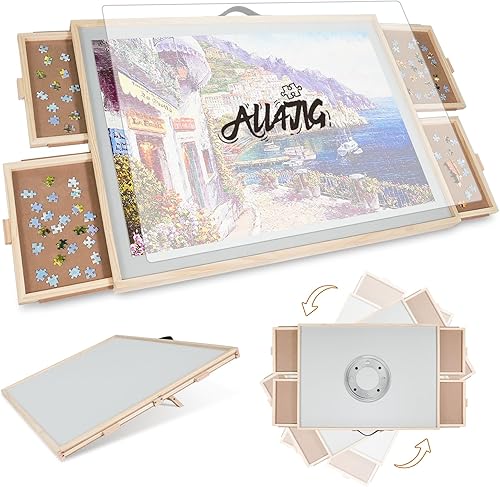
This ALL4JIG combines a pine frame with a cloth work area and three tilt positions. Choose it when you want wood construction and both forms of adjustment.
Pros
- Three tilt positions
- New Zealand pine construction
- Carry handle and clear cover
Cons
- Wood construction does not mean a bare wood work surface
- Confirm usable dimensions for a close-fitting puzzle
This ALL4JIG suits readers who want wood construction with defined angle choices. Its New Zealand pine build supports an Oxford cloth work surface, three tilt positions, full rotation, four drawers and a clear cover.
The cloth matters as much as the frame: you assemble the puzzle on fabric rather than exposed wood. Choose it for that combination, rather than expecting a smooth wooden surface for sliding whole sections.
The carry handle helps you reposition the board, but plan to support it underneath when it holds a puzzle. Under-furniture storage works only if the folded board, cover and any protruding parts clear the opening.
Buy this version if three working positions meet your needs and you want both tilt and rotation. Skip it for a tightly fitting puzzle until you confirm the usable area, since the frame's outside measurements are not the same as assembly space.
ALL4JIG 1500 Tilt and Spin Board: Best for shared hobby spaces
- Tilts and rotates 360°
- 4 sorting drawers
- Oxford cloth surface
- Translucent cover
A wooden board for readers who alternate between puzzles and crafts such as diamond painting. The drawers can organize loose pieces or small hobby supplies between projects.
Pros
- Supports puzzles and light crafts
- Tilt and rotation
- Translucent cover included
Cons
- Weighs 5.9 kg
- Cloth surface needs protection during messy crafts
The ALL4JIG Tilt and Spin suits a hobby space that changes tasks between projects. Its wooden build, Oxford cloth surface, four drawers and translucent cover support puzzles, diamond painting and other light crafts.
It shares much of the earlier ALL4JIG's basic design, including tilt and full rotation. There is little reason to switch between the two solely for those shared features; choose around the exact size and adjustment you need.
At 5.9 kg, it makes more sense for occasional moves than frequent carrying. Keep craft supplies separate from puzzle pieces, and clear the board fully before changing activities.
Buy it if you want one covered surface for several dry hobbies. Skip it if your crafts involve wet paint, loose glue or other materials that need a washable worktop, and use a suitable protective layer whenever the task could mark the cloth.
BuilderButler 1500 Easel Board: Best for a regular tabletop
- Tilts and rotates
- 4 drawers
- Clear protective cover
- Oxford cloth surface
BuilderButler suits a puzzle station that stays on the same table most days. Its wooden build and non-slip base pair with a cloth surface and covered storage.
Pros
- Non-slip underside on rotating base
- Clear cover and sorting drawers
- Brand offers a one-year quality guarantee
Cons
- Weighs 5.92 kg
- Less appealing for frequent carrying
BuilderButler suits a regular puzzle station on an existing table. Its natural wood board has an Oxford cloth surface and turns on a plastic base with a non-slip underside.
The board measures 34.25 x 25.2 in and includes four drawers and a clear cover. At 5.92 kg, it is better suited to staying nearby than being carried across the house after every session.
The base's non-slip underside is useful when you want the assembly to stay positioned while you work. Place it on a clean, level table rather than assuming that grip will compensate for an uneven support surface.
Choose it if you want a wooden tilt-and-rotate setup that usually stays in one place. Skip it if low carrying weight is your main concern, or if you need a specific angle range; BuilderButler backs it with a one-year quality guarantee.
ALL4JIG 2000 Tilt and Rotate Board: Best for larger puzzle projects
- Designed for up to 2,000 pieces
- Tilts and rotates 360°
- 4 sorting drawers
- Translucent cover
Choose this larger ALL4JIG when your finished puzzle exceeds the usable area of smaller boards. It suits a spacious puzzle station better than a setup you carry daily.
Pros
- Designed for larger puzzles
- Cloth work surface
- Tilt, rotation and sorting storage
Cons
- Weighs 8 kg
- Needs careful table and storage measurements
Choose the ALL4JIG 2000 when your finished puzzle needs more assembly room than the smaller boards offer. It carries the same basic cloth-covered wooden format, with tilt, rotation, four drawers and a translucent cover.
Capacity is the reason to accept its larger size. Buying it merely for spare room can leave you reaching farther across the board while using up table space you could devote to sorting.
The board weighs 8 kg, so decide where it will live before starting a puzzle. A nearby horizontal storage spot is more practical than a narrow gap that demands lifting, twisting or turning the loaded board upright.
Buy it for larger projects on a spacious support table. Skip it if you mostly assemble smaller designs and move your setup often, and confirm the usable and assembled dimensions before ordering because the size descriptions differ.
JOIN&JOY 1500 Tilt and Rotate Board: Best for visual sorting
- 3 tilt angles
- Rotates 360°
- 4 brightly colored drawers
- Transparent protective cover
JOIN&JOY suits puzzlers who use color cues to keep piece groups separate. Its colored drawers complement a felt surface and three tilt positions.
Pros
- Distinct drawer colors
- Three tilt positions
- Leather carry handle
Cons
- Drawer colors may contrast poorly with some pieces
- Requires space around the board
JOIN&JOY is a useful choice for puzzlers who remember groups by color. Its four brightly colored drawers let you assign a distinct home to edges, buildings, sky or other parts of the picture.
The 34 x 25 in wooden board also includes a felt surface, three tilt positions, full rotation and a transparent cover. A leather handle helps with repositioning and putting the board away.
Colored drawers work best when their backgrounds contrast with the pieces inside. Put pale pieces against a darker drawer and move similarly colored pieces elsewhere if their outlines become hard to see.
Choose this board if visual cues help you keep a sorting system consistent across sessions. Skip it if you prefer neutral sorting backgrounds, and give each drawer a clear role rather than changing categories whenever one starts to fill.
Becko 1500 Tilting Board, 4 Drawers: Best for fine-tuning your angle
- 5 tilt settings up to 30°
- 4 drawers with magnetic closures
- Transparent cover
- Flannelette surface
Becko puts angle choice ahead of rotation. It suits puzzlers who want several working positions, a soft fabric surface and drawers with magnetic closures.
Pros
- Five tilt settings
- Magnetic drawer closures
- Anti-slip pad on the back
Cons
- Weighs 14 lb
- No rotating base
Becko is the pick for readers who want more control over their working angle without needing a rotating base. Its five settings reach a maximum tilt of 30°, giving you several positions to compare from your chair.
The pinewood and MDF construction carries a flannelette surface, four colored drawers and a transparent PP cover. Small magnets help keep the drawers closed, while an anti-slip pad on the back helps protect the supporting tabletop.
The usable area is 35.43 x 24.41 in, which makes the shorter side worth checking for wider designs. The board weighs 14 lb, so keep its storage spot accessible if you clear the table each night.
Buy it if angle choice matters more than turning the puzzle toward you. Skip it if reaching the far edge is your main problem, because changing slope and bringing an edge closer solve different needs.
Bits and Pieces Deluxe Easel Board: Best for planned shelf storage
- Adjustable tilt surface
- Swivel base
- Protective cover
- Folds with a handle
This folding easel suits readers with a measured storage spot and separate sorting space. Its swivel base brings different puzzle edges within reach.
Pros
- Adjustable tilt and swivel base
- Stand folds for storage
- Protective cover included
Cons
- Weighs 9.12 kg
- Folded unit still needs substantial space
The Bits and Pieces Deluxe Easel suits readers with a planned storage shelf and separate sorting space. It combines adjustable tilt, a swivel base and a protective cover, with a stand that folds and a carry handle.
It accommodates puzzles up to 24 x 34 in. Check both dimensions, particularly if you favor square designs or puzzles with unusually wide borders.
Folded, it measures 35.5 x 26.375 x 4 in and weighs 9.12 kg. A folding stand reduces the setup height, but this remains a substantial object to lift and store.
Buy it if the folded shape fits a convenient spot and you already use sorting trays beside your puzzle. Skip it if you need a light board for daily moves or want built-in drawers to hold your loose pieces between sessions.
Jigpal Felt Tilting Board: Best for frequent room changes
- 3 tilt angles: 18°, 23° and 28°
- Felt surface
- 6 sorting trays
- Cover doubles as a stand
Jigpal suits smaller puzzles that move between rooms. Its low weight matters more for that routine than the larger capacity of the wooden boards.
Pros
- Weighs 3.6 lb
- Six separate sorting trays
- Cover also serves as the stand
Cons
- Limited to smaller finished puzzles
- Separate trays need their own space during use
Jigpal makes the most sense for smaller puzzles that move between rooms. At 3.6 lb, it asks much less of you during a daily lift than the heavier wooden options.
Its usable area measures 29.92 x 20.08 in, with a felt surface and raised edges. The stand offers 18°, 23° and 28° positions, then flips over to serve as the cover.
Six separate sorting trays give you more individual groups than a four-drawer setup. They also need space beside the board during use, so include them when planning a small table.
Choose Jigpal if your finished puzzle fits and carrying weight is a firm priority. Skip it if you regularly buy larger designs, want a rotating base or need every sorting compartment built into the board; its compact format involves those tradeoffs.
How do you choose the best tilting puzzle board for your space?
Choose by finished size, supported footprint and storage route, in that order. A board that fits the puzzle but cannot turn, open its drawers or reach its storage spot will make every session harder.
Measure the puzzle before the piece count
Use the finished dimensions printed on your puzzle box, then compare both sides with the board's usable area. A capacity label cannot account for every puzzle shape or piece size.
Leave some space around the finished border for handling edge pieces. If the design nearly fills the surface, plan to sort loose pieces in drawers or trays rather than around the picture.
Allow room for corners and drawers
A rectangular board sweeps a wider area as it turns than it occupies while sitting straight. Check the turning path against walls, lamps, nearby chairs and anything else on the table.
Drawers need their own clearance, too. A board pushed against a wall may fit neatly but leave one side's storage difficult to use.
Measure the whole storage route
Check the opening beneath your furniture, the depth behind it and the path from the table. Include the folded stand, base, cover and handles rather than measuring only the thin assembly surface.
Keep unfinished puzzles horizontal unless the instructions specifically allow another storage position. A carry handle and secure drawers do not hold every loose piece on the main board.
What makes a tilting puzzle board comfortable to use?
The most useful setup keeps the active puzzle section within easy reach while letting your shoulders stay relaxed. Tilt brings the picture toward your eyes; rotation brings a different section toward your hands.
Which tilt setting is best for a tilting puzzle board?
Start with the shallowest position and increase it only if you can still reach comfortably. A steeper angle may improve your view while making the upper section harder to work on.
Watch your arms as well as your neck. If you raise your shoulders or hold your elbows in the air, adjust your chair, lower the angle or move the active section closer.
A tabletop board adds height above the furniture beneath it. Our guide to choosing an adjustable puzzle table height explains how seat and work-surface height fit together.
When does rotation help more than tilt?
Rotation helps most when your main difficulty is reaching across a wide puzzle. Close the drawers before turning, move slowly and follow the instructions about whether to lower the board first.
For a fuller comparison, read tilting or rotating puzzle board: which is better?. Our guide to placing a puzzle table in a small room can help if turning clearance is limited.
How should you check the setup before starting?
Place the empty board on a level, stable table and engage the stand fully. Gently check for rocking, then try the adjustment controls and drawers before adding hundreds of loose pieces.
Put a few pieces on the surface at a low angle and watch for sliding. Follow how to use a puzzle board to tilt, rotate and cover it for a step-by-step routine.
Which surface and storage features will you actually use?
Choose fabric for friction, bare plastic for cleanup and storage features around your sorting habits. The right combination depends on what you do during a session and how you pause it.
Fabric grip versus easy piece movement
Felt, flannelette and Oxford cloth add friction when you work on an incline. That same resistance can make it harder to slide a joined section across the surface.
Lower the board before moving a large section, and support the pieces rather than dragging them by one edge. If you are comparing different storage methods, see puzzle board or puzzle mat: which should you choose?.
Drawers versus separate trays
Drawers keep groups attached to the board, while separate trays let you spread categories around your seat. More compartments help only if you can remember what belongs in each one.
Try edges, distinctive objects, repeating textures and uncertain pieces as starting groups. Our guide to sorting puzzle pieces with trays explains how to change those groups as the picture develops.
What a cover can protect
A cover helps shield an unfinished layout from dust and casual contact. Do not treat it as a clamp, a carrying strap or a guarantee against a pet standing on the board.
Flatten the board before covering it, and move overlapping loose pieces into storage so the cover rests evenly. Compare storage designs in our guide to puzzle boards with drawers and covers.
How do you care for a tilting puzzle board?
Remove loose debris gently and keep moisture away from fabric, wood and moving parts unless the care instructions allow it. Clear the board before cleaning rather than wiping around an unfinished puzzle.
Use a soft brush for dust on cloth, and follow the brand's directions for marks. Avoid soaking fabric or wooden edges, and let any damp area dry fully before adding pieces or replacing the cover.
Inspect the stand and base when the board is empty. Remove trapped pieces before opening drawers or folding supports, and keep fingers clear of hinges.
For longer breaks, choose a dry, level storage place where nothing heavy will press on the puzzle. See how to store puzzles, finished or not for options beyond daily under-furniture storage.
Which tilting puzzle board should you choose?
Choose the best tilting puzzle board for your routine, with size and handling as firm limits. A smaller board you can comfortably set up is more useful than a larger one you avoid moving.
Pick WELGEE for cleanup, Playboda for felt grip, or Becko when angle choice comes first. Choose the ALL4JIG 2000 only when your puzzle needs its extra capacity, and Jigpal when frequent carrying shapes the decision.
For the wooden alternatives, choose ALL4JIG for defined tilt positions, JOIN&JOY for visual sorting or BuilderButler for a regular tabletop station. The folding Bits and Pieces suits a measured storage spot, while the ALL4JIG Tilt and Spin fits a shared hobby workspace.
Before ordering, write down your puzzle dimensions, table space and storage clearance. If those measurements suggest you need different furniture, return to the complete puzzle table and board buying guide to choose the support beneath your board.
Our top 3 picks at a glance
-
1
-
2
-
3
Frequently asked questions
What is the best tilting puzzle board for most people?
The WELGEE 1500 Tilt and Rotate Board is the best all-around choice here for a wipe-clean surface, sorting storage and rotation. Playboda is the better fit if fabric grip is your priority, while Becko suits readers who care more about angle choices than turning the board.
Do tilting puzzle boards need a non-slip surface?
A grippy surface is useful if you work with loose pieces on an incline; felt, flannelette and Oxford cloth add friction, but you should still start at a shallow angle and watch for movement. A waterproof surface serves a different need: easier cleanup rather than fabric grip.
Is a rotating base useful on a tilting puzzle board?
A rotating base is useful when the far edge of a puzzle is hard to reach from your seat; it brings that section closer without requiring you to lean across the board. Leave clearance for the corners, close drawers before turning, and lower the board if the instructions require it.
Can a tilting puzzle board hold a 2,000-piece puzzle?
Yes, if its usable work area fits the finished puzzle; the ALL4JIG 2000 Tilt and Rotate Board is designed for that capacity, but puzzle shapes and dimensions vary. Measure both sides of the finished design and leave room to handle edge pieces rather than relying on piece count alone.
Can you store an unfinished puzzle board upright?
Keep an unfinished puzzle board horizontal unless its instructions specifically allow upright storage with pieces in place; drawer closures and a protective cover do not automatically secure the main puzzle. Lower the stand, close storage compartments and support the board from underneath when moving it to its storage spot.