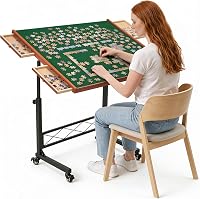
How High Should an Adjustable Puzzle Table Be?
Set an adjustable puzzle table near your relaxed elbow height, then fine-tune it for your seat, reach, and board angle. Choose a range that covers your measured positions, with enough clearance for your knees and the table base.
On this page (9 sections)
- How high should an adjustable puzzle table be?
- How do you measure your comfortable table height?
- Does sitting or standing change the ideal height?
- What height ranges do these adjustable puzzle tables offer?
- What else matters besides adjustable height?
- How should you set up and care for the table?
- Which setup mistakes should you avoid?
- Does table tilt affect how high it should be?
- Which adjustable puzzle table should you choose?
Set an adjustable puzzle table near your relaxed elbow height, then fine-tune it so you can reach the puzzle without shrugging or bending forward. The right setting depends on your seat, leg clearance, and board angle.
Choose the table around your measurements, rather than its tallest setting. A wide height range helps with different seats, but the base must also let the board come close enough.
How high should an adjustable puzzle table be?
Start near elbow height in your actual working position. Adjust from there until your shoulders stay down and your hands reach the working area comfortably.
For standing, wear your usual indoor footwear and bend your elbows with your upper arms relaxed. Compare that height with the table's maximum before assuming a tall setting will suit you.
For sitting, keep your feet supported and use the chair or sofa you plan to puzzle from. A soft couch changes your seated height as its cushions compress.
With a tilted board, the front edge and far edge sit at different heights. Judge the area where you place pieces, rather than trying to line up every part of the surface with your elbows.
How do you measure your comfortable table height?
Measure your elbow height, knee clearance, and approach space before choosing a table. Together, these show whether a model can fit your body and furniture.
- Sit in your usual position with your feet supported.
- Relax your shoulders and bend your elbows comfortably.
- Measure from the floor to the underside of your elbow.
- Measure the height of your knees and any chair arms.
- Check where the table's legs, base, drawers, and shelf would sit.
- Repeat the elbow measurement while standing if you want both positions.
The tabletop height doesn't tell you the clearance beneath its drawers or frame. Leave enough room to shift your legs without pressing against those parts.
Mark the proposed board outline with paper or painter's tape. From your seat, check whether you can reach its middle without stretching across the whole surface.
Does sitting or standing change the ideal height?
Yes, measure both positions separately if you want to switch between them. A table that fits your chair may still be too low for standing.
Also check how the height adjustment works before choosing a table for frequent changes. Don't assume an adjustable model can be raised safely with an unfinished puzzle on top.
Can you use an adjustable puzzle table with a couch?
Yes, if the base can approach the couch and the board clears your knees and sofa arms. Measure underneath the sofa, including any low crossbars or feet that block the frame.
The CODACE 2000 Table, Adjustable Legs adjusts from 27 to 34 in, with a top that tilts up to 35 degrees. It suits buyers whose measured working height falls within that range and who want a larger puzzle station.
Its 41 x 30 in board, 6 removable wooden sorting trays, 2 fabric drawers, and lower storage space suit large projects with several piece groups. Skip it if that footprint crowds your room or puts the far side beyond reach.
Allow space to open the drawers as well as sit at the table. Our guide to placing a puzzle table in a small room covers room layout and positioning.
Can a puzzle table work beside a bed?
Yes, if the base fits beneath or beside the bed without pushing the board away from you. Check the bed frame and storage boxes, not just the gap beneath the mattress.
The Doerpuz 1500 Table, Adjustable Height has a U-shaped base designed to slide under a sofa or bed. Its 2 height settings make it a choice for a fixed seat, once you confirm both heights suit that seat.
Four drawers and a plastic cover provide piece storage and protection between sessions. Skip this model if you need small height changes or several people will share it from different seats.
Its top can move toward vertical for storage, but don't assume an unfinished puzzle can stay in place during that move. For working angles and covering your progress, see how to use a puzzle board.
What height ranges do these adjustable puzzle tables offer?
JoyBerri reaches lowest and highest among the 3 models with stated ranges here. BuilderButler offers another broad range, while CODACE fits a narrower band and Doerpuz uses 2 settings.
The BuilderButler 1500 Table with Wheels adjusts from 26.77 to 36.22 in and tilts up to 45 degrees. Four casters, including 2 locking wheels, let you reposition it and secure it for use.
Choose BuilderButler if you want separate storage for pieces and craft supplies: it has 4 wooden drawers and 2 deeper fabric drawers. Skip it if you need a lower seated setting than its minimum allows.
The JoyBerri Adjustable Height Table has 9 settings from 21 to 37 in, a top that tilts up to 45 degrees, and locking wheels. It is the stronger choice here for a low seat or shared use across different seated heights.
Its 4 magnetically secured drawers help keep sorted groups contained. Skip it if your required standing height exceeds its maximum; discrete settings also offer less fine adjustment than a continuously adjustable mechanism.
For other formats, including separate boards, use the puzzle tables and boards buying guide.
What else matters besides adjustable height?
Board size, reach, and usable floor space matter as much as height. A comfortable front edge won't solve a puzzle surface that is too small or too far away.
Compare your puzzle's finished dimensions with the usable assembly area. Piece counts don't define a fixed size, and wide or panoramic puzzles need special attention.
Leave sorting space outside the puzzle outline, either in drawers or nearby trays. The puzzle table size guide explains how to judge fit before you commit.
For shared puzzling, decide whether people will sit opposite each other or take turns from one chair. A steep tilt favors the person facing it, while a flatter board is easier to use from several sides.
How should you set up and care for the table?
Start flat, secure the frame, and add tilt gradually. Follow the assembly and adjustment instructions, then check the table before spreading out loose pieces.
Use a level floor and engage any wheel locks before working. Keep fingers clear of hinges and adjustment points, and avoid leaning your body weight on the tabletop.
After choosing a height, raise the board only as far as you need for a clear view. Felt adds grip, but loose pieces can still shift when you change the angle.
Before rolling the table, flatten the top, close the drawers, and clear the route. Check thresholds and rugs first, and avoid moving an unfinished puzzle when the route would jolt the board.
Use the cover between sessions, but keep drinks away from the puzzle. Remove dust gently with a soft brush, wipe hard parts with a lightly damp cloth, and let everything dry before covering.
Which setup mistakes should you avoid?
Avoid buying for maximum height alone, using maximum tilt by default, or ignoring reach. Each can leave an adjustable table uncomfortable despite its range of settings.
If your shoulders rise, lower the working area slightly. If you bend forward, first bring the table closer, then adjust height or angle; raising a distant board won't fix the gap.
Don't force your knees around a shelf or frame to reach the puzzle. A different base design may suit you better than another height setting.
Keep frequently used piece groups near the front instead of reaching across the board for every placement. Our guide to choosing a puzzle table for adults covers fit and everyday use.
Does table tilt affect how high it should be?
Yes, recheck height after changing the angle because tilt changes where your hands meet the puzzle. Use the lowest angle that gives you a comfortable view.
Glare can also change as the board rises. Move a lamp or change the table's position before adding more tilt to solve a lighting problem.
The puzzle table or board buying guide helps compare a full table with a separate board. For tighter layouts, see where to put a puzzle table in a small room.
Which adjustable puzzle table should you choose?
Choose the adjustable puzzle table that fits your measured position and room. Use storage and tilt to break a tie after height, clearance, and reach are right.
Pick JoyBerri for lower seats or several seated users, and BuilderButler for mixed puzzle and craft storage. Choose CODACE for larger projects with removable sorting trays, or Doerpuz when an under-sofa or under-bed base matters most.
If none fits your seat and reach, compare another table or a separate board. The complete puzzle table and board guide is the next step for choosing the right format.
Frequently asked questions
What is a comfortable height for a puzzle table?
A comfortable puzzle table puts the working area near your relaxed elbows while leaving room for your legs. Measure from the floor to your elbow in your usual seat, then adjust the table until you can place pieces without lifting your shoulders or bending forward for each move.
Should a puzzle table be at elbow height?
Elbow height is a starting point, not a fixed setting. A tilted board raises parts of the puzzle above the front edge, so adjust for the area where your hands work most often; check that you can reach nearby pieces with relaxed shoulders and fairly straight wrists.
How high should a puzzle table be for a couch?
Use your seated elbow height after the couch cushion has compressed under you. Then check knee clearance, the height of the sofa arms, and room beneath the sofa for the base; a suitable tabletop height won't help if the frame keeps the puzzle too far from your body.
Is standing better than sitting to do a puzzle?
Neither position is better for everyone. Standing makes it easier to move around a large board, while sitting lets you work with support from your chair; choose a height range that fits your preferred positions, change position when you feel stiff, and take breaks away from the puzzle.