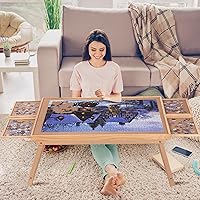
How to Choose a Puzzle Table for Adults
Choose a puzzle table for adults by matching its usable surface, working height and storage needs to your puzzle and room. Pick adjustable height for shared use, folding legs for storage, or locking wheels for frequent moves.
On this page (13 sections)
- What should you check first when choosing a puzzle table for adults?
- How much surface space does your puzzle need?
- What height and tilt should you choose?
- Which adults should choose the JoyBerri table?
- Which adults should choose the ALL4JIG table?
- Which adults should choose the TEAKMAMA table?
- Which adults should choose the Doerpuz table?
- Should you prioritize folding legs or wheels?
- How useful are drawers, felt and covers?
- How should you set up a puzzle table before starting?
- How do you care for the table and store unfinished work?
- Which buying mistakes are easiest to avoid?
- How do you make the final choice?
A puzzle table for adults should fit your finished puzzle, your chair and your room. Start with those measurements, then choose height adjustment, folding legs or wheels according to how you’ll use it.
The most useful table solves a daily problem: reaching distant pieces, freeing the dining table or keeping an unfinished puzzle out between sessions. Extra features earn their space only if you’ll use them.
For a broader comparison of table styles and boards, start with our puzzle tables and boards buying guide. If surface size is your first concern, use our guide to choose a table size for a 1,500-piece puzzle.
What should you check first when choosing a puzzle table for adults?
Check puzzle fit, seated fit and room clearance before comparing accessories. A table that fails any of these checks will be awkward to use, even with drawers and a cover.
Read the finished dimensions on your puzzle box and mark that rectangle on an existing table. Sit beside it to see how far you can reach without leaning heavily on the edge.
Next, measure your planned floor space with the chair pulled out. Include the space needed to open drawers and walk past someone who is puzzling.
| Your main need | Start with | Check next |
|---|---|---|
| Share the table with another adult | Adjustable height | Both users’ preferred working heights |
| Clear a room between sessions | Folding legs | Folded size and lifting weight |
| Move an unfinished puzzle | Wheels with brakes | Doorways, rugs and thresholds |
| Keep a regular hobby corner | A suitable seated height | Knee room and chair access |
| Sort pieces away from the main board | Drawers | Access from your chosen seat |
Also decide where the puzzle box will go. A large reference image can occupy space you expected to use for sorting.
How much surface space does your puzzle need?
Choose a usable assembly area larger than the finished puzzle, with room for any pieces you want to sort beside it. Piece count alone cannot confirm a fit.
Two puzzles with the same count can have different shapes and dimensions. A long panoramic design needs enough length even if its total area seems modest.
Measure a puzzle table for adults in both directions
Compare the puzzle’s length and width separately with the clear area inside any raised edges. Overall furniture dimensions can include a frame that you cannot use for assembly.
For example, a puzzle measuring 30 x 22 in leaves little sorting space on a clear surface measuring 31 x 23 in. It fits, but most loose pieces will need another home.
Drawers can take over that sorting work, though you still need room to inspect pieces as you search. Leave a clear patch beside the growing puzzle or use a tray that you can bring close.
Our puzzle table size guide explains how to compare dimensions for larger puzzles. Use the same method for any piece count.
What height and tilt should you choose?
Choose a height that lets you work with relaxed shoulders, supported feet and room for your knees. Add tilt if bringing the far edge toward your line of sight would make the puzzle easier to view.
Use your actual chair when measuring. A height that works beside a dining chair may feel too high from a low sofa.
Sit upright and rest your forearms near the proposed surface height without lifting your shoulders. Check that the underside of the table and its adjustment hardware leave enough legroom.
For standing use, measure separately rather than assuming an adjustable table will rise far enough. Your preferred standing height may fall outside its range.
Tilt changes viewing angle, but it does not replace height adjustment. Raising the back of the board can improve your view while also making loose pieces more likely to slide.
Start with a shallow angle and keep separate sorting trays level. Our guide to how high a puzzle table should be covers working positions in more detail.
Which adults should choose the JoyBerri table?
Choose the JoyBerri Adjustable Height Table for shared use or changing seated positions. Its defined height range makes it easier to compare the table with your chair before buying.
It offers 9 height options from 21 to 37 in and a tabletop that tilts up to 45 degrees. That gives you separate ways to change the surface height and viewing angle.
The felt surface supports angled puzzling, while 4 magnetically secured drawers hold sorted pieces. A protective cover and locking wheels suit a puzzle that stays out but sometimes needs to move.
At 23.5 lb, this is a table to assess for rolling access rather than frequent carrying. Plan a parking place that you can reach without lifting it over steps.
Skip it if you need a confirmed fold-flat design for storage under furniture. Also rule it out if your preferred working height sits outside its adjustment range, especially if standing use is your main goal.
Which adults should choose the ALL4JIG table?
Choose the ALL4JIG 1500 Table with Legs and Wheels for varied hobby work and a broad tilt range. It suits someone who wants one adjustable station for puzzles, reading or crafts.
The surface adjusts from flat to 90 degrees, and the table has adjustable height settings. A near-vertical position is not a reason to place loose puzzle pieces at that angle; use a shallow tilt for assembly.
Its felt surface, 4 drawers and semi-transparent cover help divide active work from stored pieces. The title gives a puzzle area of 24.92 x 33.58 in, so compare both sides with your finished puzzle.
Four casters provide movement, and the table weighs 20.9 lb. Before buying for a shared living room, confirm the wheel-brake arrangement and exact height range, since those details affect daily use.
Skip it if your decision depends on a known standing height or confirmed wheel locks. Choose it for its range of uses only when those uses fit your routine, rather than treating the steepest angle as the main benefit.
Which adults should choose the TEAKMAMA table?
Choose the TEAKMAMA 1500 Table with Legs for folding storage at a consistent seated height. It makes sense when you prefer to set up the same way each time.
Its height is 27.6 in, with overall dimensions of 34.2 in wide by 26.5 in deep. Compare that height with your chair before choosing it over an adjustable model.
The table has 4 drawers and a PVC cover, and it weighs 18.1 lb. Folding the legs reduces storage bulk, but you still need to handle the board and keep it level when carrying an unfinished puzzle.
It also includes adhesive sheets and hooks for finished puzzles. Keep those for a project you intend to preserve, rather than using adhesive as a way to hold an unfinished puzzle during storage.
Skip it if you need frequent height changes or rolling movement. It is a better match for one chair and a reachable storage spot than for several users with different working positions.
For other legged options, see our puzzle tables with legs and wheels guide.
Which adults should choose the Doerpuz table?
Choose the Doerpuz 1500 Folding Table with Wheels when both rolling movement and folding storage matter. It also suits puzzlers who want the reference image held above the work area.
The table has 5 locked angles, folding legs and 4 casters, each with a brake. Its image holder and 2 clips give the box or reference guide a place away from loose pieces.
Felt lines the board and all 4 drawers, while locking clips secure the drawers during movement. The cover helps shield the puzzle between sessions.
At 13.52 kg, or about 29.8 lb, it is the heaviest option here. Skip it if storage means regular lifting, particularly into a tight space where you cannot keep the board level.
Confirm the usable assembly area and working height before choosing it for a specific puzzle or chair. Its folding and rolling features are useful only after those basic fit checks pass.
Should you prioritize folding legs or wheels?
Choose folding legs for reducing storage bulk and wheels for moving a set-up table. These solve different problems, even when a model includes both.
A folding table still needs a storage location large enough for its full board. Measure beneath the bed or sofa, including the opening, internal depth and any center supports that block access.
Do not assume folding means the puzzle can stand upright behind a door. Loose pieces and unfinished sections generally need a level surface unless the table’s instructions allow another position.
Wheels are most useful along a clear, level route. Rugs, thresholds and narrow turns can turn a short move into a lift, which changes which table makes sense.
Plan where you will push the table from without pressing on the puzzle surface. Check that drawers stay closed and that the cover is in place before moving.
Our guide to where to put a puzzle table in a small room can help you plan both its working position and parking space.
How useful are drawers, felt and covers?
Drawers organize pieces, felt limits sliding and covers protect work between sessions. None replaces careful handling or enough room for the finished puzzle.
Use drawers for groups you can recognize quickly, such as border pieces, text, sky or a building. Packing every drawer with mixed pieces only moves the search problem off the board.
Keep pieces in a shallow layer where possible. Dense piles hide shapes and make it harder to close a drawer without catching a piece.
If you sort by color but keep getting stuck, separate pieces by shape or image detail instead. Our guide to sorting puzzle pieces with trays explains ways to keep useful groups within reach.
Felt adds friction, but connected sections can still shift when you change the angle. Lift pieces to reposition them rather than dragging delicate sections across the surface.
Treat a cover as a barrier against everyday disturbance, rather than a waterproof seal or shelf. Keep drinks elsewhere and do not stack books or other objects on the covered puzzle.
How should you set up a puzzle table before starting?
Set the height, secure the supports and check the working position before opening the puzzle bags. Making large adjustments around loose pieces adds avoidable work.
- Put the table on a level area with room for the chair and drawers.
- Follow its assembly instructions and fully engage the leg supports or adjustment locks.
- Engage any wheel brakes, then check that the table stays steady under light hand pressure.
- Sit down and confirm knee clearance, reach and reference-image placement.
- Start flat or at a shallow angle, then arrange your sorting groups.
Place a lamp where your body will not cast a shadow across the center. If light reflects strongly from the puzzle image, change the lamp position before increasing the tilt.
Keep the most-used drawer within easy reach of your seat. A drawer that opens into your knee or a nearby wall will quickly become wasted storage.
For angle changes and covering routines, read how to use a puzzle board with tilt, rotation and a cover.
How do you care for the table and store unfinished work?
Remove loose debris gently, keep moisture away from the surface and check moving parts as part of your setup. Follow the table’s care instructions before using any cleaning product.
Pick up stray pieces before cleaning drawers or felt. Avoid soaking fabric or wood, and let any cleaned area dry fully before returning cardboard pieces.
Check accessible fasteners, folding supports and drawer catches periodically. If something loosens, correct it before moving the table with a puzzle aboard.
Before putting work away, bring the surface level and move pieces clear of the cover’s edges. Close drawers without forcing them, then secure their catches if fitted.
Keep the puzzle box with the project so the reference image and any remaining pieces stay together. For longer breaks, see our guide to storing finished and unfinished puzzles.
Which buying mistakes are easiest to avoid?
Avoid choosing by piece count, feature count or folding claims alone. The right measurements and a realistic storage plan matter more than the longest list of accessories.
- Checking only the tabletop: Measure the frame, chair space and open drawers too.
- Ignoring the far edge: A puzzle can fit while remaining difficult to reach from your seat.
- Assuming tilt means rotation: Raising the board changes its angle; it does not turn distant sections toward you.
- Treating wheels as a lifting aid: Steps and tall thresholds still require a safe way to carry the table.
- Choosing folding legs without a parking spot: Confirm the folded table fits before relying on under-furniture storage.
- Expecting a cover to secure every piece: Move slowly and keep the surface level.
Another common mistake is buying extra surface area for puzzles you rarely build. Size the table for your usual projects, then decide whether an occasional larger puzzle justifies the added room.
How do you make the final choice?
Choose a puzzle table for adults around the hardest part of your current setup. Once puzzle size and chair fit are confirmed, use the feature that removes that problem as your deciding factor.
Pick JoyBerri if several people share the station or you want a clearly defined height range. Pick ALL4JIG if varied crafts and reading will share the space with puzzles, after confirming its height and wheel details.
Pick TEAKMAMA if a consistent seated height and folding storage suit your routine. Pick Doerpuz if you need both folding legs and braked wheels, and you can manage its weight when lifting is necessary.
Before ordering, write down the usable surface you need, your preferred height and your storage opening. Those measurements make the final choice clearer than comparing accessories alone.
If none fits those limits, use our best puzzle tables guide to compare other styles around the measurements you now know.
Frequently asked questions
What height should a puzzle table be?
Choose a height that lets you reach the puzzle with relaxed shoulders and supported feet. Measure with the chair you plan to use, leaving room for your knees beneath the frame; if people share the table, compare each person's preferred surface height with the adjustment range.
Are wheels useful on a puzzle table?
Wheels are useful when you move an unfinished puzzle to clear a room or change your working spot. Choose reachable brakes, check the route for rugs and thresholds, and close the drawers before moving; roll slowly with the surface level, then engage the brakes before starting again.
Should I choose a puzzle table with folding legs?
Choose folding legs when you have a storage spot large enough for the folded table and can manage the lifting involved. Measure the opening, depth and clearance before buying; folding saves space between sessions, but it adds a setup step each time you bring the table out.
How big should a puzzle table for adults be?
A puzzle table for adults should fit the finished puzzle with extra room wherever you plan to sort pieces. Use the puzzle box's finished dimensions rather than its piece count; compare both sides with the usable assembly area, and allow separate space for trays or the reference image.