8 Best Puzzle Tables with Legs and Wheels (November 2026)
The best puzzle tables with legs and wheels include the BuilderButler 1500 Table with Wheels for everyday puzzlers, the BuilderButler 2000 Table with Wheels for large puzzle sorters, and the ALL4JIG 1500 Table with Legs and Wheels for puzzle and craft sessions.
On this page (7 sections)
- How we chose puzzle tables with legs and wheels
- The best puzzle tables with legs and wheels
- How do you choose a puzzle table with legs?
- How should you set up and move a rolling puzzle table?
- How do drawers, covers and care protect your progress?
- What mistakes should you avoid with a puzzle table?
- Which puzzle table with legs should you choose?
The BuilderButler 1500 Table with Wheels is the best puzzle table with legs for most puzzlers who want a dedicated workspace with adjustable height, tilt and storage. Choose a larger surface for bigger puzzles, a rotating ALL4JIG for easier reach, or a folding model when the room serves several purposes.
Start with your puzzle's finished dimensions and the chair you'll use. A roomy tabletop helps only if you can reach its far edge and sit close enough to work comfortably.
Our complete puzzle table and board guide explains the main setup choices. If floor space is tight, plan where to put a puzzle table in a small room before choosing its size.
Our picks at a glance
-
1

-
2
Best for large puzzle sorters
BuilderButler 2000 Table with Wheels
8.5/10 our score
See it on Amazon -
3
 Best for puzzle and craft sessions
ALL4JIG 1500 Table with Legs and Wheels
8.4/10 our score
See it on Amazon
- 4
 Check it
ALL4JIG 2000 Table with Legs and Wheels
Best for reaching large puzzles - 5Check it
ALL4JIG 1500 Table, Vertical Option
Best for seated solo puzzlers - 6Check it
BuilderButler 2000 Table, Large Size
Best for wider puzzle layouts - 7
 Check it
JoyPcsTable 1500 No-Assembly Table
Best for avoiding assembly - 8
 Check it
Doerpuz 1500 Folding Table with Wheels
Best for shared living rooms
How we chose puzzle tables with legs and wheels
We ranked these tables by puzzle fit, working adjustments, storage and mobility, with different picks for permanent stations and rooms that need clearing. Height adjustment earns more weight for everyday use, while rotation and folding solve more specific problems.
The top pick combines several useful features without requiring you to choose a large tabletop. Lower-ranked models can still be the better buy when their folding legs, rotating board or extra surface area solve your main problem.
Some measurements conflict, particularly for the larger BuilderButler models. Confirm the usable puzzle area, full footprint and working height before ordering; puzzle area and overall furniture size are separate measurements.
| Product | Best for | Puzzle size | Advertised puzzle area | Tilt and height | Our score |
|---|---|---|---|---|---|
| BuilderButler 1500 Table with Wheels | everyday puzzlers | 1500-piece model; match puzzle dimensions | 33.58 x 24.92 in | Up to 45°; 26.77–36.22 in | 8.8 |
| BuilderButler 2000 Table with Wheels | large puzzle sorters | 2000-piece model; confirm usable area | 40.16 x 28.5 in | Up to 45°; 26.77–36.22 in | 8.5 |
| ALL4JIG 1500 Table with Legs and Wheels | puzzle and craft sessions | 1500-piece model; match puzzle dimensions | 24.92 x 33.58 in | 0°–90°; adjustable height | 8.4 |
| ALL4JIG 2000 Table with Legs and Wheels | reaching large puzzles | 2000-piece model; match puzzle dimensions | 28.5 x 40.16 in | 0°–90°; adjustable height | 8.1 |
| ALL4JIG 1500 Table, Vertical Option | seated solo puzzlers | 1500-piece model; match puzzle dimensions | 24.92 x 33.58 in | 0°–90°; adjustable height | 7.9 |
| BuilderButler 2000 Table, Large Size | wider puzzle layouts | 2000-piece model; confirm usable area | 40.6 x 30.1 in | Up to 45°; 26.77–36.22 in | 7.8 |
| JoyPcsTable 1500 No-Assembly Table | avoiding assembly | 1500-piece model; match puzzle dimensions | 7.3 | ||
| Doerpuz 1500 Folding Table with Wheels | shared living rooms | 1500-piece model; confirm usable area | 7.2 |
The best puzzle tables with legs and wheels
Choose BuilderButler for storage and height adjustment, ALL4JIG for broader working positions, or a folding model for a shared room. The individual recommendations below explain who benefits from each design and who should choose another option.
BuilderButler 1500 Table with Wheels: Best for everyday puzzlers
- Surface adjusts up to 45°
- Height adjusts from 26.77 to 36.22 in
- Four casters, two lock
- Four wooden and two fabric drawers
A strong everyday choice for a dedicated puzzle station, with adjustable height, tilt and separate storage for pieces and supplies.
Pros
- Six drawers for sorting and supplies
- Height and angle adjust
- Felt surface and cover included
Cons
- Two of four wheels lock
- No folding design specified
The BuilderButler 1500 is the strongest starting point for someone who puzzles regularly and wants to leave a project set up. Its advertised work area is 33.58 x 24.92 in, with height adjustment from 26.77 to 36.22 in.
The top tilts up to 45°, so you can bring the puzzle toward you without committing to a steep working position. Four casters handle relocation, and two lock when you settle into place.
Its four wooden drawers and two deeper fabric drawers suit a mixed storage routine. Keep sorted pieces separate from spare trays and hobby supplies rather than letting everything crowd the puzzle border.
The felt surface and semi-transparent cover round out a useful everyday station. Skip it if you need legs that fold for storage or board rotation to reach distant sections.
For a shared household, check the height against each person's chair before deciding. Adjustment is most useful when everyone can sit close to the table.
BuilderButler 2000 Table with Wheels: Best for large puzzle sorters
- Surface adjusts up to 45°
- Height adjusts from 26.77 to 36.22 in
- Four casters, two lock
- Four wooden and two fabric drawers
Choose this larger BuilderButler for broad puzzles and a sorting routine that benefits from six drawers.
Pros
- Larger advertised puzzle area
- Six drawers
- Adjustable working height
Cons
- Conflicting size and capacity information
- Needs more floor space than the smaller version
The BuilderButler 2000 Table with Wheels suits a puzzler whose projects outgrow the smaller model but who still wants six drawers for sorting and supplies. Its advertised puzzle area is 40.16 x 28.5 in.
It keeps the smaller BuilderButler's height range, tilt limit, felt surface and semi-transparent cover. Moving up therefore buys more workspace rather than a different adjustment system.
Choose it when the puzzle itself needs the extra area, especially if drawers will hold loose pieces while you build. A larger top can also separate a partly assembled section from the main image, provided both fit.
Skip it if you mostly finish smaller puzzles and would use the extra surface as storage. That leaves you reaching farther and giving up floor space without improving puzzle fit.
There is conflicting capacity information for this model, including a separate 1500-piece specification. Use confirmed working dimensions, rather than either piece-count label, to make the final choice.
ALL4JIG 1500 Table with Legs and Wheels: Best for puzzle and craft sessions
- Angle adjusts from 0° to 90°
- Adjustable height
- Four caster wheels
- Four drawers and protective cover
A tilting table for readers who alternate puzzles with drawing, reading or crafts and want four sorting drawers.
Pros
- Broad tilt range
- Four sliding drawers
- Felt surface and cover included
Cons
- Exact height range needs confirmation
- Rotation is not specified for this version
The ALL4JIG 1500 Table with Legs and Wheels is a good choice for alternating puzzles with reading, drawing or crafts. Its 0° to 90° tilt range gives those activities more working positions than the BuilderButler designs.
The advertised puzzle area is 24.92 x 33.58 in, and the table has adjustable height, four sliding drawers and caster wheels. A felt surface and semi-transparent cover support an ongoing puzzle project.
Buy it if you want angle adjustment without specifically needing board rotation. The four drawers can separate edge pieces, strong colors and partly sorted groups while keeping the center clear.
Skip this version if turning the puzzle toward you is the main reason for buying a table. The rotating ALL4JIG models below address that need directly.
A steep maximum angle is useful for some tasks, but it isn't a target for loose jigsaw pieces. Begin nearly flat, then raise the top only as far as your current work allows.
ALL4JIG 2000 Table with Legs and Wheels: Best for reaching large puzzles
- Angle adjusts from 0° to 90°
- 360° board rotation
- Adjustable height
- Four drawers and protective cover
The larger rotating ALL4JIG suits puzzlers who want to bring distant sections closer without moving their chair.
Pros
- 360° board rotation
- Horizontal and vertical positions
- Four sorting drawers
Cons
- Needs clearance for rotation
- Exact height range needs confirmation
The ALL4JIG 2000 is the pick for a large puzzle that becomes awkward to reach from one seat. Its 360° rotating board lets you bring a distant section closer rather than repeatedly stretching across the image.
The advertised puzzle area is 28.5 x 40.16 in. Adjustable height, a 0° to 90° tilt range, four drawers, felt and a semi-transparent cover give it several ways to support long projects.
This version also offers horizontal and vertical tabletop positions. Follow the instructions for each adjustment, and distinguish turning the board from increasing its slope.
Choose it when reach matters as much as surface size. Rotation helps most when the table has enough open space around it to turn freely.
Skip it if the table must sit tightly between furniture or against a wall. A large rotating rectangle needs clearance beyond its resting footprint, and its corners can meet nearby objects as it turns.
ALL4JIG 1500 Table, Vertical Option: Best for seated solo puzzlers
- Angle adjusts from 0° to 90°
- 360° board rotation
- Adjustable height
- Four caster wheels
Choose this smaller rotating model when you want access to several sides of a puzzle from one seat.
Pros
- Board rotates through 360°
- Four drawers
- Protective cover included
Cons
- Needs space around the rotating top
- Exact height range needs confirmation
The ALL4JIG 1500 Table, Vertical Option suits a solo puzzler who wants rotation in the smaller size. Its advertised puzzle area is 24.92 x 33.58 in, so choosing this version adds access options rather than more puzzle space.
The board rotates through 360° and offers horizontal and vertical positions. It also has adjustable height, a broad tilt range, four drawers, a cover and four caster wheels.
Buy it if you tend to work from one chair and want to bring different puzzle edges within reach. Turning the whole image can also give you a fresh view of a difficult shape or color boundary.
Skip it if you normally walk around your puzzle or work with another person from opposite sides. You may get less benefit from the extra movement options.
Before turning, move drinks and reference materials out of the board's path. Support the top and secure its adjustment controls as directed before you resume placing pieces.
BuilderButler 2000 Table, Large Size: Best for wider puzzle layouts
- Surface adjusts up to 45°
- Height adjusts from 26.77 to 36.22 in
- Four casters, two lock
- Four wooden and two fabric drawers
An alternative for puzzles that need more width or depth than the other BuilderButler surfaces offer.
Pros
- Largest advertised BuilderButler area here
- Six drawers
- Adjustable height and tilt
Cons
- Conflicting overall dimensions
- Larger surface needs more room
The BuilderButler 2000 Table, Large Size is worth considering when your puzzle needs more depth as well as width. Its advertised puzzle area is 40.6 x 30.1 in, larger in both directions than the other BuilderButler 2000 model here.
It shares that model's height adjustment, tilt, six-drawer layout, felt and semi-transparent cover. Choose between the two by the puzzle's shape and your room measurements.
This is the better candidate for a project that narrowly exceeds the other table's working depth. Extra width alone won't solve a puzzle that runs beyond the front or back edge.
Skip it if the added depth would put the far side beyond a comfortable reach. A surface that fits the image still needs to fit the person building it.
Conflicting overall dimensions need resolving before you plan its parking space. Our guide to puzzle tables for 2000-piece puzzles explains how to compare larger work areas.
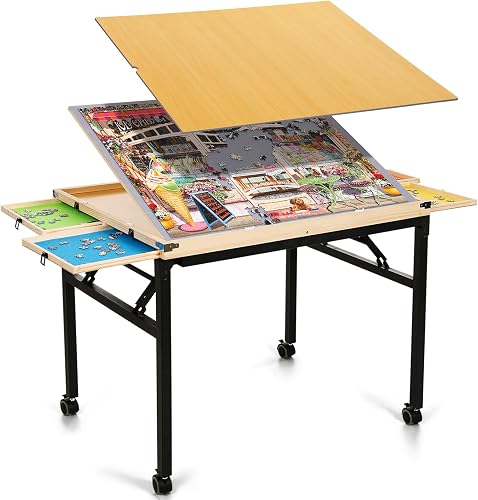
JoyPcsTable 1500 No-Assembly Table: Best for avoiding assembly
- No installation required
- Three tilt angles: 15°, 30° and 40°
- Four lockable casters
- Four drawers and wooden cover
A folding wood table for buyers who want to skip assembly and secure all four wheels while working.
Pros
- No assembly required
- All four wheels lock
- Wooden cover included
Cons
- Three fixed tilt settings
- Working height needs confirmation
The JoyPcsTable 1500 No-Assembly Table is the clearest choice for buyers who want to avoid installation. It combines folding legs with four lockable casters, four drawers and a wooden protective cover.
Its overall length and width are 38 x 25 in. Those measurements describe the table, so don't assume the full rectangle is available for your puzzle.
The three tilt positions are 15°, 30° and 40°. Choose it if fixed angle settings suit your routine and a wooden cover appeals more than a semi-transparent one.
All four wheel locks are useful when you want to secure each corner after moving the table. They still need a level floor and a properly opened base.
Skip it if you need a particular adjustable working height or fine control over the slope. Confirm its height against your actual chair, and measure the folded package before assigning it a storage spot.
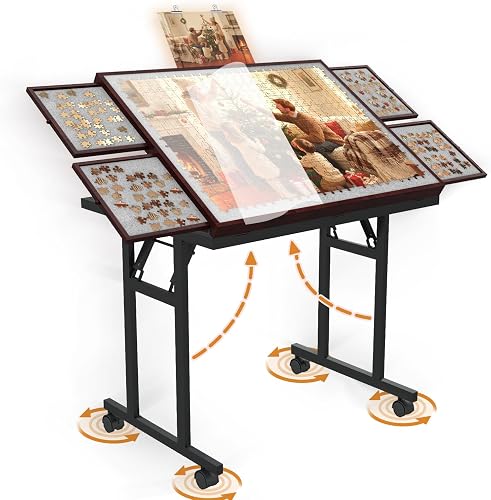
Doerpuz 1500 Folding Table with Wheels: Best for shared living rooms
- Folding legs
- Five locked tilt angles
- Four casters with brakes
- Four drawers and cover
A folding option with drawer clips and a reference holder for puzzlers who need their room back between projects.
Pros
- Legs fold against the tabletop
- Drawers have locking clips
- Picture holder and two clips included
Cons
- Usable surface dimensions need confirmation
- Folding still requires a suitable storage space
The Doerpuz 1500 Folding Table with Wheels suits a shared living room where the puzzle station must sometimes move aside. Its legs fold against the tabletop, and drawer locking clips help keep the drawers closed during movement.
Five locked tilt positions offer several working angles. Each of the four casters has a brake, while four felt-lined drawers and a cover support sorting and storage between sessions.
The picture holder and two clips are useful if you regularly refer to the box image. They give that reference a defined place instead of leaving it among loose pieces.
Choose it when folding storage and keeping supplies together matter more than a permanent furniture setup. Plan a storage location before you unfold it for the first project.
Skip it if you expect folding legs to make the whole table easy to carry. It weighs 13.52 kg, and the broad tabletop still needs room and support when stored.
How do you choose a puzzle table with legs?
Choose by puzzle fit, seated fit and room fit, in that order. Then decide which extras solve a real problem: rotation for reach, drawers for sorting, or folding legs for storage.
What puzzle table with legs fits your puzzle size?
Measure the finished image shown on the puzzle box and compare both dimensions with the clear working surface. Piece count alone isn't enough because puzzle shapes and piece sizes vary.
Leave some room around the image so the border doesn't sit against the frame. If the finished puzzle nearly fills the surface, plan to sort in drawers or separate trays.
Don't add unnecessary tabletop space just to hold every loose piece at once. Our guide to sorting puzzle pieces with trays explains how to keep useful groups close without covering the assembly area.
For sizing help, read what size puzzle table fits a 1,500-piece puzzle. Check the longest puzzles you actually buy, including panoramic shapes, rather than choosing around an average project.
Will the table fit your chair and legs?
Choose a working height that lets you sit close with relaxed shoulders and supported feet. A soft sofa can place you much lower than a dining chair, even in the same room.
Measure from the floor while seated, and account for armrests, knees and drawer structures beneath the top. Height adjustment doesn't guarantee that the base will slide under a sofa or bed.
Avoid buying for standing use just because a table adjusts upward. Match its maximum working height to your own position, and use our adjustable puzzle table height guide to plan the setup.
How much tilt or rotation will you use?
Choose tilt for your viewing angle and rotation for bringing sections closer. They solve different problems, and neither replaces a comfortable table height.
Start flat for sorting and building the border. A shallow slope may suit detailed assembly, while a steep position is better reserved for tasks and materials that stay secure there.
Felt adds grip, but joined sections and individual pieces can behave differently as the slope rises. Reduce the angle if pieces drift or if you find yourself holding them in place.
For rotation, allow space for the corners to sweep around the center. Include drawer handles, your chair and nearby furniture when you picture that movement.
Does the room have space beyond the tabletop?
Allow room for open drawers, your chair and a clear route around the table. A footprint that fits on paper can still block a doorway once someone sits down.
Wheels help you relocate a table on a suitable floor, but thresholds, rugs and narrow turns can interrupt that route. Measure the tightest passage and decide where the table will park between sessions.
If storage is the goal, check the entire folded size, including hardware and wheels. Do not assume the table can stand on its side or hold an unfinished puzzle upright unless its instructions allow it.
How should you set up and move a rolling puzzle table?
Set up the empty table first, secure every support and adjustment, then add your puzzle. Checking the base before loading the top makes problems easier to correct.
Choose a level patch of floor and open folding legs fully as instructed. Tighten assembly hardware to the maker's directions without forcing it.
Engage every available wheel brake, then gently check the table from your normal seated position. The top should hold its setting when you rest your hands lightly on the working edge.
Set the height before adjusting the slope. Keep fingers clear of hinges and supports, and support the tabletop while loosening a control.
Before moving an unfinished puzzle, return the top to a low or flat position as directed. Close the drawers, engage drawer clips where fitted and clear loose objects from the surface.
Roll slowly and stop before obstacles instead of pushing through them. If a threshold requires lifting, get help as needed and use the handling points in the instructions.
Once parked, apply the brakes again and check the top's adjustment locks. Our guide to using a puzzle board, including tilt and covers explains how to manage the work surface between sessions.
How do drawers, covers and care protect your progress?
Use drawers for loose pieces and a cover between sessions, while keeping liquids and heavy objects away from the puzzle. Protection works best as part of a routine.
Assign each drawer a clear job, such as edges, sky, buildings or unsorted pieces. Keep groups shallow enough to see, and check that pieces aren't caught where a drawer closes.
Deeper storage is useful for supplies, but small pieces become harder to search when piled together. Move a few groups onto a tray when you need to spread them out.
Before adding a cover, clear any pieces resting on the frame and check that nothing obstructs its fit. A cover isn't a clamp for holding the puzzle during tilting or transport.
Don't use the covered puzzle as a shelf for drinks, books or a laptop. Cover protection doesn't guarantee a safe load for items placed above delicate cardboard pieces.
Follow the maker's care directions for felt, wood and hardware. As a general routine, remove dry crumbs gently and keep excess moisture away from the surface and drawer edges.
Wipe spills promptly, let damp parts dry before covering, and check fasteners and caster attachments periodically. For longer breaks, see our guide to storing unfinished and finished puzzles.
What mistakes should you avoid with a puzzle table?
Avoid choosing by piece count or feature count alone. The right table fits your current puzzles and daily routine without making the room harder to use.
- Confusing overall size with working area: frames and edges can reduce the space available for the image.
- Buying more surface than you can reach: extra depth can leave the far section awkward to work on.
- Assuming wheels mean folding legs: rolling, height adjustment and folding are separate features.
- Using the steepest angle immediately: start low and watch how loose pieces behave.
- Forgetting drawer clearance: a table beside a sofa may fit until a drawer opens.
- Treating a cover as a transport lock: secure loose contents before moving the table.
- Choosing for occasional crafts first: prioritize puzzle fit if puzzles will occupy the table most days.
For family puzzling, agree before rotating or changing the slope. A position that helps one person can move another person's section out of reach.
Which puzzle table with legs should you choose?
Choose your puzzle table with legs by the problem it needs to solve first. The final choice should follow your measurements, then your preferred way to work.
Pick the BuilderButler 1500 for an everyday station with separate storage for pieces and supplies. Move to a larger BuilderButler only when your puzzle needs the additional working area.
Choose the ALL4JIG 1500 for puzzles and other angled tasks, or a rotating ALL4JIG when reaching different sections from one seat matters most. Buy the larger rotating version only if both the puzzle and the turning clearance fit.
Choose JoyPcsTable to avoid assembly, or Doerpuz when folding storage, drawer clips and a reference holder match your routine. Measure the storage spot before either becomes your choice.
If none fits both your chair and your room, use our best puzzle tables guide to compare other setups before committing floor space.
Our top 3 picks at a glance
-
1
-
2
Best for large puzzle sorters
BuilderButler 2000 Table with Wheels
8.5/10 our score
See it on Amazon -
3
Best for puzzle and craft sessions
ALL4JIG 1500 Table with Legs and Wheels
8.4/10 our score
See it on Amazon
Frequently asked questions
What should I check before buying a puzzle table with legs?
Match the usable surface to your puzzle's finished dimensions, then check the working height against your chair; measure space for your knees, open drawers and movement around the table. If you plan to store it, confirm the folded size too, since wheels and adjustable legs do not mean a table folds.
Are puzzle tables with wheels stable while puzzling?
Wheel brakes help prevent rolling, but a steady table also needs a level floor, secure joints and correctly engaged adjustment locks. Lock the wheels before working, then gently check for movement; if the table rocks or the top shifts, stop and correct the setup before adding your puzzle pieces.
Is a tilting puzzle table better than a flat table?
A tilting table suits puzzlers who prefer to bring the image toward their line of sight; a flat top is better for spreading loose pieces, working from several sides and moving unfinished work. Start with a shallow angle and increase it only while pieces and joined sections remain secure.
Do puzzle tables with legs fold for storage?
Some do, including the JoyPcsTable and Doerpuz models here; folding legs reduce the space taken up by the base, but the tabletop still needs somewhere to go. Measure the complete folded table, including wheels and hardware, and confirm whether it can be stored in your intended position with a puzzle inside.


