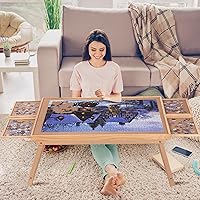
10 Best Puzzle Tables for 2000-Piece Puzzles (November 2026)
The best puzzle tables for 2000-piece puzzles include the BuilderButler 2000 Table with Wheels for regular home puzzlers, the HEBESPACE 2000 Metal Table with Drawers for frequent angle changes, and the ALL4JIG 2000 Table with Legs and Wheels for reaching distant sections.
On this page (8 sections)
- How we chose puzzle tables for 2000-piece puzzles
- How large should a puzzle table for 2000 pieces be?
- Which features matter most on a 2000-piece puzzle table?
- The best puzzle tables for 2000-piece puzzles
- How to choose a puzzle table for a 2000-piece puzzle
- How should you set up and care for a large puzzle table?
- Which mistakes make a large puzzle table harder to use?
- Which puzzle table should you choose?
The BuilderButler 2000 Table with Wheels is our top puzzle table for a 2000-piece puzzle when its usable surface fits your chosen puzzle. It combines adjustable height and tilt with sorting drawers, accessory storage and locking wheels.
Choose HEBESPACE if you want easier angle changes, or ALL4JIG if bringing distant sections closer matters most. A folding-leg board makes more sense when you need your shared table back after each session.
Start with the finished dimensions on your puzzle box. A 2000-piece label describes capacity broadly, but it doesn't settle whether a wide landscape or unusually deep puzzle will fit.
For a broader comparison of table and board styles, see our complete puzzle table and board buying guide. Our puzzle table size guide explains how to compare a puzzle with its work surface.
Our picks at a glance
-
1
 Best for regular home puzzlers
BuilderButler 2000 Table with Wheels
8.5/10 our score
See it on Amazon -
2
 Best for frequent angle changes
HEBESPACE 2000 Metal Table with Drawers
8.2/10 our score
See it on Amazon -
3
 Best for reaching distant sections
ALL4JIG 2000 Table with Legs and Wheels
8.1/10 our score
See it on Amazon
- 4Check it
BuilderButler 2000 Table, Large Size
Best for deeper puzzle layouts - 5
 Check it
TEAKMAMA 2000 Table, 4 Drawers
Best for floor seating - 6
 Check it
CODACE 2000 Table, Adjustable Legs
Best for sorting away from board - 7
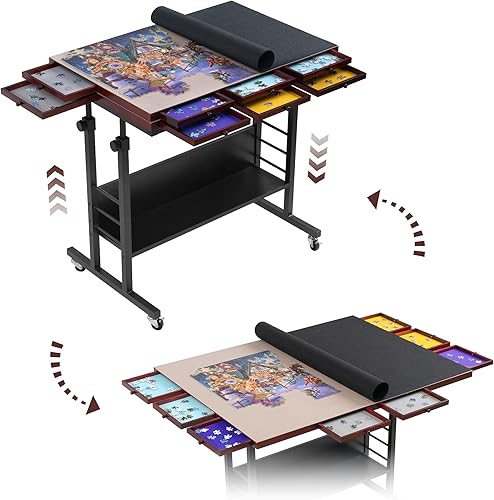 Best for many sorting groupsCheck it
- 8
 Check it
RAGOZONERY 2000 Table with Drawers
Best for shared dining tables - 9
 Best for rooms needing clearanceCheck it
- 10
 Check it
ALL4JIG 2000 Metal Tilting Table
Best for changing seat heights
How we chose puzzle tables for 2000-piece puzzles
Usable puzzle space comes first, followed by seat fit, adjustment, sorting and storage between sessions. A table with more features is still the wrong choice if your puzzle overhangs its working area.
We compared the dimensions, adjustment systems and storage layouts to identify which buyers each design suits. Rotation earns its place when reach matters; folding earns its place when keeping a permanent table isn't practical.
Some models have conflicting size or capacity figures. Those differences affect the recommendation, especially for the first BuilderButler and the folding CODACE, where confirming the actual assembly area is essential.
How large should a puzzle table for 2000 pieces be?
Choose a usable surface larger than your finished puzzle in both directions. There isn't one board size that fits every 2000-piece puzzle, because piece size, shape and finished proportions vary.
A hypothetical 39 x 27 in puzzle on a 40 x 28 in usable surface leaves only half an inch around each edge when centered. It fits, but there is little room for loose pieces or moving connected sections.
Measure inside any raised frame rather than counting the outer woodwork. Also distinguish a board's assembly area from the table's overall footprint, which can include supports, drawers or handles.
For help comparing measurements, read our guide to choosing a puzzle table size. If the puzzle uses nearly all the available space, plan sorting trays beside the table from the start.
Which features matter most on a 2000-piece puzzle table?
Choose height for your seat, rotation for reach, and storage for your sorting habits. Tilt changes your view, while wheels and folding mechanisms determine how you reclaim the room afterward.
Is an adjustable puzzle table for 2000-piece puzzles worth it?
Adjustment is useful when a fixed surface leaves your shoulders raised or makes you lean forward. Sit in your usual chair, relax your arms, and measure a comfortable working height before comparing ranges.
A sofa cushion compresses under you, so measure while seated rather than using the sofa's empty height. Armrests, lower shelves and crossbars can also stop a table from moving close enough.
For wheelchair use, check clear width between supports, knee space and the approach route. Our adjustable puzzle table height guide explains how to match the surface to your sitting position.
Do drawers and covers help with large puzzles?
Drawers free the assembly area, while covers help shield work between sessions. Removable trays are useful when you want to search a color group beside your seat or share sorting with another person.
Drawer count matters less than drawer size and access. A drawer facing a wall is inconvenient, and deep piles make it harder to see individual pieces.
A cover isn't a carrying case or permission to stack household items on the puzzle. For longer breaks, our guide on how to store jigsaw puzzles covers ways to keep unfinished work together.
Should you choose wheels or folding legs?
Choose wheels for a table that stays assembled, and folding legs for a board you intend to put away. A foldaway tabletop on a rolling frame may still occupy substantial floor space.
Measure the entire moving route, including doorways, corners and thresholds. For under-furniture storage, check the opening, the depth behind it and any supports hidden beneath the sofa or bed.
The best puzzle tables for 2000-piece puzzles
The BuilderButler 2000 Table with Wheels is the strongest all-around choice, while HEBESPACE favors frequent tilt changes and ALL4JIG favors rotating access. Use the individual fit checks below to rule out unsuitable designs before comparing convenience features.
| Product | Best for | Board size | Tilt | Storage | Our score |
|---|---|---|---|---|---|
| BuilderButler 2000 Table with Wheels | regular home puzzlers | 40.16 x 28.5 in | Up to 45° | 4 wooden and 2 fabric drawers | 8.5 |
| HEBESPACE 2000 Metal Table with Drawers | frequent angle changes | 0° to 30° | 8.2 | ||
| ALL4JIG 2000 Table with Legs and Wheels | reaching distant sections | 40.16 x 28.5 in | 4 drawers | 8.1 | |
| BuilderButler 2000 Table, Large Size | deeper puzzle layouts | 40.6 x 30.1 in | Up to 45° | 4 wooden and 2 fabric drawers | 7.8 |
| TEAKMAMA 2000 Table, 4 Drawers | floor seating | 4 drawers | 7.8 | ||
| CODACE 2000 Table, Adjustable Legs | sorting away from board | 41 x 30 in | 7.7 | ||
| Tektalk 2000 Foldable Table | many sorting groups | 8 drawers | 7.6 | ||
| RAGOZONERY 2000 Table with Drawers | shared dining tables | 4 drawers | 7.5 | ||
| CODACE 2000 Foldable Table | rooms needing clearance | 0° to 45° | 6 removable trays | 7.1 | |
| ALL4JIG 2000 Metal Tilting Table | changing seat heights | 41.10 x 29.29 in | 5 preset angles | 7.0 |
BuilderButler 2000 Table with Wheels: Best for regular home puzzlers
- Tilts up to 45°
- Height adjusts from 26.77 to 36.22 in
- 4 wooden drawers and 2 fabric drawers
- 4 wheels, 2 lock
A practical choice for leaving a puzzle set up, with adjustable height and tilt, separate piece and accessory storage, and locking wheels.
Pros
- Adjustable height and angle
- Six drawers
- Cover and locking wheels
Cons
- Conflicting size and capacity figures need confirmation
- Open drawers need extra clearance
Choose this BuilderButler for a regular puzzle station with separate storage for pieces and supplies. Its four wooden drawers can hold sorted groups, while two deeper fabric drawers give accessories somewhere to go.
The height adjusts from 26.77 to 36.22 in, and the felt-covered top tilts up to 45°. Four casters, including two locking wheels, let you move the station without treating the board as a carrying tray.
There is an important fit check: the 40.16 x 28.5 in board dimensions appear alongside other size and capacity figures that don't agree. Confirm the usable inner dimensions before ordering, particularly for a puzzle close to either limit.
Skip it if you need a board that disappears under furniture or if your puzzle exceeds the confirmed work area. For a permanent corner, position the table so the drawers remain accessible from your seat.
HEBESPACE 2000 Metal Table with Drawers: Best for frequent angle changes
- 41.34 x 29.53 in work surface
- Pneumatic tilt from 0° to 30°
- Height adjusts from 22.16 to 33.27 in
- 4 casters, 2 lock
One-touch pneumatic tilt suits puzzlers who change the board angle often. Its lower starting height also makes it worth considering for lower seating.
Pros
- One-touch pneumatic tilt
- Lower starting height than several alternatives
- Protective cover and lined drawers
Cons
- Maximum tilt is 30°
- Height figures differ, so confirm any critical seat clearance
Choose HEBESPACE if changing the angle is part of your routine. Its one-touch pneumatic mechanism is the main reason to prefer it over a table that requires more manual repositioning.
The work surface measures 41.34 x 29.53 in, with tilt from flat to 30°. The stated height range is 22.16 to 33.27 in, although other height figures differ, so verify any measurement critical to your seat.
Lined drawers hold sorted pieces, and a cover protects the work area between sessions. The metal frame and locking casters suit a dedicated station that you roll aside rather than dismantle.
Skip it if you want steeper angles or expect to work at a height beyond its confirmed range. When setting it up, leave access to the tilt control so changing position doesn't require reaching across your puzzle.
ALL4JIG 2000 Table with Legs and Wheels: Best for reaching distant sections
- 360° rotating board
- Tilt from 0° to 90°
- Switches between horizontal and vertical layouts
- 4 drawers and protective cover
Rotation brings distant puzzle sections closer to your seat. Choose it for an open spot where the board has room to turn.
Pros
- 360° rotation
- Horizontal and vertical layouts
- Felt surface, cover and four drawers
Cons
- Board corners need clearance while turning
- Confirm usable space inside the frame
Choose this ALL4JIG when reaching the far side is your main difficulty. Its 360° rotation lets you bring a distant section toward your hands instead of stretching across the puzzle.
The board is described as 40.16 x 28.5 in, with four drawers, felt and a protective cover. It also offers adjustable height, horizontal and vertical layouts, and a tilt range reaching 90°.
That maximum angle isn't a target for assembling loose pieces. Work flat at first, then increase the slope gradually while checking whether separate pieces or joined sections start shifting.
Skip it for a tight alcove where the corners cannot turn freely. Close drawers before rotating, move slowly, and check that the board clears your knees as well as nearby furniture.
BuilderButler 2000 Table, Large Size: Best for deeper puzzle layouts
- 40.6 x 30.1 in board
- Tilts up to 45°
- Height adjusts from 26.77 to 36.22 in
- 4 wooden drawers and 2 fabric drawers
Consider this BuilderButler version when puzzle depth rules out a shallower board, while retaining adjustable height, tilt and separate accessory storage.
Pros
- Deeper stated board than the first BuilderButler
- Six drawers
- Felt surface, cover and locking wheels
Cons
- Conflicting dimensions require a usable-area check
- Needs room for the board and open drawers
Consider the larger BuilderButler when puzzle depth rules out a shallower board. Its stated 40.6 x 30.1 in top offers more depth than the first BuilderButler, which may decide the fit for a particular puzzle.
It retains the same adjustment ranges and drawer arrangement as that model. Felt, a semi-transparent cover and locking casters support a puzzle station that stays ready between sessions.
Other dimension figures conflict, so treat confirmed usable space as the deciding measurement. Extra outer size won't help if the inner frame leaves too little room for your puzzle.
Skip it if your current puzzle fits the smaller option and the larger footprint crowds your room. If you choose it, put frequently used sorting groups near your seat so the extra depth doesn't encourage repeated reaching.
TEAKMAMA 2000 Table, 4 Drawers: Best for floor seating
- 41.3 x 27.5 in work area
- 4 drawers
- Protective cover
- Folding legs
Folding legs suit low setups on the floor or a suitable supporting surface. Four drawers keep sorted groups off the assembly area.
Pros
- Folding legs for low setups
- Four drawers and a cover
- Can store under furniture with enough clearance
Cons
- Low-table format won't suit every chair
- 27.5 in workspace depth can limit puzzle fit
Choose TEAKMAMA for floor seating or use on a suitable existing surface. Its folding legs offer a low-table setup rather than the adjustable rolling station found on several other picks.
The 41.3 x 27.5 in working area includes four drawers and a cover. At 14.3 lb, the empty board is still a large object to lift and guide around furniture.
Its shallower working depth deserves attention before you commit to a large puzzle. Use the drawers for loose pieces when the assembled image fills most of the surface.
Skip it if you want a full-height table beside an ordinary chair. On carpet, check that all supports sit evenly; on a bed or sofa, avoid soft or sloping areas that let the board rock as you work.
CODACE 2000 Table, Adjustable Legs: Best for sorting away from board
- 41 x 30 in board
- Height adjusts from 27 to 34 in
- Tilts up to 35°
- 2 pull-out drawers with 6 removable trays
Removable trays let you work through a small group of pieces beside your seat. Fabric drawers and a lower shelf hold other puzzle supplies.
Pros
- Six removable sorting trays
- Separate accessory storage and shelf
- Adjustable height, tilt and locking wheels
Cons
- Lower shelf needs checking for leg clearance
- Not a folding-leg model
Choose this CODACE if you prefer sorting small groups away from the main board. Two pull-out drawers hold six removable wooden trays, so you can bring one group close without covering the assembly area.
The board measures 41 x 30 in, with height adjustment from 27 to 34 in and tilt up to 35°. Fabric drawers and a lower wooden shelf provide separate places for boxes and accessories.
That layout suits a puzzler who keeps several categories active, such as edges, lettering, sky and buildings. Give each tray a clear role rather than filling every container with mixed pieces.
Skip it if the shelf blocks your preferred leg position or you need folding storage. Check the approach to your chair before filling the lower storage, then keep heavier supplies low and clear of the wheels.
Tektalk 2000 Foldable Table: Best for many sorting groups
- Opens to 40.2 x 30.3 in
- Height adjusts from 29.5 to 37.4 in
- 8 drawers and 4 casters
- Two felt covers
Eight drawers suit puzzles with many distinct colors or image areas. The board changes between smaller and expanded formats.
Pros
- Eight sorting drawers
- Two covers for different puzzle sizes
- Adjustable height and lower shelf
Cons
- Assembly is required
- Foldaway board doesn't mean flat under-bed storage
Choose Tektalk for many separate sorting groups and a board that changes size. Its foldaway and flipping design expands to 40.2 x 30.3 in for larger puzzles.
Eight drawers provide the most separate drawer compartments in this comparison. Two felt covers serve different puzzle sizes, and the lower shelf holds boxes or other accessories.
Height adjusts from 29.5 to 37.4 in, so this is less suitable for a low sofa than a table with a lower starting point. Assembly is required, and its 18.5 kg weight favors rolling over frequent lifting.
Skip it if you expect a flat board that slides under a bed. Open it fully before starting a large puzzle, and follow its folding instructions rather than changing the board format beneath an unfinished assembly.
RAGOZONERY 2000 Table with Drawers: Best for shared dining tables
- 41.34 x 27.95 in work surface
- 4 drawers
- Folding legs
- No-install design
Use this folding-leg board on a suitable table, then move the whole board when the shared surface is needed. Drawer clips help retain drawers during moves.
Pros
- No-install folding-leg format
- Four drawers and a cover
- Metal clips help retain drawers
Cons
- Large board still needs a storage spot
- 27.95 in workspace depth can limit puzzle fit
Choose RAGOZONERY if you want a folding-leg board for a shared surface. Its no-install format suits someone who prefers to avoid assembling a rolling frame.
The smooth 41.34 x 27.95 in work surface lets you move connected sections while working flat. Four drawers keep sorted pieces separate, with metal clips to help retain drawers during moves.
This is a useful format for clearing a dining table, but moving the board doesn't remove the need for a second storage location. Measure that destination before starting a puzzle that may remain unfinished for days.
Skip it for puzzles deeper than the usable surface or for a chair setup needing adjustable full-height legs. Close and secure each drawer before lifting, and get help if the board is awkward to carry level.
CODACE 2000 Foldable Table: Best for rooms needing clearance
- Folding legs
- Height adjusts from 27.5 to 35.4 in
- Tilt adjusts from 0° to 45°
- 6 removable sorting trays and cover
Folding legs offer a way to reclaim floor space while retaining height and angle adjustment. Confirm the usable board dimensions before choosing it for a large puzzle.
Pros
- Folding legs
- Six removable sorting trays
- Adjustable height and tilt
Cons
- 34 x 26 in dimensions raise a puzzle-fit concern
- Attaching the legs requires eight screws
Consider the folding CODACE when reclaiming floor space is essential, but settle puzzle fit first. Its 34 x 26 in dimension figures raise a concern for a board intended for 2000-piece puzzles.
Don't choose it for a larger finished puzzle unless the usable working area is confirmed to accommodate that puzzle. Folding convenience cannot make up for an assembly that extends beyond the edges.
The legs adjust from 27.5 to 35.4 in, and the top tilts up to 45°. Six removable sorting trays, felt, a cover and casters combine organization with a folding frame.
Skip it if the working dimensions remain unclear. Setup requires attaching the legs with eight screws, and storing an unfinished puzzle requires a position that keeps the assembly supported and level.
ALL4JIG 2000 Metal Tilting Table: Best for changing seat heights
- Height adjusts from 28.74 to 39.37 in by hand crank
- 5 preset tilt angles
- 360° rotation
- 4 removable drawers and protective cover
A hand crank suits a table shared by people using different working heights. Rotation and removable drawers help bring sections and sorted pieces closer.
Pros
- Hand-crank height adjustment
- 360° rotation
- Removable drawers and wipe-clean cover
Cons
- Tilt uses preset positions
- Minimum height may be too high for low seating
Choose this ALL4JIG if several people need different working heights and you prefer a hand crank. Its adjustment range runs from 28.74 to 39.37 in.
The 41.10 x 29.29 in board rotates fully, switches layout and uses five preset tilt positions. Four removable drawers let each person bring a sorting group closer rather than reaching across another puzzler.
A cross-shaped iron base supports the table, with two locking casters among its four wheels. The translucent cover has a wipe-clean surface for use between sessions.
Skip it if you want fine angle changes between preset positions or a lower setting for a deep sofa. Before buying, check crank clearance beside your chair and space for your feet around the base.
How to choose a puzzle table for a 2000-piece puzzle
Choose in this order: puzzle fit, seat fit, room fit, then convenience features. This prevents an appealing drawer system or rotating top from distracting you from a basic mismatch.
Write down your largest planned puzzle's finished dimensions and your comfortable working height. Add the available floor space and storage opening, then use those measurements to eliminate unsuitable tables.
Next, decide where loose pieces will go. A close-fitting board can work well with separate trays, but it won't also offer a wide sorting border.
Finally, choose the feature that solves your biggest daily problem. Rotation addresses reach, removable trays address sorting, and folding addresses the need to clear the room.
For layout ideas, see where to put a puzzle table in a small room. Include space for your chair to move back, not just enough floor area for the table itself.
How should you set up and care for a large puzzle table?
Set the table level, secure its adjustments and start with a flat surface. Finish assembly and check fasteners before spreading pieces across the board.
Lock any locking casters, then sit down and check knee space. Keep the image reference and your most-used sorting group within easy reach so you aren't repeatedly twisting or leaning.
Begin with a small number of sorting groups, adding more only when they help. Our guide to sorting puzzle pieces with trays explains how to separate pieces without creating too many piles.
Raise the angle gradually after you understand how pieces behave on the surface. Felt adds grip, but loose pieces and large connected sections may respond differently to a slope.
Keep drinks on another surface and use dry hands when handling cardboard pieces. Remove dust and lint gently, following the table's care instructions before applying moisture or a cleaning product.
Close drawers and lower the board toward flat before rolling it. Move slowly over thresholds, and avoid pulling the table by a drawer or using the cover as a handle.
Which mistakes make a large puzzle table harder to use?
The biggest mistakes are assuming capacity guarantees fit and planning storage too late. Check the puzzle, open table and stored table as three separate measurements.
- Buying to the outer edge: A frame can reduce usable space, so compare the inner assembly area with the finished image.
- Ignoring turning clearance: A rotating board's corners extend beyond its resting position as it turns.
- Overfilling drawers: Deep stacks hide pieces and can interfere with closing the drawer.
- Choosing maximum tilt immediately: Start shallow and watch for movement before increasing the angle.
- Folding with work unsupported: A cover doesn't automatically secure an unfinished puzzle vertically.
- Treating wheels as stair transport: Plan a level route, and use help when lifting is necessary.
A useful final check is to mark the intended footprint on the floor and sit beside it. This reveals blocked walkways, awkward drawer access and chair clearance before a large table arrives.
Which puzzle table should you choose?
Choose your puzzle table for a 2000-piece puzzle by the limitation you need to solve. Once the puzzle and seat fit, the decision becomes much clearer.
Pick the BuilderButler 2000 Table with Wheels for a regular station with mixed storage, HEBESPACE for frequent angle changes, or the ALL4JIG 2000 Table with Legs and Wheels for easier reach across the board.
Choose TEAKMAMA or RAGOZONERY if you need a low folding-leg board and already have a suitable place to use and store it. Favor the adjustable CODACE for removable sorting trays, or Tektalk for more separate sorting compartments.
Consider the hand-crank ALL4JIG when changing working height matters most. Choose the larger BuilderButler only when its confirmed inner dimensions solve a fit problem, and leave the folding CODACE aside until its usable area is clear.
If you're still deciding between a portable board and a full table, use our broader puzzle table comparison to choose the format your room can accommodate.
Our top 3 picks at a glance
-
1
Best for regular home puzzlers
BuilderButler 2000 Table with Wheels
8.5/10 our score
See it on Amazon -
2
Best for frequent angle changes
HEBESPACE 2000 Metal Table with Drawers
8.2/10 our score
See it on Amazon -
3
Best for reaching distant sections
ALL4JIG 2000 Table with Legs and Wheels
8.1/10 our score
See it on Amazon
Frequently asked questions
Will every 2000-piece puzzle fit a 2000-piece puzzle table?
No. Match the puzzle's finished width and length to the usable assembly area inside the board's frame.
Piece sizes and puzzle shapes vary, so equal piece counts don't guarantee equal dimensions.
If the puzzle nearly fills the surface, plan separate sorting space rather than leaving loose pieces around its border.
Can you fold a puzzle table with an unfinished puzzle on it?
Only fold it with the puzzle in place if the table's instructions allow that position. Folding legs and folding board sections are different mechanisms.
Covering a puzzle doesn't necessarily hold it against the surface, so keep the assembly level during storage unless the table has a suitable retention system.
Is felt or a smooth surface better for large puzzles?
Choose felt if you prefer more grip, especially on a gently tilted board. Choose a smooth surface if you regularly slide connected sections into place while working flat.
Felt can make those moves less easy, so lift small joined sections with support rather than dragging them across the fabric.