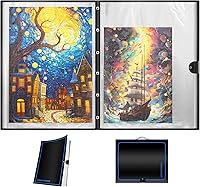
Puzzle Board Features Worth Paying For
A puzzle board with cover is worth buying when you leave puzzles unfinished or need to clear a shared table. Choose by finished puzzle dimensions first, then add drawers for sorting, rotation for reach or tilt for an angled view.
On this page (8 sections)
- Which puzzle board with cover features are worth paying for?
- What size covered board will fit your puzzle and room?
- Which covered boards match different needs?
- How should you set up a covered board for daily use?
- How do you move and care for a loaded puzzle board?
- Which common buying mistakes should you avoid?
- Related reading
- Which puzzle board with cover should you choose?
A puzzle board with cover is worth buying if you leave puzzles unfinished or need to clear a shared table. Start with a board that fits your puzzle and storage spot, then choose extras that improve how you sort, reach and place pieces.
For these 4 options, the main choices are clear: ALL4JIG offers wooden rotating boards, WELGEE combines tilt with a wipe-clean surface, and Playboda pairs tilt with felt. The right choice depends on your routine more than the longest feature list.
For a broader comparison of sizes and setups, see our puzzle tables and boards buying guide.
Which puzzle board with cover features are worth paying for?
Pay for surface space and a useful cover first, then choose drawers, rotation or tilt around your daily habits. A feature earns its place when you can name the task it makes easier.
| Feature | Worth paying for if | Check before choosing |
|---|---|---|
| Cover | You pause projects or clear a shared table | Fit, removal and where it goes during use |
| Drawers | You keep several groups of loose pieces | Access and space to open them |
| Rotation | You work from one seat | Clearance for the corners to turn |
| Tilt | You prefer an angled view | Support setup and surface grip |
| Larger surface | Your finished puzzle needs more room | Usable area and storage footprint |
| Portable design | You move the puzzle between sessions | Loaded weight, lifting route and storage access |
Choose around your most common puzzle, rather than an occasional project you might try. A large board becomes a poor fit if every short session starts with moving furniture.
Is a puzzle board cover enough to protect loose pieces?
A cover helps shield pieces from dust and casual contact, but a cover is not a carrying clamp. Unless a board has a specific securing system, loose pieces can still move when you tip it.
The ALL4JIG boards here include translucent covers, while WELGEE and Playboda use natural rubber mat covers. A translucent cover lets you see the work beneath it; an opaque cover hides the puzzle between sessions.
Also consider removal: you need somewhere clean to lay the cover while you work. Keep the side that touches the puzzle free of crumbs, grit and moisture.
Neither cover style makes the whole setup pet-proof or spill-proof. Store the covered board away from drinks and places where a pet could jump onto it.
For storage choices beyond the tabletop, see how to store unfinished and finished puzzles.
Do drawers replace separate sorting trays?
Drawers can replace some loose trays if you sort pieces into a few groups and want those groups stored with the board. Drawer count should match your sorting method, rather than act as a reason to buy a larger model.
For example, you might separate borders, lettering, buildings and background colors. More drawers help when you keep those groups separate; fewer can work if you prefer broad categories.
Check access from your usual seat and whether a wall, table edge or chair blocks an open drawer. You may otherwise end up shifting the whole board just to reach a group.
Avoid packing pieces into deep piles when you need to scan their shapes. Our puzzle sorting trays guide explains other ways to spread out groups without crowding the assembly area.
When does rotation help more than extra space?
Rotation helps most when you sit in one place and want to bring distant sections closer. It changes which edge faces you, but does not create more table space.
Allow room for the corners to sweep around as the board turns. A rectangular board can fit on a table while still hitting a wall, lamp or drink during rotation.
Close drawers before turning, move nearby objects and rotate slowly. If you already walk around a table and work from several sides, this feature may add little.
When should you pay for tilt?
Tilt is useful if you prefer looking at an angled surface instead of bending over a flat one. Choose the support and work surface together, since loose pieces need grip as the angle increases.
Start with a shallow angle and change it with your hands clear of hinges and supports. Keep loose sorting piles in drawers or trays while adjusting the board.
Tilt cannot compensate for a table that is too high or a chair that leaves you reaching. Set your seating position first, then adjust the board.
Our guide to using a puzzle board for tilt, rotation and cover covers these movements in more detail.
What size covered board will fit your puzzle and room?
Choose by finished puzzle dimensions, then check the usable assembly area, table footprint and storage space. A 1500-piece label is a capacity guide, not a promise that every puzzle with that count will fit.
Read the finished width and height on the puzzle box. Allow some breathing room around the assembled image so pieces do not sit against the frame.
If the puzzle nearly fills the surface, plan to sort elsewhere. Extra room on the board is useful, but separate trays can be easier to place than a much larger board.
Measure the storage opening as well as the space behind it. Sofa legs, bed supports and drawer handles can block a board that would otherwise fit underneath.
Make a paper or cardboard outline of the board's footprint before ordering. Put it on the table, sit down and check your reach, drawer access and path through the room.
For more help matching dimensions, read our guide to choosing the right board size.
Which covered boards match different needs?
Choose the ALL4JIG models for wooden rotating setups, WELGEE for wipe-clean work, or Playboda for a felt surface with tilt. Each solves a different problem, so compare the tradeoffs before choosing.
ALL4JIG 1500 Rotating Board, 6 Drawers
The ALL4JIG 1500 Rotating Board, 6 Drawers suits puzzlers who split loose pieces into several groups and prefer a wooden workspace. Its 6 drawers give those groups separate homes, while the translucent cover lets you see the unfinished image.
The board has a 360-degree Lazy Susan base and weighs 4.4 kg. Treat that weight as part of your moving routine, especially if the storage spot requires bending or reaching.
Two dimensions appear for this model: 24.92 x 33.58 in and 36.8 x 27.4 x 2.1 in. Confirm the usable assembly area and full footprint before ordering, particularly if your puzzle or storage opening is a close fit.
Choose it if sorting is a major part of your sessions and you want to bring different sections toward one seat. It makes more sense than the larger ALL4JIG when your regular puzzles fit comfortably.
Skip it if you need tilt or expect to carry the loaded board one-handed. Buyers who sort into only 2 or 3 broad groups may also gain little from the extra drawers.
ALL4JIG 2000 Rotating Board, 4 Drawers
The ALL4JIG 2000 Rotating Board, 4 Drawers suits larger projects that need more assembly room. Choose it for the workspace, rather than assuming the bigger model also offers more sorting compartments.
It combines a wooden surface, translucent cover and rotating base with 4 sorting drawers. That layout suits broad groups, with separate trays available for finer sorting.
Its stated dimensions are 28.5 x 40.16 in, with another measurement of 40 x 28.19 in. Plan table and storage space around the larger footprint, and leave extra clearance for rotation.
Choose this model when your usual finished puzzles need the extra room and you have a stable place to keep it. A larger surface can also leave more working space around a smaller puzzle.
Skip it for cramped shared tables or storage routes with tight turns. If your puzzles fit the smaller wooden model, the larger board may add handling work without improving your sessions.
For frequent moves, think through the whole route while holding your arms at the board's width. Include doorways, chair backs and the final lowering motion.
WELGEE 1500 Tilt and Rotate Board
The WELGEE 1500 Tilt and Rotate Board suits buyers who want an angled view and a surface that can be wiped clean. Its ABS plastic work area is the main reason to choose it over a felt-covered option.
The board combines tilt with an 18 in rotating base and uses a warm-white surface. Choose that background if you prefer a light workspace beneath your pieces.
WELGEE says the waterproof surface allows direct puzzle gluing and cleanup with a damp cloth. That makes it worth considering if preserving completed puzzles is part of your routine.
Check the glue's directions before applying it, and keep adhesive away from drawers, edges and moving parts. A waterproof work surface does not make the whole board suitable for soaking.
Skip it if you specifically want felt or rarely use an angled view. The tilt hardware offers less value when the board will stay flat throughout every puzzle.
Before committing to glue, decide how you will lift, dry and frame the finished image. Our guide to preserving a finished puzzle helps you plan those next steps.
Playboda 1500 Tilt and Rotate Board
The Playboda 1500 Tilt and Rotate Board suits puzzlers who prefer felt under their pieces and expect to use tilt regularly. Playboda says the felt work surface helps resist sliding when the board is angled.
Its ABS plastic body combines an 18 in rotating base with a tilting support. The 4 gray drawers give you space for separate sorting groups, while the black cover hides the work between sessions.
Choose it when surface grip matters more to you than a smooth, wipe-clean workspace. Felt also changes how pieces move, so consider whether you prefer placing pieces individually or sliding small groups around.
Playboda says the drawers stay in place when the board is lifted or placed vertically. That drawer feature does not secure the unfinished puzzle on the main surface, so keep the loaded board level.
Skip it if direct gluing is your main goal or you want to see the puzzle through its cover. WELGEE is the clearer choice here for buyers who want a surface intended for direct glue use.
How should you set up a covered board for daily use?
Set the board on a stable, level table with its base supported, then check every movement before adding pieces. It is easier to spot a blocked drawer or awkward support while the surface is empty.
- Clear the table and remove crumbs or grit from beneath the base.
- Position your chair so you can reach the near edge without leaning forward.
- Open each drawer and check that it clears furniture.
- Turn a rotating board slowly through its full sweep.
- Set up any tilt support according to its instructions.
- Place the empty cover somewhere clean and within reach.
Begin with the border or a few small groups rather than emptying every piece onto the work area. This leaves room to learn where you want your sorting groups.
Keep the puzzle box image where you can see it without covering drawers or blocking rotation. A reference image that repeatedly gets moved can become more disruptive than a missing board feature.
Before pausing, remove stray pieces from drawer tracks and make sure no pieces sit across the cover's edge. Lower the cover gently instead of dragging it across the puzzle.
How do you move and care for a loaded puzzle board?
Move a loaded board flat, slowly and with support beneath it. Close the drawers, return a tilting board to its flat position and clear the route before lifting.
Keep your grip away from drawers and moving supports. If the board feels awkward when empty, arrange help before moving it with an unfinished puzzle.
Store it on a flat surface where nobody will step on it or stack objects above the puzzle. Avoid balancing it against a wall, since a cover alone does not hold every piece in place.
For routine care, clear loose debris before covering the work. Clean an empty board whenever possible so moisture and cleaning residue stay away from cardboard pieces.
Wipe wooden parts with minimal moisture and dry them promptly. Avoid soaking wood, flooding drawer channels or using abrasive pads on the assembly surface.
For felt, use a soft brush or lint roller gently, without catching raised fibers. Do not assume a felt surface or rubber cover can go in a washing machine.
Let the surface and cover dry fully before placing pieces back on them. Keep the board away from damp storage areas and strong heat that could affect its materials.
Which common buying mistakes should you avoid?
Avoid choosing by piece count, drawer count or portability claims alone. The board must work as a complete setup, including the puzzle, table, chair and storage route.
- Buying the biggest board available: unused space still has to be carried and stored.
- Confusing footprint with work area: frames and hardware may occupy part of the stated dimensions.
- Forgetting open drawers: a board can fit the table while its storage remains blocked.
- Treating a cover as a seal: drinks and pets still belong away from the puzzle.
- Skipping the loaded lift: an empty board is easier to handle than one you must keep level.
- Buying tilt without considering grip: loose pieces may move as the angle changes.
Also distinguish a rigid board cover from a roll-up storage system. If rolling rather than flat storage is your priority, read how puzzle mats work before choosing a board.
Related reading
Use these guides to compare alternatives, plan your setup or organize pieces between sessions.
Which puzzle board with cover should you choose?
Choose your puzzle board with cover by its main job: holding sorted groups, fitting larger projects, offering wipe-clean work or supporting an angled felt surface. Then confirm that the loaded board can stay level through your storage routine.
Pick the ALL4JIG 1500 for several sorting groups in a wooden rotating setup. Choose the ALL4JIG 2000 when your finished puzzle needs more room and you have space for the wider board.
Choose WELGEE for tilt with a wipe-clean surface and direct-gluing use. Pick Playboda if you prefer felt and want grip while working at an angle.
If none fits both your puzzle and storage spot, keep comparing rather than accepting an awkward daily lift. Our puzzle boards with drawers and covers guide offers more options for matching those needs.
Frequently asked questions
Is a cover worth it for a puzzle board?
A cover is worth buying if your puzzle stays unfinished between sessions or you need to clear a shared table; it helps shield the work from dust and casual contact. A loose cover does not clamp pieces in place, so carry the board level and store it flat unless its instructions allow otherwise.
Are drawers useful on a puzzle board?
Drawers are useful when you sort pieces into groups and want to keep those groups together between sessions; choose the drawer count around your sorting habits, then check access from your usual seat. Open drawers need space beside the board, and you should close them before lifting or rotating it.
Do you need a rotating puzzle board?
Choose rotation if you usually sit in one place and struggle to reach the far side of a puzzle; turning the work can bring that area closer. Leave room for the corners to sweep around, close drawers before turning, and keep the base fully supported on a stable table.
Should you choose a tilting puzzle board?
Choose tilt if you prefer to view the puzzle at an angle and can use a surface that holds pieces in place; begin with a shallow angle and follow the support instructions. Tilt changes your view, but it does not replace a suitable table height or bring every section within reach.