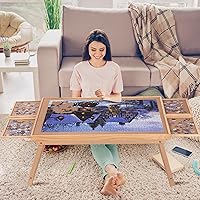
ALL4JIG 1500 Puzzle Table Review: Worth It? (November 2026)
The ALL4JIG puzzle table suits puzzlers who want a dedicated workspace with adjustable height, tilt, drawers and a cover, without assembly. Choose the main 1500-piece model if its working height fits your chair and you have room to leave it set up.
On this page (9 sections)
- What does the ALL4JIG puzzle table offer?
- Will your puzzle and room fit the table?
- How should you set the height and tilt?
- How useful are the drawers, cover and wheels?
- When should you choose the other ALL4JIG model?
- When is HEBESPACE the better choice?
- How should you care for the work surface?
- What mistakes should you avoid before buying?
- Which ALL4JIG puzzle table should you choose?
The ALL4JIG puzzle table is a good choice for regular puzzlers who want a dedicated, adjustable workspace without assembly. Buy the main 1500-piece model if its height suits your seat and you have floor space for both the table and its open drawers.
Its main benefit is keeping a project ready for the next session while freeing your dining table. The buying decision comes down to chair fit, finished puzzle dimensions and how often you'll move the setup.
What does the ALL4JIG puzzle table offer?
The main model combines height adjustment, a tilting top and built-in piece storage in a freestanding table. It suits someone who puzzles often enough to give the hobby a regular place in the room.
ALL4JIG 1500 Table with Legs: Best for seated puzzle sessions

- Height adjusts from 28 to 34.5 in
- 3 tilt angles or flat
- 4 drawers and a translucent cover
- 4 caster wheels, 2 lock
Choose this table for a regular puzzle spot beside a suitable chair or sofa. It combines height and angle adjustment with storage and a cover, and requires no assembly.
Pros
- No assembly required
- Height and tilt adjust separately
- Drawers keep sorted groups off the work surface
- Two casters lock for stationary use
Cons
- Needs 3 inches of clearance to slide the base under furniture
- Fixed tilt positions offer less angle choice than a wider-range design
The New Zealand pine top has a stated puzzle area of 24.53 x 33.19 inches, and the table uses a metal frame. Its height adjusts from 28 to 34.5 inches, with 3 tilt positions plus flat.
Four drawers hold sorted pieces, while a translucent cover goes over unfinished work. Four casters let you roll the table, and 2 lock to help hold it in place.
The main model earns its 8.9 score here because it combines these features with no assembly required. The alternatives each score 8.4 and serve more specific needs: a broader angle range or a lower work surface.
Who should buy the main ALL4JIG puzzle table?
Choose it if you want to sit down and resume a puzzle without clearing another table. It also suits someone who prefers a few fixed angle choices over adjusting the top through a broad range.
Skip it if your comfortable working height falls below its minimum, or if you'd need to carry it upstairs after each session. Wheels help on a clear floor route, but they don't make a freestanding table as easy to store as a separate board.
Will your puzzle and room fit the table?
Check finished puzzle dimensions before piece count. A 1500-piece label is a starting point, since puzzles with the same number of pieces can have different shapes and measurements.
Compare the puzzle box dimensions with the usable assembly area, leaving some space around the border for your hands. Don't assume the full outside dimensions of a table equal the area available for building.
A puzzle that nearly fills the surface leaves little room for loose pieces beside it. Decide whether you'll sort in the drawers, on a nearby tray or on another surface before buying.
Our 1,500-piece puzzle size guide explains how to compare finished dimensions and working space. For unusually wide or tall puzzles, the measurements matter more than the count on the box.
The base needs 3 inches of clearance to slide beneath a sofa or bed. Measure the actual route under the furniture, including any low frame rails, rather than checking only the gap at the front.
Leave room for your knees, chair movement and drawers opening on the sides. Painter's tape on the floor can help you judge whether the table will block a walkway or crowd nearby furniture.
For a tight room, plan its parking spot as carefully as its working spot. Our guide to placing a puzzle table in a small room covers layouts that leave access around the table.
If no workable floor space exists, compare it with a board used on furniture you already have. The puzzle tables and boards guide explains which setup fits each storage routine.
How should you set the height and tilt?
Set chair position and table height before tilt. An angled surface won't solve a setup that leaves your shoulders raised or makes you reach across a large gap.
Sit back in your usual chair with your feet supported. Bring the table close enough to reach the near edge while leaving room for your legs and any chair arms.
The main model uses 4 screw buttons for height adjustment. With the surface clear, follow the table's instructions and secure each adjustment point before placing the puzzle on top.
Start with the surface flat, then choose a shallow angle if you want a clearer view. Check both the near edge and far corners, since a position that feels comfortable at the bottom can still leave the top hard to reach.
A guide to puzzle table height can help you match the work surface to your chair. Use your normal seat for this check, especially if you plan to puzzle from a soft sofa that sinks under your weight.
Keep loose pieces in drawers or trays when changing the angle. Tilt gradually and watch for movement before committing a large assembled section to that position.
Don't keep increasing the angle just because another setting is available. The useful position is the one that lets you see and reach the puzzle while keeping pieces where you put them.
How useful are the drawers, cover and wheels?
These features are most useful when a puzzle stays in progress for several days. They reduce how much you need to pack away, but each works better with a simple routine.
Give each drawer a clear job, such as edges, lettering, sky or a distinct color group. Keep the active group close to you instead of opening every drawer at once and reaching around the table.
Avoid filling drawers so tightly that pieces catch when they close. If a group becomes too large, split it into smaller sections using separate trays.
The cover helps keep dust and accidental contact off the work surface between sessions. Don't stack books, craft tools or drinks on it, and choose a location where pets can't climb onto the table.
Before moving the table, return the top to flat, close the drawers and clear the route. Release the caster locks for movement, then engage them again at the new spot.
Roll slowly across smooth flooring and stop at raised thresholds. If a route requires lifting, put loose pieces in closed containers before moving the table.
For longer breaks, see how to store puzzles between sessions. A cover over the table and a separate container for overflow pieces solve different parts of the storage problem.
When should you choose the other ALL4JIG model?
Choose the ALL4JIG 1500 Table with Legs and Wheels if you want a felt surface and more angle choice for different hobbies. It makes the most sense for someone who will use the table for reading or crafts as well as puzzles.
ALL4JIG 1500 Table with Legs and Wheels: Best for mixed craft sessions

- 0° to 90° tilt
- Adjustable height
- Non-slip felt surface
- 4 drawers, cover and caster wheels
A choice for people who want a felt surface and a broad angle range for puzzles, reading and crafts. Assembly is required, and the exact height range needs confirmation before matching it to a seat.
Pros
- Broad tilt range for different activities
- Non-slip felt work surface
- Four drawers for separate piece groups
- Cover and caster wheels included
Cons
- Assembly required
- Exact height range needs confirmation
- Maximum tilt isn't a useful target for loose puzzle pieces
This model offers 0° to 90° tilt, adjustable height and a stated puzzle area of 24.92 x 33.58 inches. It requires assembly and weighs 20.9 pounds.
The broad angle range is useful for changing activities, but a near-vertical position isn't a sensible goal for a loose jigsaw. Start shallow and choose an angle based on piece movement and reach.
Its non-slip felt surface is a reason to consider it if you prefer that material beneath your puzzle. Felt still needs care, and it doesn't remove the need to secure loose pieces before moving or adjusting the table.
Both ALL4JIG models have wheels, so the product names don't distinguish their mobility. Compare the surface, angle adjustment and setup requirements instead.
Skip this version if you want to avoid assembly or need a confirmed height match for a particular seat. Confirm its exact height range before ordering if chair fit is the deciding factor.
When is HEBESPACE the better choice?
Choose HEBESPACE when the main ALL4JIG sits too high for your preferred chair. Its lower minimum height is the clearest reason to consider it.
HEBESPACE 1500 Metal Table with Legs: Best for low seated setups

- Height adjusts from 22.16 to 33.27 in
- 0° to 30° pneumatic tilt
- 4 drawers with non-slip liners
- Cover and 4 casters, 2 lock
Choose this metal-frame alternative when you need the work surface to sit lower. Its one-touch pneumatic tilt suits puzzlers who expect to change the viewing angle during a session.
Pros
- Lower minimum working height
- One-touch pneumatic tilt control
- Non-slip drawer liners
- Two locking casters
Cons
- Assembly required
- Tilt stops at 30°
- Needs a dedicated floor space
The HEBESPACE adjusts from 22.16 to 33.27 inches, with a 35.43 x 27.87-inch work surface. Its iron frame supports a top with one-touch pneumatic tilt from 0° to 30°.
That tilt control suits someone who expects to change the viewing angle during a session. The pneumatic feature controls the angle; don't assume it also powers the height adjustment.
Four drawers have non-slip liners, and a cover protects the work between sessions. It also has 4 casters, including 2 that lock, and requires assembly.
Skip it if you want a steep surface for other activities or would rather avoid putting a table together. If your chair already fits the main ALL4JIG well, decide whether the different tilt control is useful enough to change your choice.
How should you care for the work surface?
Keep moisture, crumbs and adhesive away from the assembly area. A clean surface makes pieces easier to slide, sort and inspect.
Remove loose pieces before cleaning so you don't sweep one into a cloth or onto the floor. Use a soft brush for dry debris and follow the care instructions for the wood, felt and cover.
Avoid soaking any surface or spraying cleaner directly onto it. Let the work area dry fully before returning cardboard pieces.
Keep puzzle glue away from the table unless the work surface is protected with a suitable separate backing. A finished puzzle can be moved to that backing before any preserving work begins.
For a practical routine covering angle changes and end-of-session care, read how to use a puzzle board. The same habits help protect pieces on a table.
What mistakes should you avoid before buying?
The biggest mistake is choosing by feature count before checking fit. A table can have useful storage and adjustment yet still be wrong for your puzzle, chair or room.
- Buying by piece count alone: compare the finished puzzle's width and height with the assembly area.
- Measuring with the chair empty: sit in your usual position before judging table height and reach.
- Forgetting open drawers: allow room beside the table as well as beneath it.
- Choosing the steepest tilt: use the lowest angle that gives you a comfortable view.
- Treating wheels as carrying handles: plan a floor route and avoid moving a loaded table over steps.
- Using the cover as storage space: put books, drinks and hobby tools elsewhere.
Also consider how often the table must disappear from the room. If putting it away after every session is essential, our comparison of a puzzle table versus a board can help you choose a setup you'll keep using.
Which ALL4JIG puzzle table should you choose?
Pick the main ALL4JIG 1500 Table with Legs for a regular seated puzzle spot when its height fits your chair. It is the clearest choice here if avoiding assembly matters and a few fixed tilt positions meet your needs.
Choose the other ALL4JIG model for its felt surface and broader angle range across puzzles and crafts. Choose HEBESPACE when a lower work surface or one-touch pneumatic tilt matters more.
Before ordering an ALL4JIG puzzle table, write down your puzzle dimensions, comfortable working height and available floor space. For a broader comparison of table styles, use the puzzle table and board buying guide.
Frequently asked questions
Is the ALL4JIG 1500 Table with Legs adjustable?
Yes, the main model adjusts from 28 to 34.5 inches high and offers 3 tilt angles plus flat. Match the height to your seat before choosing an angle, then check that you can reach the far edge without leaning forward or lifting your shoulders.
Does the ALL4JIG puzzle table have drawers and a cover?
Yes, it includes 4 drawers and a translucent cover for organizing pieces and covering work between sessions. Use the drawers for small sorted groups, and keep excess pieces in separate containers rather than crowding the surface or forcing the drawers shut; keep drinks away from the puzzle.
Can you move the ALL4JIG table around a room?
Yes, its caster wheels let you roll it to another spot, and 2 wheels lock for stationary use. Before moving an unfinished puzzle, return the top to flat, close the drawers and clear the route; stop at thresholds rather than pushing hard enough to jolt the table.
Does the ALL4JIG 1500 Table with Legs need assembly?
No assembly is required for the main ALL4JIG 1500 Table with Legs; initial setup still matters: choose a level spot, check the adjustment controls and set the table for your chair before adding pieces. The other ALL4JIG model and the HEBESPACE alternative discussed here require assembly.