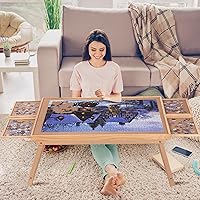
Becko 1500-Piece Tilting Puzzle Table Review: Worth It? (November 2026)
The five-drawer Becko puzzle table suits puzzlers who want a dedicated rolling workspace with adjustable height, tilt and built-in sorting. Choose it after checking your puzzle's finished dimensions and your preferred working height.
On this page (9 sections)
- What does the Becko 1500-piece tilting puzzle table offer?
- How much room does the Becko table need?
- Is the tilt and height range right for your chair?
- How should you use the drawers, cover and wheels?
- When is the four-drawer Becko the better choice?
- When should you choose the upvercy instead?
- How should you set up and care for a puzzle table?
- What mistakes should you avoid before choosing a model?
- Which Becko puzzle table should you choose?
The five-drawer Becko puzzle table is a good fit for puzzlers who want a dedicated work surface with built-in sorting, adjustable height and tilt. Choose it if you leave puzzles in progress and want to keep pieces together between sessions.
The four-drawer Becko makes more sense when upright tabletop storage matters, while the upvercy suits a lower seated workspace. Your puzzle's finished size, chair and available floor space should decide which one comes home.
What does the Becko 1500-piece tilting puzzle table offer?
The five-drawer Becko combines a sloped work surface and separate sorting storage on a rolling frame. It's most useful when you want to stop clearing a dining table after each puzzle session.
Becko 1500 Tilting Table, 5 Drawers: Best for organized sorting

- 5 angle adjustments up to 30°
- Height adjusts from 27.6 to 35.4 in
- 5 drawers and clear protective cover
- 4 wheels, 2 lockable
Choose this Becko for a dedicated puzzle station with separate sorting drawers and a clear cover. Adjustable height and tilt let you change the work surface to suit your chair and viewing angle.
Pros
- Five differently colored sorting drawers
- Five tilt settings up to 30°
- Clear cover helps keep dust off unfinished puzzles
- Bottom shelf stores boxes and accessories
Cons
- Minimum height may be too high beside a low seat
- Needs floor space plus clearance for drawers and a chair
Its smooth flannel surface adds friction beneath puzzle pieces, and the colored drawer linings help you tell sorting groups apart. A clear cover goes over unfinished work, with a lower shelf for boxes or other accessories.
The frame uses metal alongside pinewood and particleboard. This is a freestanding piece of furniture, so plan a regular parking spot rather than treating it like a board you can tuck onto any shelf.
Who should choose the five-drawer Becko puzzle table?
Choose it if sorting and returning to an unfinished puzzle are central to your routine. Separate drawers suit puzzles with several distinct areas, such as sky, buildings, foliage and patterned borders.
The extra drawer is useful when you regularly run out of sorting groups. It adds less value if you spread every piece face up beside the puzzle and rarely put loose pieces away.
Skip this model if you need a low surface beside a deep sofa or expect to carry your puzzle workspace between floors. Wheels help with rolling on the same level; they don't replace a portable board.
How much room does the Becko table need?
Allow for a 36.2 x 25.2 in assembled footprint, plus space for your chair, open drawers and movement around the table. Its usable puzzle area is 35.4 x 24.4 in, which is the measurement to compare with your puzzle box.
A puzzle that nearly fills the usable area leaves little room for loose pieces. In that case, plan to sort in drawers or separate trays rather than count on a wide border around the picture.
Piece count is only a rough guide to fit. A long panoramic puzzle can need a different surface from a more square puzzle with the same number of pieces.
Mark the table's footprint on the floor with removable tape before ordering. Sit beside that outline and check whether someone can still pass behind your chair.
Measure the route to its storage spot too, including tight turns and doorways. Avoid a plan that requires rolling a puzzle over steps or lifting the table whenever you finish a session.
For a closer fit check, see what size puzzle table fits a 1,500-piece puzzle.
Is the tilt and height range right for your chair?
The five-drawer Becko adjusts from 27.6 to 35.4 in high, with five angle settings up to 30°. Height sets where your arms work, while tilt changes how you view and reach across the picture.
Start by sitting in the chair you'll actually use, with your feet supported and shoulders relaxed. Measure a surface where your forearms can rest comfortably without lifting your shoulders.
Check knee space as well as tabletop height. A suitable top height won't help if the chair arms, frame or storage beneath the table stop you from sitting close enough.
The top setting may suit some standing users, but it won't suit everyone. Compare it with your own comfortable standing work height before choosing this table for that purpose.
Begin puzzling with a shallow tilt rather than the steepest setting. Check a few loose pieces before placing large connected sections on the slope, and keep frequently used pieces within easy reach.
Tilt also changes the height of the far edge, so reassess your reach after adjusting it. Bring the work closer or change position rather than leaning across the whole board for every piece.
The guide to tilting, rotating and covering a puzzle board explains how these features affect use. For chair measurements, see how high an adjustable puzzle table should be.
How should you use the drawers, cover and wheels?
Use the drawers for distinct sorting groups, the cover for breaks and the wheel locks whenever you work. These features help most when you give each one a clear job.
For a landscape puzzle, you might separate edge pieces, sky, water, greenery and buildings. For an abstract image, groups based on line direction or texture may be easier to search than broad colors.
Keep pieces in a shallow layer where possible. A crowded drawer hides useful details and turns every search into another round of sorting.
The drawer magnets help keep the five-drawer Becko's drawers closed between sessions. Still, close every drawer before rolling the table and check that nothing sticks out.
Use the lower shelf for items you need less often, such as the box or spare trays. Keep the reference picture where you can see it without repeatedly bending down.
The clear cover helps keep dust off your work and leaves the picture visible. Treat it as a protective layer, not a secured enclosure that makes the puzzle safe from a determined pet.
Before moving the table, return the top to flat, close the drawers and clear loose accessories. Move slowly with the frame under control, then lock the wheels again at the destination.
If your puzzle has more useful sorting groups than the drawers can hold, how to sort puzzle pieces with trays explains how to add temporary sorting space.
When is the four-drawer Becko the better choice?
Choose the four-drawer Becko when moving the table aside and storing the top upright matter more than having another drawer. It's a practical alternative for a shared room where the puzzle station can't stay in its working position.
Becko 1500 Tilting Table, 4 Drawers: Best for shared living rooms

- Height adjusts from 27.6 to 35.4 in
- 4 differently colored drawers
- Tabletop flips to 90° for storage
- Protective cover and 4 wheels, 2 lockable
This Becko suits a room where the table needs to move aside between sessions. Its top flips upright for storage against a wall, while four colored drawers keep sorting groups separate.
Pros
- Tabletop flips upright for storage
- Four color-coded drawers
- Protective cover included
- Bottom shelf holds boxes or accessories
Cons
- One fewer sorting drawer than the five-drawer Becko
- Upright storage should not be assumed safe for an unfinished puzzle
It shares the five-drawer model's usable puzzle area and height range. Four colored drawers handle sorting, a gray felt cover protects work from dust, and the lower shelf holds boxes or accessories.
The tabletop flips to 90° for storage against a wall. That feature helps with parking the table, but the base still needs floor space.
Don't assume the cover secures loose pieces or an unfinished puzzle for vertical storage. Clear the surface before turning it upright unless the instructions explicitly permit storing a puzzle that way.
This distinction matters if you want to put a large unfinished puzzle away every evening. A top that parks vertically is useful only if that storage method fits how you handle work in progress.
Skip this model if you regularly need a fifth sorting group or want the five-drawer model's clear cover. Choose it because its storage arrangement solves a room problem, rather than simply because it has fewer drawers.
When should you choose the upvercy instead?
Choose the upvercy if your preferred seated work height is below the Becko's minimum. Its height adjusts from 22.2 to 31.5 in, making it the first alternative to consider beside a lower seat.
upvercy 1500 Adjustable Table: Best for low seated workspaces

- Height adjusts from 22.2 to 31.5 in
- 6 tilt angles
- 2 divided wooden drawers and 1 fabric drawer
- 4 wheels, 2 lockable
The upvercy suits puzzlers who need a lower work surface beside their seat. Divided wooden drawers separate pieces into eight sections, with a fabric drawer for accessories.
Pros
- Lower minimum height than either Becko
- Six tilt positions
- Eight sorting sections across two wooden drawers
- Separate fabric drawer for accessories
Cons
- Lower maximum height than either Becko
- Confirm usable puzzle dimensions before choosing it for a large puzzle
It offers six tilt positions, a felt work surface and edge stoppers around all sides. Two wooden drawers divide into eight sorting sections, while a separate fabric drawer holds accessories.
Count sorting sections rather than drawer fronts when comparing storage. The divided layout suits someone who wants several small groups, while separate undivided drawers allow more freedom in how pieces spread out.
Its translucent cover provides a protective layer over the puzzle. Keep drinks elsewhere, since a cover shouldn't become a reason to leave liquids beside unfinished work.
Skip the upvercy if you need the Becko's higher top setting. Also confirm the usable work area before buying it for a particular large puzzle, since overall furniture dimensions don't tell you the clear space available for assembly.
Its 1500-piece name is not enough to settle that fit question. Choose it for its lower working position after checking that your puzzle fits.
How should you set up and care for a puzzle table?
Set up the table on a level floor with enough room to adjust it, then follow its instructions before adding puzzle pieces. Make your first height and angle changes with the surface clear.
Check the fasteners and adjustment knobs before use, and engage both wheel locks. Sit in place to confirm that your knees fit and you can reach the middle without stretching.
Keep the first sorting session simple. Put the border in one group, choose a few large visual sections and leave room to change the groups as the image develops.
For care, lift away loose cardboard dust with a soft brush. Follow the care instructions for deeper cleaning, avoid soaking fabric or wood-based parts, and let any cleaned surface dry fully before replacing pieces.
Keep food, drinks and puzzle glue away from the working surface. If you plan to preserve a finished puzzle, arrange a suitable transfer or finishing surface before starting that step.
Recheck knobs and fasteners if the table develops movement during use. Stop and correct the cause before continuing with a tilted surface.
What mistakes should you avoid before choosing a model?
Avoid choosing by piece count, drawer count or maximum height alone. Each number helps only when it matches the puzzle and the way you sit, sort and store.
- Buying for an exact edge-to-edge fit: leave working space or plan separate sorting storage.
- Measuring the room without the chair: include the space you occupy while seated and getting up.
- Assuming adjustable means suitable for everyone: compare the full height range with your own chair and posture.
- Choosing extra drawers without a sorting plan: think about the groups you use and how large they become.
- Treating upright storage as puzzle storage: a folding or flipping top doesn't by itself secure unfinished work.
- Planning to move the table with drawers open: close storage and flatten the work surface first.
For smaller rooms, where to put a puzzle table in a small room covers placement ideas. If you're still weighing a freestanding table against a board, compare the options in puzzle tables and boards.
Which Becko puzzle table should you choose?
Choose the five-drawer Becko puzzle table if you have a regular floor spot and want distinct sorting groups beside an unfinished puzzle. Its extra drawer and clear cover suit someone who returns to the same project over several sessions.
Choose the four-drawer Becko if parking the top upright solves a space problem and you're prepared to clear the surface for that storage position. Choose the upvercy when a lower seated work surface is the deciding need.
Before ordering, write down your puzzle's finished dimensions, comfortable work height and parking space. If one fails the fit check, choose a different setup rather than planning around an awkward reach or blocked walkway.
Once those measurements work, start with a flat surface and adjust gradually. Use how to use a puzzle board to plan your first session, including tilt, piece placement and covering unfinished work.
Frequently asked questions
Does the Becko 1500-piece puzzle table tilt?
The five-drawer Becko has five angle settings up to 30°; its flannel surface adds friction beneath the pieces, but start with a shallow slope and check that loose pieces stay put before increasing the angle. Return the surface to flat before moving the table.
How tall is the Becko puzzle table?
Both Becko models adjust from 27.6 to 35.4 in using knobs on the legs; compare that range with a comfortable work surface while sitting in your usual chair. If you want to work standing up, check the upper limit too, since it won't suit every person's standing posture.
Will the Becko table fit a 1,500-piece puzzle?
Both Becko tables have a usable puzzle area of 35.4 x 24.4 in; Becko describes them as fitting most puzzles up to 1,500 pieces, but finished dimensions decide the fit. Check the puzzle box and allow extra space if you want to keep loose pieces beside the assembled picture.
What is the difference between the Becko four- and five-drawer tables?
The five-drawer Becko adds another sorting drawer, a clear cover and five tilt settings up to 30°; the four-drawer version has a gray felt cover and a top that flips upright for storage. Both share the same usable puzzle area and height range, so choose around sorting and storage habits.