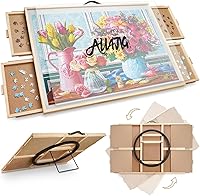
ALL4JIG vs Playboda Rotating Puzzle Boards: Which Is Better? (November 2026)
In Playboda vs ALL4JIG, choose ALL4JIG for wood and a translucent cover or Playboda for easier surface cleaning. Choose Playboda's smaller model only after checking your puzzle's finished dimensions.
On this page (9 sections)
- Playboda vs ALL4JIG: what should decide your choice?
- Who should buy ALL4JIG, and who should skip it?
- Who should choose either Playboda size?
- How do you check puzzle fit and rotation clearance?
- Which cover and drawer setup suits your habits?
- How should you set up a rotating puzzle board?
- How should you clean, move and store these boards?
- What mistakes make either board harder to use?
- Playboda vs ALL4JIG: which should you buy?
In Playboda vs ALL4JIG, choose ALL4JIG if you want wood and a see-through cover; choose Playboda if easy cleaning is your priority. Pick the smaller Playboda only when your puzzles fit its working area.
All 3 boards rotate, have 4 sorting drawers and include a cover. Those shared features help you keep a project together, but surface care, puzzle fit and storage space should decide which one you buy.
If rotation is your main priority, see our guide to rotating puzzle boards. For a broader choice of workspaces, start with the complete puzzle table and board guide.

 Best for frequent puzzle sessions
Playboda 1500 Rotating Board, Drawers and Cover
Playboda vs ALL4JIG: what should decide your choice?
Choose by material, puzzle dimensions and your between-session routine. Rotation and drawers appear across these models, so they do little to separate the brands.
ALL4JIG makes sense for a dry workspace where you prefer the look and feel of wood. Its translucent cover also lets you check the puzzle without uncovering it.
Playboda makes sense if you finish puzzles often and want to wipe the surface before starting another. Its ABS plastic work surface is waterproof, though a cardboard puzzle resting on it still needs protection from liquids.
Size comes next: a board should fit your usual puzzles and the place where it will wait between sessions. Buying extra capacity helps only if you can comfortably use, turn and store the larger board.
Playboda or ALL4JIG for your usual routine?
Choose ALL4JIG for a wooden workspace; choose Playboda for simpler cleanup. If both appeal, picture the task you repeat most often: uncovering an ongoing project, clearing puzzle dust or moving the board off a dining table.
A gift buyer should check those habits before choosing by appearance. The recipient's puzzle boxes and storage spot tell you more about a suitable board than their favorite piece count alone.
Who should buy ALL4JIG, and who should skip it?
Buy ALL4JIG if you prefer wood and can give the board a dry, supported place to sit. It suits a puzzler who values a translucent cover and wants the board to remain visible in a shared room.
The smooth wooden surface provides a place to assemble pieces, while its drawer handles help you open separate sorting groups. ALL4JIG also describes the board as suitable for building bricks, diamond painting and fuse bead projects.
That second use is useful if your craft area serves several hobbies. Clear away small craft parts before returning to a puzzle so they don't mix with loose pieces or interfere with the rotating base.
Skip this model if frequent damp cleanup is a central part of your routine. Wood calls for more caution around moisture, and Playboda is the more direct choice for a wipe-clean work surface.
Also pause if your puzzle would come close to the board's edges. ALL4JIG's dimensions conflict across its specifications, so confirm both the clear working area and outside footprint before ordering.
Our ALL4JIG 1,500-piece board review takes a closer look at this option if wood is already your preference.
Who should choose either Playboda size?
Choose Playboda if surface cleanup matters more than having a wooden board. Both sizes have a warm white background, which Playboda says helps pieces stand out without glare.
That background may appeal if your puzzles contain many dark sections or subtle color changes. Good room lighting still matters: place your lamp so your hands don't cast a shadow across the section you're assembling.
Choose the larger Playboda for larger projects
The 1,500-piece Playboda is the better choice if you regularly assemble larger puzzles or want more room around smaller ones. Its stated board size is 35 x 27 in, so plan a storage spot before choosing it.
Extra room can hold small assembled sections while you work on the border. It also lets you keep a few active pieces near the section where they belong instead of returning every piece to a drawer.
Skip the larger model if carrying and storing a broad board would interrupt every session. A board that becomes awkward to put away may be less useful than a smaller one matched to your usual puzzles.
Choose the smaller Playboda for puzzles that fit
The smaller Playboda offers a 30 x 22 in working area within an overall 32 x 24 in footprint. It suits many standard 1,000-piece puzzles and takes less space than the larger Playboda.
It does not fit White Mountain and Springbok 1,000-piece puzzles measuring 24 x 30 in. Playboda recommends its larger model for those puzzles.
Skip the smaller board if your favorite puzzle brands regularly use oversized formats. It is also a poor fit if you want to spread most loose pieces around a nearly board-sized puzzle.
How do you check puzzle fit and rotation clearance?
Measure the finished puzzle, the usable board surface and the space around the board. Each measurement answers a different question, and piece count cannot replace any of them.
Start with the finished dimensions printed on the puzzle box. Compare both sides with the clear assembly area, allowing some room to move pieces and lift completed sections.
A puzzle that just matches the board's limits leaves no spare work area. If that is your usual puzzle size, plan to sort mostly in drawers or separate trays.
Next, measure your table and the nearby obstacles. A rectangular board's corners swing outward as it turns, so fitting it neatly between a wall and a lamp does not mean it can rotate there.
Make a paper or cardboard outline of the outside footprint and turn it through the intended space. Include room to pull out drawers without hitting a chair arm, table edge or neighboring object.
Finally, measure the storage opening, including height. A low gap under a bed is useful only if the board, cover and base can pass through without scraping or tilting the unfinished puzzle.
Our guide to what size puzzle table fits a 1,500-piece puzzle explains how puzzle shape and finished dimensions affect the space you need.
Which cover and drawer setup suits your habits?
Choose ALL4JIG's translucent cover for visibility or Playboda's rubber mat cover if you prefer that cover style. Neither choice removes the need to keep pieces flat and handle the board carefully.
Being able to see the puzzle can help you decide where to resume without lifting the cover. Playboda says its natural rubber mat fits closely over pieces and resists shifting.
Before covering, separate any stacks of loose pieces and check for pieces standing on edge. A cover should rest over an even arrangement, rather than press against a pile or raised section.
Use the drawers for broad groups you can recognize later. Borders, sky, buildings and foliage are useful starting categories for a landscape puzzle, but a different image may need a different system.
Leave enough room in each drawer to move pieces aside while searching. Overfilling makes it harder to see shapes and increases the chance that a piece catches when you close the drawer.
The drawers don't have to hold every unused piece. If you prefer spreading pieces face up, our guide to sorting puzzle pieces with trays explains how separate trays can support that routine.
For more storage ideas, see how to store unfinished puzzles. Our puzzle board feature guide can help you weigh cover style against other features.
How should you set up a rotating puzzle board?
Set the board on a stable, level surface and check its movement before adding pieces. These are tabletop boards, so your existing table and chair determine the working height.
Start with an empty board and make sure the base sits securely. Both Playboda models have a tool-free removable base; follow the included assembly directions and check that it is seated before turning.
Turn the empty board through a full circle, then open each drawer. Move nearby objects until neither motion catches on anything.
Choose a seat that lets you reach the near edge with relaxed shoulders. Rotation helps bring sections closer, but a flat board on a low coffee table can still leave you bending forward.
If viewing angle is your main concern, compare the options in our guide to rotating and tilting puzzle boards. A rotating base changes reach; a tilting surface changes the angle at which you see and work on the puzzle.
Once the setup is comfortable, build the border within the working area and assign your sorting groups. Our guide to using a puzzle board covers turning, covering and arranging a project between sessions.
How should you clean, move and store these boards?
Clean the empty surface, let it dry and move an unfinished puzzle with the board level. A cover helps protect the project, but careful handling still matters.
For Playboda, wipe puzzle dust from the plastic surface with a damp cloth. Use only as much moisture as needed, then let the surface dry before adding cardboard pieces.
For ALL4JIG, start with a soft, dry cloth and follow its care instructions for marks that need more attention. Avoid soaking the wood or leaving moisture against it.
Keep crumbs and loose pieces away from the base and drawer openings. If a drawer resists closing, stop and check for a trapped piece rather than pushing harder.
Before moving the board, close the drawers and place the cover over the puzzle. Clear the route first, support the board evenly and avoid tipping it to squeeze through a narrow gap.
Don't use the cover as a handle or assume it secures loose pieces for upright storage. Keep the project flat unless the board's instructions expressly allow another position.
Playboda says you can apply puzzle glue directly on its plastic surface. Check the adhesive's directions first, protect the surrounding table and avoid letting glue run toward drawers or the rotating mechanism.
A waterproof work surface does not mean every adhesive will release cleanly. Use a suitable barrier if the glue instructions call for one, especially when preserving a puzzle for the first time.
What mistakes make either board harder to use?
The biggest mistakes are buying by piece count, ignoring turning space and treating the cover as a carrying lock. Each can leave you with a board that fits your plans on paper but disrupts actual use.
- Buying too close to the size limit: leave space to handle the border and move small sections instead of filling every inch.
- Sorting everything onto the main surface: use drawers or trays so loose pieces don't crowd the assembly area.
- Turning with drawers open: close them first to reduce the chance of catching a drawer on nearby furniture.
- Spinning too quickly: rotate slowly, especially when loose pieces sit near the edge.
- Choosing extra size without a storage plan: measure the route and resting place before committing to a larger board.
- Leaving drinks beside the puzzle: a waterproof plastic surface protects the board better than it protects cardboard pieces.
- Assuming removal means safe storage: detaching a Playboda base still leaves you needing a flat, supported place for the board.
You should also avoid choosing either brand to solve a need for adjustable height. If your table is the wrong height, the board will keep that same basic seating problem.
Playboda vs ALL4JIG: which should you buy?
Buy the board that fits your largest regular puzzle and the routine you can sustain. Once fit is settled, use surface care and cover preference to make the final choice.
- Choose ALL4JIG if you want wood, value seeing through the cover and have a dry place to work and store the board.
- Choose Playboda 1,500 if you prefer damp-cloth cleanup and need room for larger puzzles or oversized 1,000-piece designs.
- Choose Playboda 1,000 if your usual puzzles fit comfortably and saving space matters more than keeping room for future larger projects.
- Skip all 3 if you need a freestanding table, adjustable height or a tilted working angle.
Before buying, write down your usual puzzle dimensions and measure one realistic storage spot. Those 2 checks will settle more of the Playboda vs ALL4JIG decision than the shared drawer and rotation features.
If neither brand fits that space, compare alternatives in our best rotating puzzle boards guide.
Frequently asked questions
Is Playboda or ALL4JIG better for a rotating puzzle board?
Choose ALL4JIG if a wooden surface and translucent cover suit your room and routine; choose Playboda if easy surface cleaning matters more, then select its size by your puzzle's finished dimensions. The shared rotation and drawer features make material, fit and cover handling the more useful deciding factors.
Do ALL4JIG and Playboda boards both rotate?
Yes, the ALL4JIG board and both Playboda models use a Lazy Susan base for full rotation; both Playboda bases also detach without tools. Leave room for the board's corners to swing, close the drawers before turning, and keep loose pieces away from the edge during each turn.
Which Playboda size should I choose?
Choose the smaller Playboda only if your puzzle fits its 30 x 22 in working area with enough room for comfortable assembly; White Mountain and Springbok 1,000-piece puzzles measuring 24 x 30 in will not fit. Playboda recommends its larger board for those puzzles, so check inches before piece count.
Are the covers on ALL4JIG and Playboda the same?
No, ALL4JIG has a translucent cover, while both Playboda models have a natural rubber mat cover; the translucent option lets you see the puzzle below it. Place either cover over a flat arrangement of pieces, close the drawers, and keep the board level when moving it between sessions.