9 Best Puzzle Board That Does Not Use Felt (November 2026)
The best puzzle boards without felt surfaces include the Tektalk Jigsaw Puzzle Board Portable Puzzle Mat for most puzzlers, the Lavievert 1000 Piece Jigsaw Puzzle Board for sorting and storage, and the WELGEE 1500 Tilt and Rotate Board (best plastic board for gluing).
On this page (5 sections)
The best puzzle board that does not use felt for most people is the Tektalk Jigsaw Puzzle Board Portable Puzzle Mat, which pairs a soft flannelette surface with a dust cover at a weight that suits everyday puzzling. If you want a plastic top you can glue on, the WELGEE 1500 Tilt and Rotate Board is the better buy.
Not everyone wants a wool or synthetic felt top. Felt grips pieces well, but it holds dust, it can pill over time, and glue sinks straight into it when you try to seal a finished puzzle.
That's why this list leaves felt surfaces out and looks at flannelette, hardwood, lacquered wood, ABS plastic and Oxford cloth instead.
The trade-off is real: a non-felt surface often grips a little less than felt, so the best picks here pair their tops with raised edges, mat covers or a rotating base. Start with our puzzle board guide if you're still deciding between a mat, a board and a table.
And if you plan to angle your work, our tilting puzzle board roundup covers that separately.
Our picks at a glance
-
1
 Best for most puzzlers
Tektalk Jigsaw Puzzle Board Portable Puzzle Mat
9.7/10 our score
See it on Amazon -
2
 Best for sorting and storage
Lavievert 1000 Piece Jigsaw Puzzle Board
9.2/10 our score
See it on Amazon -
3

- 4
 Check it
Beyond Innovations 1000 Rotating Board
Best wooden spinner - 5
 Check it
BuilderButler 1000 Rotating Board
Best for compact rooms - 6
 Check it
Playboda 1500 Tilt and Rotate Board
Best large felt-free top - 7
 Check it
BuilderButler 1500 Easel Board
Best for neck and back comfort - 8
 Check it
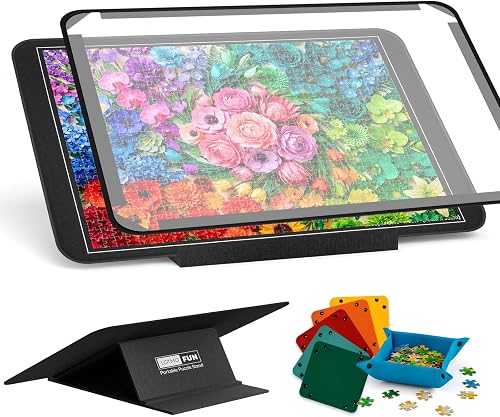
LOTMOFUN Puzzle Board for 1000 Pieces
Best for angled puzzling on a budget - 9
 Check it
RAGOZONERY 1500 Table, Folding Legs
Best free-standing table
The best felt-free puzzle boards for every kind of puzzler
The Tektalk is the strongest all-round pick for everyday puzzling, while the other boards here win on a named need: gluing, storage, spinning, comfort or a smaller footprint. Decide what your surface must do before you compare the extras.
Tektalk Jigsaw Puzzle Board Portable Puzzle Mat: Best for most puzzlers
- Flannelette and polyester fabric surface
- Dust-proof cover included
- Up to 1
- 000 pieces
- 30.7 x 20.9 in
A soft fabric cover grips pieces without wool felt, and the included dust cover lets you pause mid-puzzle.
Pros
- Soft fabric holds pieces in place
- Dust-proof cover included
- Light enough to carry to the couch
Cons
- Tops out at 1,000 pieces
- No sorting drawers or tilt
Tektalk suits the puzzler who works on the couch or in bed and needs to pack the whole project away in one move. The flannelette and polyester fabric is soft enough to hold loose pieces in place, yet it isn't wool felt, so the cover wipes down more easily.
The board measures 30.7 x 20.9 in and takes puzzles up to 1,000 pieces. It's light enough to carry room to room, which matters if you share the living room table with other people.
A dust cover is included, so you can save an unfinished puzzle against dust, damp and pets. The flannelette layer sits over a polyester build that stays anti-bending and sturdy, so the mat doesn't sag when you lift it with pieces on top.
The trade-off is size and features. There's no tilt, no rotation and no sorting drawers, so you spread pieces on the fabric itself.
For straightforward, comfortable puzzling that you can stop and start, though, this is the board to beat.
Buy it if you want a light, grippy surface you can move and cover in seconds. Look elsewhere if you need to spin the board or angle it.
Lavievert 1000 Piece Jigsaw Puzzle Board: Best for sorting and storage
- Detachable board
- Four sorting trays
- Padded cover
- Carry handle
- Up to 1
- 000 pieces
Four trays and a padded cover turn the board into a portable storage kit for people who sort as they go.
Pros
- Four sorting trays included
- Detachable board for solo use
- Handle makes it easy to carry
Cons
- Heavier than a plain fabric board
- No tilt or rotation
Lavievert suits a household that sorts as it goes and wants everything in one bag. The kit includes a removable puzzle board, four sorting trays and a padded cover, all carried by a sturdy handle.
The Oxford cloth and flannelette build is lighter and more compact than a wooden case. The board detaches, so you can work on it alone or leave it in the bag between sessions.
A clear slot on the back takes a name or puzzle title, handy when more than one person in the house has a puzzle on the go. When you're not using the trays, they slot into hook and loop closures so they don't rattle around in transit.
At 30.71 x 20.87 in, it handles up to 1,000 pieces, and the soft felt padding inside helps store an unfinished puzzle intact. It weighs more than the Tektalk, and like the Tektalk it doesn't tilt or rotate.
Pick it when organization matters more than spinning.
Buy it if you want trays, a cover and a handle in one package. Choose the WELGEE or Playboda instead if you want a large board that turns.
WELGEE 1500 Tilt and Rotate Board: Best plastic board for gluing
- Waterproof ABS plastic surface
- 360° rotating base
- Tilt feature
- Four slide-out drawers
- Rubber mat cover
- Up to 1
- 500 pieces
- 35 x 27 in
A smooth plastic top you can glue on directly, with tilt and spin so you reach every corner without stretching.
Pros
- Waterproof surface wipes clean
- Tilt and 360° rotation
- Four drawers for sorting
Cons
- Plastic looks less classic than wood
- Bigger footprint than a 1,000-piece board
WELGEE suits puzzlers who plan to glue and frame the finished picture. Its waterproof ABS plastic surface takes glue directly, with no wax paper or film between puzzle and board, and wipes clean with a damp cloth.
The 35 x 27 in top handles up to 1,500 pieces. Tilt and a 360° rotating base work together: angle the board so you sit up straight, then spin the extra-large 18-inch turntable to reach any corner.
Four slide-out drawers keep pieces sorted by color. A natural rubber mat cover sits tighter than a thin plastic cover, creases less, and protects unfinished work.
The one-piece injection-molded ABS resists bending better than a thin wooden panel, and the warm white surface gives good contrast against piece colors.
The plastic build looks less traditional than wood and takes up real table space. It's also the heavier end of this group once loaded.
The reward is a board you can glue on, wipe down and turn in place.
Buy it for gluing and framing on a big spinning surface. Skip it if you want a wooden top or a small board you can tuck away.
Beyond Innovations 1000 Rotating Board: Best wooden spinner
- Lacquered natural wood surface
- 360° Lazy Susan
- Four drawers
- Transparent puzzle cover
- Up to 1
- 000 pieces
- 30 x 22 in
Natural wood with a smooth lacquer finish and a spinning base, for puzzlers who prefer timber to fabric.
Pros
- Smooth lacquered wood top
- 360° rotating base
- Four drawers and a clear cover
Cons
- No tilt feature
- Wood weighs more than a fabric mat
Beyond Innovations suits buyers who want the look and feel of natural wood without felt. The top is lacquered natural wood, smooth to the touch and resistant to warping with normal use.
The lacquer adds a sealed finish, so a little glue on the surface beads rather than soaking straight in.
A Lazy Susan base spins the 30 x 22 in board 360°, so you can reach across a 1,000-piece puzzle without moving your chair. Four sliding drawers hold extra pieces, and a removable transparent cover keeps a work in progress safe between sessions.
A sticker set comes in the box for labeling drawers or puzzle names.
There's no tilt here, so it's the spinner for people who are happy to puzzle flat. The wood build also weighs more than a fabric mat, which matters if you move the board between rooms.
Pick it when you want timber and rotation in one.
Buy it for a wooden spinner with drawers and a cover. Choose a plastic or fabric board if weight is a concern.
BuilderButler 1000 Rotating Board: Best for compact rooms
- Hardwood surface
- 360° Lazy Susan
- Four drawers
- Translucent cover
- Up to 1
- 000 pieces
- 28.74 x 20.94 in
A smaller wooden rotating board that stows under a bed, with drawers and a cover for tidy storage.
Pros
- Smallest footprint here
- Rounded, sanded edges
- Four drawers plus a cover
Cons
- No tilt
- Tighter space for a full 1,000 pieces
BuilderButler's 1,000-piece board suits small rooms where the puzzle has to disappear under the couch. Its 28.74 x 20.94 in footprint is the smallest here, and the hardwood top has rounded, sanded edges that feel smooth on the hands.
The brand says the wood is biodegradable and free from harmful chemicals, which is a point in its favor if the board will sit in a family room.
It spins 360° on a Lazy Susan base, so the smaller size doesn't stop you reaching the far side. Four drawers with handles sort pieces, and a translucent cover shields an unfinished puzzle from dust and pets.
The natural wood finish makes it a reasonable gift for a puzzle-loving friend. The top also works for diamond painting and fuse beads when the jigsaw is put away.
The smaller top leaves less spare room around a full 1,000-piece puzzle. There's no tilt, and the board is heavier than a fabric mat.
Pick it when floor and table space are tight.
Buy it for compact storage and a wooden spinning top. Go bigger if you regularly build 1,500-piece puzzles.
Playboda 1500 Tilt and Rotate Board: Best large felt-free top
- ABS plastic frame with fabric surface
- 2-in-1 tilt and rotate
- 18-inch rotating base
- Four drawers
- Rubber mat cover
- Up to 1
- 500 pieces
- 35 x 27 in
A big 1,500-piece board with tilt and spin, for puzzlers who want a wide, non-wool surface and room to sort.
Pros
- Large 35 x 27 in top
- Tilt and 360° rotation
- Rubber mat cover included
Cons
- Fabric top needs care when gluing
- Takes up a lot of table space
Playboda suits puzzlers who work big and want a wide, non-wool surface. The 35 x 27 in top takes up to 1,500 pieces and includes four drawers for sorting.
The drawers have rounded handles and straight-edged interiors, and they stay put even when the board is lifted or stood on its side.
It combines tilt with an 18-inch rotating base, so you can angle the board and spin it to any side. The surface is a fabric top on an ABS plastic frame: it isn't wool felt, and the felt layer is built not to bend and to last.
A natural rubber mat cover protects an unfinished puzzle from dust, spills and pets.
Because the top is fabric rather than bare plastic, glue still needs care here. It's also a large board that wants a dedicated table.
Pick it when 1,500-piece projects and comfort matter more than gluing directly on the surface.
Buy it for a big tilting, spinning board for long puzzles. Choose the WELGEE instead if you plan to glue on the surface itself.
BuilderButler 1500 Easel Board: Best for neck and back comfort
- Natural wood surface
- Tilting easel design
- Plastic Lazy Susan base
- Four drawers
- Clear cover
- Up to 1
- 500 pieces
- 34.25 x 25.2 in
A wooden tilting board with a rotating base, for long sessions where sitting up straight matters.
Pros
- Adjustable tilt for comfort
- Rotates 360°
- Four drawers for sorting
Cons
- Oxford cloth top is not for gluing on
- Heavier wood build
BuilderButler's easel board suits long sessions where neck and back strain creep in. The tilting easel design lets you set an angle that keeps you sitting upright, while a plastic Lazy Susan base with a non-slip foot spins the board so you don't stretch for far pieces.
The 34.25 x 25.2 in top takes up to 1,500 pieces. Four sorting drawers and a clear protective cover keep pieces organized and safe between sessions.
The natural wood build is durable and looks good on a table. Beyond puzzles, the drawers hold brushes and tools for painting or diamond painting, and the surface doubles as a laptop tray or a base for building blocks.
Its Oxford cloth top keeps pieces from sliding when tilted, but that same surface isn't ideal for gluing. It's also a heavier wooden board.
Pick it for comfort on long builds, and choose the WELGEE for a gluing-friendly plastic top.
Buy it if comfort during long sessions is your priority. Skip it if you need a smooth surface for glue.
LOTMOFUN Puzzle Board for 1000 Pieces: Best for angled puzzling on a budget
- Felt-free non-slip surface
- Adjustable stand with 13° to 23° angles
- Six puzzle trays
- Velcro-sealed cover
- Up to 1
- 000 pieces
- 32 x 22 in
A stand plus board and six trays, so you can angle the surface and keep pieces sorted.
Pros
- Adjustable 13° to 23° stand
- Six sorting trays
- Cover seals with velcro
Cons
- Glossy pieces need the lowest angle
- No rotation
LOTMOFUN suits puzzlers who want an adjustable angle without paying for a big spinning table. The set includes a board, a stand, six puzzle trays and a cover with a velcro seal.
The 32 x 22 in board takes up to 1,000 pieces, with printed guides for 500-piece projects so you can lay out smaller puzzles evenly. The stand adjusts from 13° to 23°, so you can raise the surface to a comfortable angle and lower it for glossy pieces that slide.
Six trays sort by color. The cover seals on all four sides, which keeps dust and pets away from an unfinished puzzle.
The felt surface is non-slip and resists scratches and water, and the whole set weighs little enough to carry from room to room.
The trade-offs are simple: no rotation, and glossy pieces need the lowest angle. Pick it when you want an angled board and lots of trays without a spinning base.
Buy it for an affordable angled setup with six trays. Choose a rotating board if spinning matters more than tilt.
RAGOZONERY 1500 Table, Folding Legs: Best free-standing table
- Hardwood surface
- Folding legs
- Four drawers with metal clips
- Plastic cover
- Up to 1
- 500 pieces
- 34 x 26 in
A free-standing wooden puzzle table with folding legs, for puzzlers who want a dedicated surface without a table underneath.
Pros
- Folding legs, no table needed
- Four drawers with metal clips
- Large 34 x 26 in top
Cons
- Heaviest and bulkiest pick here
- No tilt or rotation
RAGOZONERY suits puzzlers who want a free-standing table and no setup. The folding legs mean you don't need a table underneath, and the 34 x 26 in hardwood top takes up to 1,500 pieces.
It arrives ready to use, so there's no assembly before the first puzzle.
Four drawers with metal clips stop pieces sliding out when you move the table. A plastic cover protects your work from pets.
The legs fold so the whole thing slides under a sofa or bed, and the light, stable frame works on a floor, a coffee table or even a bed.
The downside is bulk. This is the heaviest, largest pick on the list, and it doesn't tilt or rotate.
The smooth hardwood top moves pieces easily but is a plain wood surface, so treat gluing with the same caution as any unsealed timber. Pick it when you want a dedicated puzzle surface in a spare room and don't mind the footprint.
For spinning and gluing, the WELGEE is the better fit.
Buy it for a dedicated folding puzzle table. Choose a board or mat instead if you need portability or rotation.
How these puzzle boards compare
Every board here skips felt, but they split into three groups: fabric-top boards that grip well, plastic boards you can glue on, and wooden boards that spin. The table below lines up the facts that matter most when you choose.
| Product | Best for | Size | Capacity | Surface | Our score |
|---|---|---|---|---|---|
| Tektalk Jigsaw Puzzle Board Portable Puzzle Mat | most puzzlers | 30.7 x 20.9 in | Up to 1 | Flannelette fabric | 9.7 |
| Lavievert 1000 Piece Jigsaw Puzzle Board | sorting and storage | 30.71 x 20.87 in | Up to 1 | Flannelette | 9.2 |
| WELGEE 1500 Tilt and Rotate Board | plastic board for gluing | 35 x 27 in | Up to 1 | Waterproof ABS plastic | 8.7 |
| Beyond Innovations 1000 Rotating Board | wooden spinner | 30 x 22 in | Up to 1 | Lacquered wood | 8.6 |
| BuilderButler 1000 Rotating Board | compact rooms | 28.74 x 20.94 in | Up to 1 | Hardwood | 8.5 |
| Playboda 1500 Tilt and Rotate Board | large felt-free top | 35 x 27 in | Up to 1 | Fabric top on plastic frame | 8.5 |
| BuilderButler 1500 Easel Board | neck and back comfort | 34.25 x 25.2 in | Up to 1 | Oxford cloth on wood | 8.1 |
| LOTMOFUN Puzzle Board for 1000 Pieces | angled puzzling on a budget | 32 x 22 in | Up to 1 | Non-slip fabric | 8.0 |
| RAGOZONERY 1500 Table, Folding Legs | free-standing table | 34 x 26 in | Up to 1 | Smooth hardwood | 7.8 |
Our score weighs specs, features and buyer feedback against what you're shopping for. The top score goes to the board that best balances grip, portability and value for most puzzlers.
Higher scores don't mean a board suits every job; the WELGEE scores lower overall but wins for gluing.
How we compared these boards
We started with the surface. Any board with a wool or synthetic felt top was left out, so every pick here uses flannelette, hardwood, lacquered wood, ABS plastic or Oxford cloth.
Then we checked size against piece count, so a "1,500-piece" board really has a top near 35 x 27 in.
Next came the extras that change daily use: covers, drawers, tilt and rotation. A board with a cover is easier to pause; a board with drawers keeps pieces sorted; a board that tilts is kinder on the neck.
We also weighed portability, since many puzzlers share the living room table. Weight settled close calls: the Tektalk at 1.24 kg and the LOTMOFUN at 1.5 kg move easily, while the wooden tables at 5 to 9 kg stay put.
Finally we looked at value tiers. A fabric mat and a wooden table do different jobs, so we scored each board against the buyer it's built for rather than against every other board.
A 1,000-piece board in a cramped flat isn't a lesser product than a 1,500-piece table; it's simply built for a different room.
What to look for in a puzzle board without felt
Start with the surface material, then match size to your usual puzzle. The extras matter next, and the last question is how you'll store the board between sessions.
Get those four right and the choice gets easy.
What surface should a non-felt puzzle board have?
Match the surface to how you finish puzzles. If you glue and frame, choose ABS plastic or lacquered wood.
If you pack puzzles away unfinished, flannelette or Oxford cloth grips better and stays quieter.
Plastic is the easiest to clean and the only surface you can glue directly onto without a barrier. Lacquered wood takes glue too, as long as the finish is sealed.
Fabric tops need care: glue can soak in and stain. Fabric also holds dust more than plastic, though a cover helps.
For grip when tilted, textured fabric and rubber mats beat plain plastic. That's why the WELGEE and Playboda pair their surfaces with mat covers.
Keep the finished-puzzle plan in mind from day one, because the surface choice is the hardest thing to change later.
How big a board do you need for 1,000 or 1,500 pieces?
A 1,000-piece puzzle needs about 30 x 21 inches, and a 1,500-piece puzzle needs about 35 x 27 inches. Buy a board slightly larger than that so you have room to spread loose pieces around the edge.
The Tektalk, Lavievert and Beyond Innovations boards sit at roughly 30 x 21 in and take 1,000 pieces. The WELGEE, Playboda, BuilderButler easel and RAGOZONERY boards run near 35 x 27 in and handle 1,500 pieces.
A smaller top like the BuilderButler 1000 leaves less spare space, which matters if you like to lay pieces out wide.
Also check the depth. Most boards here are under an inch thick, but the framed wooden tables add an inch or two, which changes whether they clear the underside of a sofa.
Measure your storage gap before you order a big model.
Do you need tilt and rotation on a felt-free board?
Tilt helps your neck, and rotation helps your reach. You don't need both, but boards with both are the most comfortable for long sessions.
A rotating base lets you spin the puzzle instead of leaning across it.
Tilt raises the far edge so you sit up straighter.
If you mostly build flat on a table, skip both and save the money. If you work for hours at a time, tilt and spin are worth the extra size and weight.
Our guide to using a puzzle board covers how to set the angle and cover your work. For spinners alone, see the rotating puzzle board roundup.
Are wooden puzzle boards harder to store?
Yes, wooden boards are heavier and bulkier than fabric mats. A wooden board with drawers like the Beyond Innovations or BuilderButler models weighs several times more than the Tektalk mat.
That's fine if the board stays on one table.
It's a nuisance if you carry it between rooms.
Fabric mats roll or fold and slide under a couch. Wooden boards usually need a shelf, a closet or space under a bed.
The RAGOZONERY table folds its legs and slides under furniture, but it's still the bulkiest pick here.
Can you glue a puzzle on a board that isn't plastic?
Only on a sealed wood surface. Fabric, raw wood and Oxford cloth can absorb glue and stain.
Check the finish before you commit.
A lacquered top like the Beyond Innovations board is sealed, so glue sits on the surface. A cloth-topped board like the BuilderButler easel is not.
If gluing is central to your hobby, buy the WELGEE. Its waterproof ABS plastic takes glue directly and wipes clean.
Otherwise, glue on a separate sheet and keep the board for assembly.
Should you pick a board with a cover or a drawer set?
Covers and drawers solve different problems, and the best boards here split on which one they favor.
Choose a cover if you pause often
A cover is the quick fix for a puzzle you stop and start. The Tektalk dust cover, the Lavievert padded cover and the rubber mats on the WELGEE and Playboda all let you break off mid-piece without losing layout.
A tight cover that doesn't shift is worth more than a loose one, which is why the rubber mat covers on the bigger boards get the edge over thin plastic sheets.
Choose drawers if you sort as you go
Drawers turn the board into a sorting station. The WELGEE, Playboda, Beyond Innovations, BuilderButler and RAGOZONERY boards each carry four, and the LOTMOFUN goes furthest with six trays.
If you like to lay out edges and colors before you build, drawers keep pieces off the work surface and within reach.
Which felt-free puzzle board should you buy?
Buy the Tektalk for everyday puzzling and easy storage, and buy the WELGEE if you plan to glue and frame your finished puzzles. Those two cover most buyers: one for grip and portability, one for a smooth, waterproof surface that spins.
For a household that sorts as it goes, choose the Lavievert kit with its four trays and handle. For a wooden spinner in a small room, pick the BuilderButler 1000.
If comfort during long sessions is the goal, the BuilderButler easel or the LOTMOFUN stand gives you a tilted surface without a full table.
Every pick here avoids felt, so the deciding question is what your surface must do. Grip, glue, spin or store: pick the board that wins on your main job and you'll puzzle more comfortably.
For the wider field, see our best puzzle boards guide.
Our top 3 picks at a glance
-
1
Best for most puzzlers
Tektalk Jigsaw Puzzle Board Portable Puzzle Mat
9.7/10 our score
See it on Amazon -
2
Best for sorting and storage
Lavievert 1000 Piece Jigsaw Puzzle Board
9.2/10 our score
See it on Amazon -
3
Frequently asked questions
What is a puzzle board that does not use felt?
It's a puzzle board with a surface made from something other than wool felt. Common options include flannelette fabric, smooth hardwood, lacquered wood, ABS plastic and Oxford cloth.
Each grips or releases pieces differently, so the right choice depends on whether you glue finished puzzles or pack them away.
Is a plastic puzzle board better than a felt one?
For gluing and cleaning, yes. ABS plastic surfaces are waterproof and wipe clean, and you can apply glue straight onto the board without stains.
Felt-style surfaces grip loose pieces better and stay quieter when you set pieces down.
Pick plastic for finished-puzzle display work and fabric for everyday assembly.
Can I use a wooden puzzle board for gluing?
Only if the wood is sealed with a lacquer or similar finish. A smooth lacquered top like the Beyond Innovations board takes glue without soaking in.
Raw or cloth-topped wood can absorb glue and stain, so keep gluing for sealed wood or plastic surfaces.
Do felt-free boards hold puzzle pieces in place when tilted?
A textured fabric or rubber surface grips best when tilted. Plain plastic and smooth wood let pieces slide unless the board has a raised edge or a mat cover.
If you plan to tilt often, choose a board with a non-slip top and a cover, such as the WELGEE or Playboda boards.
What size board fits a 1,500-piece puzzle?
Look for a surface around 35 x 27 inches for a full 1,500-piece puzzle. A 1,000-piece puzzle usually needs about 30 x 21 inches.
Boards smaller than those leave no spare room to spread loose pieces around the edge of the puzzle.


